Key facts
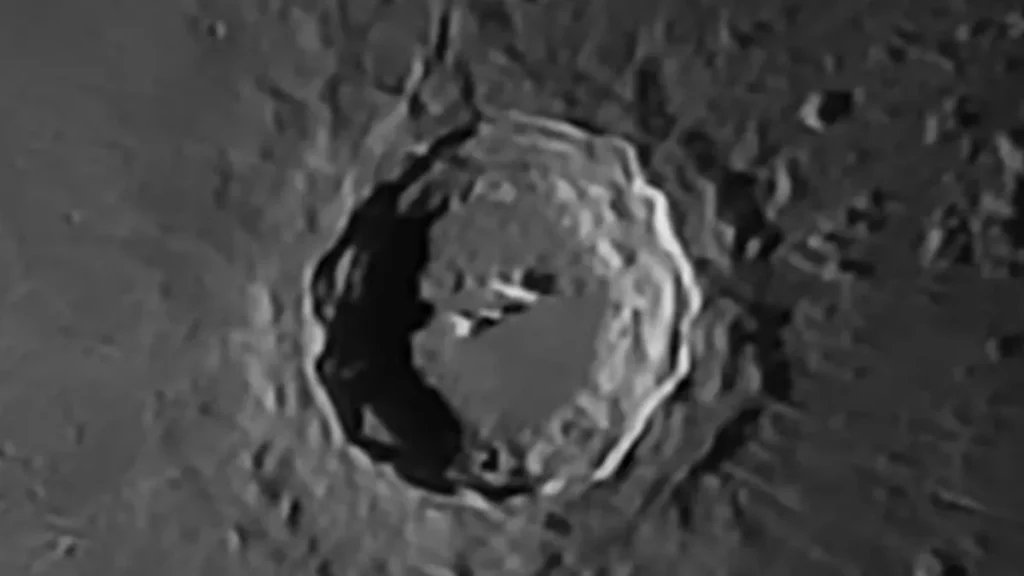
- Astronomy Magazine points to Schickard, a large flat-floored crater, as prominent in the southwest near Mare Humorum on November 22, 2026.
- The crater measures about 130 miles or 210 kilometers in diameter.
- The crater dates to roughly 4 billion years ago and originated in a giant impact.
- Schickard's dark floor is pockmarked by smaller craters that formed after the initial larger crater.
Astronomy Magazine points to Schickard, a large flat-floored crater—a crater with a relatively level interior—near Mare Humorum, a lunar plain, as prominent on November 22, 2026, along the Moon’s southwest limb.
The column presents Schickard as the featured lunar target while the Moon approaches full phase and its western limb comes into view. Astronomy Magazine lists the diameter at about 130 miles or 210 kilometers. The same sentence ties the crater’s age and origin to its diameter, dating it to roughly 4 billion years ago and tracing it to a giant impact.
Smaller craters pockmark Schickard’s dark floor, and they came after the initial larger crater. They show up there and point to subsequent impacts. Its outer walls are shallow and worn, and the column cites that condition as evidence of age. Schickard’s western wall appears slumped relative to its eastern rim, and the column tells observers to contrast the two to spot the slump.
The southwestern part of the floor looks rough, but the remainder of the crater is smoother. The column asks readers to compare the rough southwest texture with the smoother remainder of the floor. Lava covered most of the crater but left its southwestern regions untouched, and that incomplete flooding accounts for the texture contrast.
Seen from Earth, Schickard often looks oblong since it lies close to the lunar limb—the Moon’s edge as seen from Earth—but orbiters reveal it is actually quite circular. Limb position creates foreshortening as seen from Earth, while orbital images show the crater’s actual circular outline.
On November 22, 2026, the Moon is waxing gibbous with 97 percent illumination at 10 P.M. local time at coordinates of 40 deg N 90 deg W. A waxing gibbous moon is more than half illuminated but not yet full. The phase and illumination are tied to that time and coordinate pair, the same coordinates used for the daily rise and set times.
Sunrise comes at 6:53 A.M. local time on November 22, 2026; sunset follows at 4:39 P.M. local time; moonrise arrives at 2:59 P.M. local time; and moonset follows at 4:34 A.M. local time. The column states that all times use local time at coordinates of 40 deg N 90 deg W.
Astronomy Magazine recommends a Moon filter before aiming a telescope at the bright almost-full Moon on November 22, 2026. The source gives the bright nearly Full Moon as the reason for the filter recommendation before a closer telescopic view.
Mercury lies far to the west of the Sun on November 21, 2026. The column’s weekly sky event listing places this planetary position beside the Moon observation. Alison Klesman, who writes the column, is senior editor of Astronomy magazine and holds a Ph.D. in astronomy, with research spanning minor planets to supermassive black holes.




Join the discussion