Key facts
- Mercury reaches greatest western elongation on Nov 21, 2026, standing about 20° west of the Sun in the predawn sky, according to Astronomy Magazine and EarthSky.
- Observers should face a clear eastern horizon or the sunrise direction as dawn breaks.
- Mercury sits in Libra, far to the lower left of bright Venus, which is higher in the sky.
- The Moon passed near Saturn and Neptune on the morning of Nov 20, 2026, the day before the Mercury elongation.
Mercury reaches greatest western elongation on Nov. 21, 2026, standing about 20° west of the Sun in the predawn sky, according to Astronomy Magazine and EarthSky.
The exact moment of greatest western elongation occurs at 0 UTC on Nov. 21, 2026, which is 6 p.m. CT on Nov. 20, EarthSky says. EarthSky’s 2026 Mercury event list includes inferior conjunction on Nov. 4, 2026 and greatest western elongation on Nov. 21, 2026 among other conjunctions and elongations through the year. The list runs from superior conjunction on Jan. 21 to greatest elongation morning on Nov. 21, EarthSky adds.
Mercury orbits the Sun every 88 days and passes between Earth and the Sun about every 116 days, EarthSky says. It last reached inferior conjunction on Nov. 4, 2026, and emerged in the morning sky during the second week of November 2026. Since inferior conjunction, Mercury has been speeding ahead of Earth in orbit and returning to the eastern predawn sky as Earth moves along its own path. EarthSky notes that Earth is moving too, so the geometry changes as both planets travel.
Astronomy Magazine calls Mercury the solar system’s innermost planet and describes the elongation as a predawn viewing chance for observers with a clear eastern horizon. Observers should face a clear eastern horizon or the sunrise direction as dawn breaks, Astronomy Magazine and EarthSky say. A viewing site with a clear eastern horizon offers a great opportunity to spot the innermost planet, Astronomy Magazine adds.
EarthSky says to look shortly before sunrise in the sunrise direction as the sky brightens. After greatest elongation, Mercury edges back toward the sunrise and brightens a little more in morning twilight. At greatest elongation, Mercury is farthest from the sunrise, and the added brightness makes it easier to spot. EarthSky describes the apparition as brief.
Astronomy Magazine gives the magnitude as -0.5, while EarthSky gives it as -0.6. At 40° N 90° W, sunrise on the event morning comes at 6:52 a.m. local time, Astronomy Magazine lists.
Astronomy Magazine also lists sunset at 4:39 P.M., moonrise at 2:29 P.M., and moonset at 3:22 A.M. for a site at 40° N 90° W. The Moon is waxing gibbous at 92% illumination at 10 P.M. local time, according to Astronomy Magazine. The November 21 morning apparition favors the Northern Hemisphere, EarthSky says.
Southern Hemisphere observers might glimpse Mercury, especially with binoculars scanning the eastern horizon, EarthSky says. Autumn mornings are the best season for Mercury elongations in either hemisphere, EarthSky says, because the ecliptic — the Sun’s apparent path across the sky — slants steeply, nearly perpendicular to the horizon. That geometry puts Mercury higher above the horizon and farther from the Sun’s glow.
EarthSky contrasts autumn with spring, saying evening elongations in autumn are harder to see while spring evening elongations are best. Spring morning elongations are harder, EarthSky adds. Greatest elongations vary from about 28° maximum to 18° minimum distance from the Sun on the sky’s dome.
They are not equal, EarthSky notes, and viewing quality depends on the time of year and location on Earth. Mercury sits in Libra, far to the lower left of bright Venus, which is higher in the sky, Astronomy Magazine says. Venus rises earlier and appears farther from the sunrise point than Mercury, EarthSky notes, and it is much brighter.
Mercury is bright but nowhere near as bright as Venus, EarthSky adds, though Venus is also in the morning twilight higher in the sky. Venus is in Virgo, standing just north, or upper left, of the bright star Spica, Astronomy Magazine says. Arcturus in Boötes hangs to the far upper left of the Venus and Spica pair, Astronomy Magazine says.
The predawn lineup includes Mercury in Libra, Venus in Virgo near Spica, and Arcturus in Boötes far upper left. Through a telescope on Nov. 21, 2026, Mercury shows 62% phase and a width of 7 arcseconds, Astronomy Magazine says. EarthSky gives Mercury’s width as 6.64 arcseconds and says the planet appears 62% illuminated on and around Nov. 21.
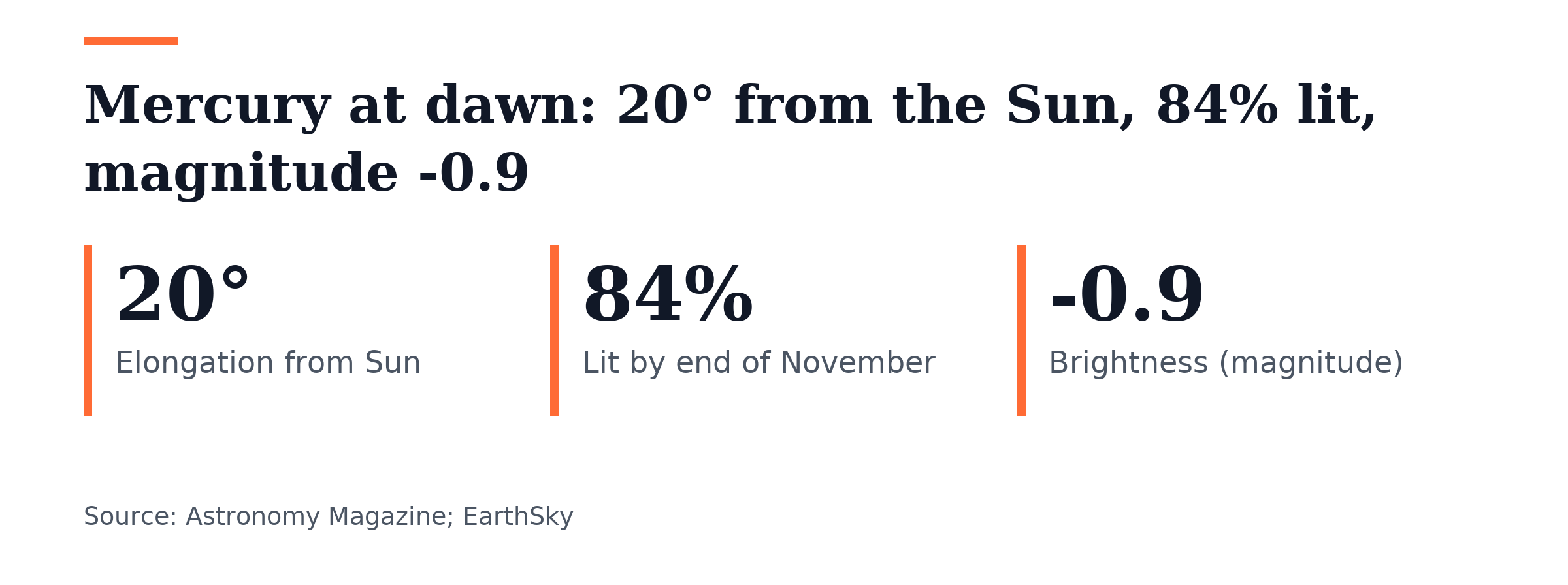
Astronomy Magazine notes that Venus’s disk is currently larger than Jupiter’s apparent size despite appearing as a sliver, and suggests comparing it with Mercury. Mercury’s gibbous phase will keep growing and reach 84% lit by the end of November 2026, Astronomy Magazine says. After Nov. 21, 2026, Mercury brightens a little to magnitude -0.9 until it slips away around mid-December in the December morning twilight, EarthSky says.
EarthSky calls this a long morning apparition for the Northern Hemisphere. The planet edges back toward the sunrise after greatest elongation, EarthSky says, making it easier to spot in morning twilight as it brightens a bit before fading into the twilight. Mercury will brighten a little more as it edges back toward the sunrise after greatest elongation, EarthSky says.
The Moon passed near Saturn and Neptune on the morning of Nov. 20, 2026, the day before the Mercury elongation, Astronomy Magazine says. Astronomy Magazine’s Sky This Week item for November 20 notes the Moon’s passage near Saturn and Neptune as the preceding morning’s event.


Join the discussion