Key facts
- The Corona Australis Molecular Cloud is a stellar nursery at the northern border of the southern constellation Corona Australis.
- The variable star R Coronae Australis shines through the gas and dust of the Corona Australis Molecular Cloud.
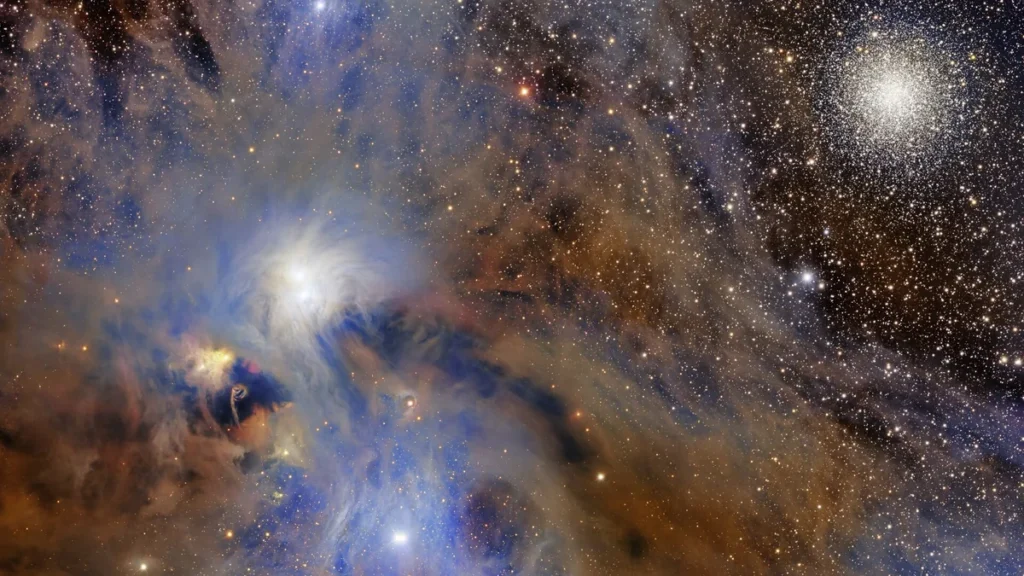
- Glowing gas and dark dust fill the left side of the image of the Corona Australis Molecular Cloud.
- Most newly forming stars in the Corona Australis Molecular Cloud remain hidden within its web of gas and dust.
Astronomy Magazine published a feature on Nov. 22, 2026, presenting the Corona Australis Molecular Cloud as a stellar nursery at the northern border of the southern constellation Corona Australis. The magazine calls the cloud one of the nearest regions where stars are forming. A molecular cloud is a cold cloud of gas and dust where molecules form, and a stellar nursery is a cloud of gas and dust where new stars are born. Astronomy Magazine says the cloud holds enough gas and dust to form thousands of stars. It sits 430 light-years from Earth, a light-year being the distance light travels in one year. The feature image shows the cloud dominated by glowing gas and dark dust.
Most newly forming stars remain hidden within the cloud’s web of gas and dust. Astronomy Magazine notes that the variable star R Coronae Australis shines through the material despite the obscuring gas and dust. A variable star is a star whose brightness changes when viewed from Earth. R Coronae Australis sits in the orange cloud below and to the left of the bright emission nebula that dominates the center-left of the image. An emission nebula is a cloud of gas that glows because nearby stars energize it. Several bluish reflection nebulae, clouds that scatter starlight, populate the area around the variable star. At the upper right of the image, the Chandelier Cluster, also known as NGC 6723, appears as a contrast to the molecular cloud.
A globular cluster is a tightly bound spherical collection of stars. This cluster contains hundreds of thousands of stars. Astronomy Magazine places it about 28,000 light-years from Earth, vastly farther than the 430-light-year nursery. The cluster inhabits far southern Sagittarius, unlike the Corona Australis nursery. This ancient collection of stars stands in contrast to the newborn stars hidden inside the nearby molecular cloud.
The magazine uses the side-by-side view to highlight different stellar populations in the southern sky. Richard Talcott wrote the feature. He previously served as senior editor and now works as contributing editor for Astronomy Magazine. Astronomy Magazine called it “A stunning stellar nursery lurks at the northern border of Corona Australis.” The feature places the newborn nursery beside an ancient cluster to highlight different stellar populations. Astronomy Magazine, “Young and old stars share the southern sky,” Nov. 22, 2026.

Join the discussion