Key facts
- Saturn's moon Iapetus reaches greatest eastern elongation on November 10, 2026, sitting roughly 9.4 arcminutes east of the ringed planet.
- Iapetus is a two-toned moon tidally locked to Saturn, meaning it rotates in step with its orbit and keeps one face toward the planet.
- When Iapetus reaches eastern elongation, its darker hemisphere faces Earthward, dropping the moon's brightness to nearly magnitude 12.
- That faintness plus Iapetus' distance from Saturn makes the moon harder to find, so the column recommends using a larger scope.
Saturn’s moon Iapetus reaches greatest eastern elongation on November 10, 2026, sitting roughly 9.4 arcminutes east of Saturn, and Astronomy Magazine’s November 10 night-sky column identifies Iapetus as the main telescopic challenge for that night.
The columns recommend looking around 9 P.M. local time on November 10, because that is when Saturn stands highest, about 50° above the southern horizon. Timing the view for the planet’s peak altitude gives observers a clear reference point before they hunt for the nearby faint moon.
Astronomy Magazine’s November 10 column and Cosmic Tribune’s report give the day’s almanac: sunset at 4:48 P.M., moonrise at 8:15 A.M., moonset at 5:19 P.M., and sunrise at 6:39 A.M., with the Moon a 4% waxing crescent. The magazine specifies that it calculates its solar and lunar timings for 40° N 90° W, and the Moon illumination figure refers to 10 P.M. local time at that site. These rise and set times and the lunar phase tell observers what the sky will look like and how bright the Moon will be.
The columns explain that Iapetus is two-toned and tidally locked to Saturn, so it rotates in step with its orbit and keeps one face turned toward the planet. At greatest eastern elongation, that locked geometry turns the darker hemisphere toward Earth, and that orientation accounts for the moon’s faintness.
Iapetus drops to nearly magnitude 12 (a brightness scale in which higher numbers mean fainter objects) when its darker hemisphere faces Earthward at greatest eastern elongation. The column notes that Saturn’s distance adds to the difficulty of spotting the moon.
Because the moon is both faint and distant from Saturn, the column recommends using a larger scope. That guidance comes after the entry describes the elongation and the orientation of the darker hemisphere.
Saturn is the brightest point in that region of the sky, hanging just below Pisces and far upper left of Fomalhaut, the brightest star in Piscis Austrinus. The column uses Fomalhaut and Pisces as sky landmarks precisely because Saturn is the brightest object in the area, while Fomalhaut sits much closer to the horizon.
Through a telescope, Saturn’s disk spans 19 arcseconds and its rings run roughly 43 arcseconds across, with the rings’ southern side facing viewers. Those dimensions show what the planet itself offers for observation even if the faint, distant moon remains out of reach.
Titan, Saturn’s largest and brightest moon at mid-8th magnitude, should definitely appear just over 2 arcminutes west of the planet. It is presented as an easy fallback target because of its size, brightness, and position close to Saturn.
Depending on the scope and timing, at least three closer moons may also appear: 10th-magnitude Tethys to the west, with Rhea and Dione to the east. These optional targets sit nearer to the planet, and their positions relative to Saturn help observers tell them apart from distant Iapetus.
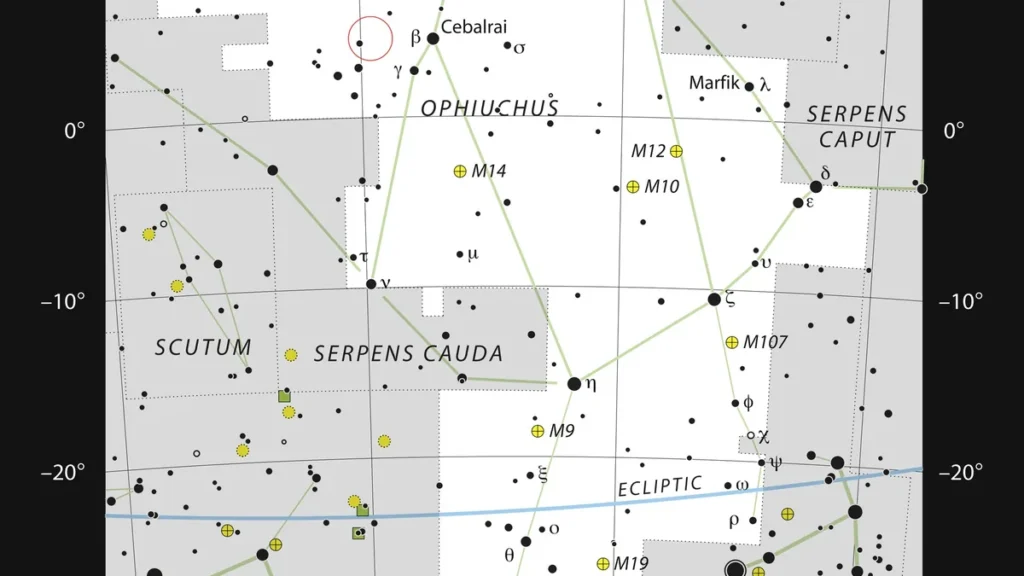
Cosmic Tribune’s report places Comet 161P/Hartley-IRAS around 10th magnitude in far northern Aquila near the border with Sagitta the Arrow. To find it, start from Altair, Aquila’s brightest star: the comet lies 7.7° north-northeast of Altair. A nearer but dimmer reference is 4th-magnitude Alpha Sagittae.
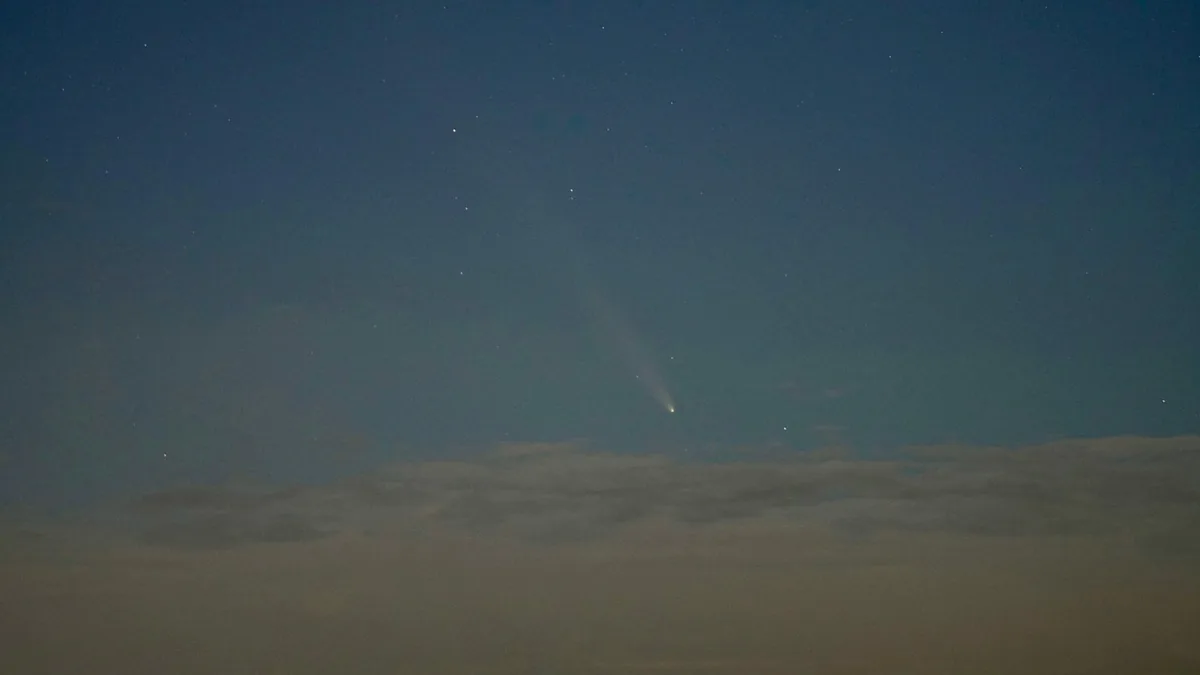
A small scope can catch the comet, but larger apertures give better views. Under high magnification, the comet’s southern side should look sharper as it moves into the solar wind, the stream of charged particles flowing from the Sun.
Cosmic Tribune framed the comet around November 9, when the New Moon at 2:02 A.M. EST created dark skies for spotting it. The object was still nearly 50° above the western horizon two hours after sunset, and New Moon darkness plus the comet’s high western altitude made it a viable target before it set.
The same night-sky column also looks ahead to November 11, when Venus reaches a stationary point in Virgo at 10 A.M. EST. That stationary point ends the planet’s westward retrograde drift and starts eastward prograde movement toward Spica.
One hour before sunrise on November 11, Venus stands just to the upper right of Spica at magnitude –4.7, with both objects about 10° high and rising with dawn. The description pairs Venus with Spica and notes the planet’s brightening as an aid to morning observers.
Through a telescope, Venus shows a 10%-lit crescent phase while its disk spans 53 arcseconds across. The detail gives the illuminated fraction and apparent disk size for observers with equipment to resolve phases.
Mercury glows at magnitude 1.2 barely 1.5° above the horizon, about 13° east or lower left of Venus, so observers need a flat horizon. The planet is low and rises as morning twilight grows, calling for a clear horizon and an early binocular scan before the sky brightens.
Mercury rises with morning twilight, so binoculars may help, but observers should put them away well before sunrise.
For live planning, TheSkyLive offers a real-time simulator showing Saturn’s ring inclination and the positions of its major moons, with adjustable date, time, and animation speed. The web-based tool lets viewers follow Saturn live, changing the viewing date and speeding up or slowing down the motion.
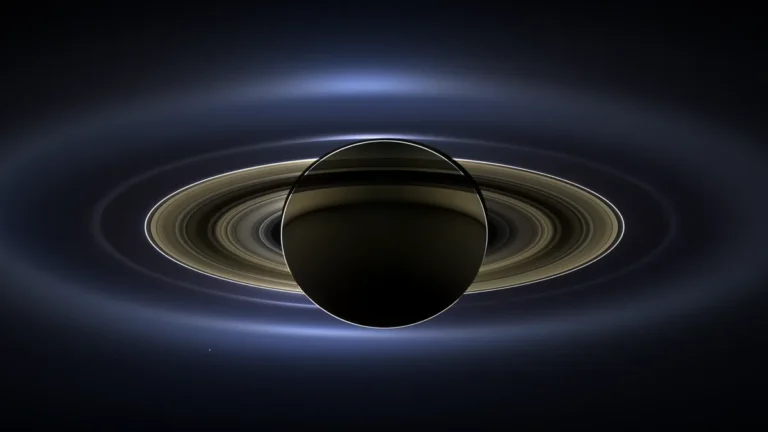
The simulator runs on the astronomia JavaScript library, a set of code for astronomical calculations based on Jean Meeus’s Astronomical Algorithms. Its image of Saturn’s disc comes from an original credited to NASA/JPL/Space Science Institute.

Join the discussion