Key facts
- On November 14, 2026, Mercury sits about 5° above the eastern horizon one hour before sunrise, according to Astronomy Magazine.
- On the morning of November 14, 2026, Mercury is less than 1° south of 4th-magnitude Kappa Virginis, Astronomy Magazine said.
- Mercury and Kappa Virginis can be captured in the same field of view through binoculars or a telescope on November 14, 2026, Astronomy Magazine said.
- Sunrise on November 14, 2026 occurs at 6:44 A.M. local time from 40° N 90° W, according to Astronomy Magazine.
Mercury reappeared in the morning sky on November 14, 2026, shining near Venus in Virgo at magnitude 0.3 about an hour before sunrise, Astronomy Magazine said.
Astronomy Magazine reported that Mercury returned after inferior conjunction early in November 2026. The column said, “Following inferior conjunction early this month, Mercury has reappeared in the morning sky.” The report is dated November 14, 2026 and turns to this morning after opening with a November 13 item about Mirach’s Ghost. It directs readers to the broader Sky This Week feature for additional viewing details.
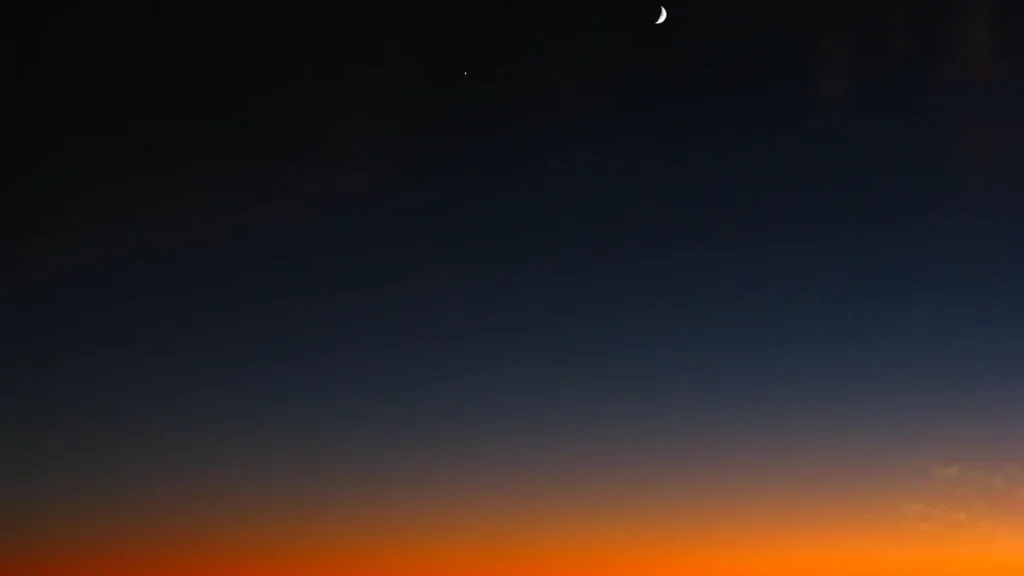
On November 14, 2026, Mercury stands about 5° above the eastern horizon, one hour before sunrise, Astronomy Magazine said. The observing item places the small planet low in the east before dawn on the morning of November 14, 2026, giving U.S. readers a specific altitude for locating it ahead of sunrise as the planet reappears after inferior conjunction early in November 2026. That height serves as the reference for finding Mercury in the predawn sky. The measurement lets readers gauge how high to look toward the east before daylight washes out the planet on November 14, 2026, matching the hour-before-sunrise timing of the reappearance.
Venus shines at magnitude –4.8, and Mercury sits to its lower left on November 14, 2026 in the predawn sky, Astronomy Magazine said. Venus and Mercury appear together before dawn in Virgo on November 14, 2026. Venus is much brighter than Mercury in the predawn sky. Observers can spot both inner planets low in the east as the sky lightens before sunrise on November 14, 2026, using the brightness gap to tell them apart as they appear together in Virgo before dawn.
Venus appears next to Spica, Virgo’s brightest star, about 12° to Mercury’s west on the morning of November 14, 2026, according to Astronomy Magazine. The star acts as a bright reference point in the constellation near Venus. The column lists the gap as about 12° west of Mercury to help readers gauge the scene for anyone tracing the planet positions before sunrise. The star marks a spot in Virgo that viewers can use to separate the planet from the background stars before dawn on November 14, 2026, with the wide gap giving a sense of scale for the planetary pair.
Venus sits only 1.4° northwest of Spica, Virgo’s brightest star, on the morning of November 14, 2026, Astronomy Magazine said. The text names Spica as the brightest star in Virgo. The column gives an angular gap between Venus and Spica on November 14, 2026. The close spacing makes Spica an easy landmark for finding Venus among the stars of Virgo before sunrise on November 14, 2026, in the predawn sky.
Mercury is less than 1° south of Kappa Virginis on the morning of November 14, 2026, Astronomy Magazine said. The star is 4th-magnitude and provides a fainter marker near Mercury. The column says the star remains visible until the brightening sky washes it out on November 14, 2026, before daylight erases the faint marker. The faint star sits close enough to the planet to serve as a temporary guidepost until daylight erases it from view.
The planet and the star fit in a single view through binoculars or a telescope on the morning of November 14, 2026, Astronomy Magazine said. The column notes that the planet and star are close enough for a single view. Either binoculars or a telescope can show both objects together on the morning of November 14, 2026. Observers can keep the pair in a single field as the sky brightens toward dawn on November 14, 2026, using the close pairing to locate the faint star next to the planet while both remain above the horizon.
Mercury shows a 32%-lit disk measuring 8 arcseconds across on November 14, 2026, Astronomy Magazine reported. Venus is 13% lit and spans 51 arcseconds across that morning. The text compares the apparent phases and sizes of the two planets. The apparent disks reveal different illumination levels for the two inner planets on November 14, 2026, with the phase difference visible through suitably magnified optics.
Astronomy Magazine gives sunrise as 6:44 A.M. local time on November 14, 2026 from 40° N 90° W. The figures apply to that location. They mark 6:44 A.M. as the sunrise time that anchors the predawn viewing on November 14, 2026. Observers at that latitude and longitude can plan their viewing around that sunrise time on the morning of November 14, 2026, using the hour before dawn to catch Mercury and Venus in the east before sunrise.
The Moon appears as a waxing crescent at 29% illumination on November 14, 2026, Astronomy Magazine said. Moonrise comes at 11:33 A.M. and moonset at 8:56 P.M. local time for 40° N 90° W. The slender moon will not take over the predawn sky on November 14, 2026. The phase and rise-set figures come from 40° N 90° W, pointing to a slender moon that stays out of the way during the planet viewing window on November 14, 2026.
The planet drifts east and will shift away from Kappa Virginis toward the lower left over the coming days, Astronomy Magazine reported on November 14, 2026. The text describes the eastward motion relative to the star. Mercury will shift farther to the lower left of Kappa Virginis in the days after November 14, 2026. The changing gap lets observers watch the planet’s motion against the fixed star over the coming mornings in Virgo, tracking the shift night by night as Mercury moves eastward.
Venus reached a stationary point recently and continues eastward, Astronomy Magazine reported on November 14, 2026. It will move northeast toward the upper left of Spica for a few days. After that, Venus will track more directly east. The brief curve toward the upper left of Spica comes before Venus resumes its more direct eastward path across the constellation on the days following November 14, 2026, offering a short window to see the planet’s changing position relative to the star after its recent stationary point.
The two stars can serve as guideposts for following Venus and Mercury over the next few days, Astronomy Magazine said on November 14, 2026. The text suggests using Spica to follow Venus. It also points to Kappa Virginis for following Mercury as the planets move across Virgo. The fixed stars let observers follow the planets’ shifting positions in the days following November 14, 2026, giving the pair of bright reference points lasting value beyond the single morning.
The star Kappa (κ) Virginis should stay visible until the brightening sky washes it out on the morning of November 14, 2026, Astronomy Magazine reported. The report puts Kappa Virginis under 1° to the south of Mercury. The pair fits in one binocular or telescope field, so the faint star acts as a temporary guidepost until daylight erases it. Observers have a narrow window to catch the pair before the growing brightness hides the star from view on November 14, 2026, after which the planet continues east without the nearby stellar marker.
Join the discussion