Key facts
- Astronomers discovered SN Ares, an exploding star, using gravitational lensing from a massive galaxy cluster and JWST high-resolution images; the blast took place when the universe measured 4.9 billion years old.
- The discovery paper appeared on the arXiv preprint server on October 23, 2026, and offers predictions for when the remaining distorted images of SN Ares will reach us.
- A research team under Conor Larison at the Space Telescope Science Institute reported finding a stellar explosion from about 8.8 billion years ago.
- The team detected SN Ares in August 2025 using JWST near-infrared images of the galaxy cluster field MACS J0308.9+2645.
Astronomers led by Conor Larison at the Space Telescope Science Institute discovered SN Ares in August 2025 using JWST near-infrared images of the galaxy cluster MACS J0308.9+2645, an exploding star whose blast took place when the universe measured 4.9 billion years old.
The discovery paper appeared on the arXiv preprint server on October 23, 2026, and it offers predictions for when the remaining distorted images of SN Ares will reach us. Titled SN Ares: A Strongly Lensed Type IIb Supernova at z=1.276 with a Predicted 70-Year Time Delay, the paper lists Conor Larison et al. as authors and carries DOI 10.48550/arxiv.2610.33161. Phys.org reported the discovery. The finding uses a massive galaxy cluster as a natural lens between Earth and the distant supernova.
The team spotted the stellar explosion from about 8.8 billion years ago, a detection made using JWST near-infrared images of the galaxy cluster field MACS J0308.9+2645. Conor Larison works at the Space Telescope Science Institute, and his group led the detection. The cluster acts as the gravitational lens that magnified the supernova’s light. Astronomers currently observe just one magnified image of the blast.
JWST spectroscopy showed helium and hydrogen features in the supernova’s light, revealing that the star had shed most of its outer hydrogen layer before exploding. Those traits define the Type IIb supernova class. Researchers state that SN Ares ranks as the highest-redshift member of its class identified through spectroscopy. The classification rests on the helium and hydrogen signatures captured by JWST.
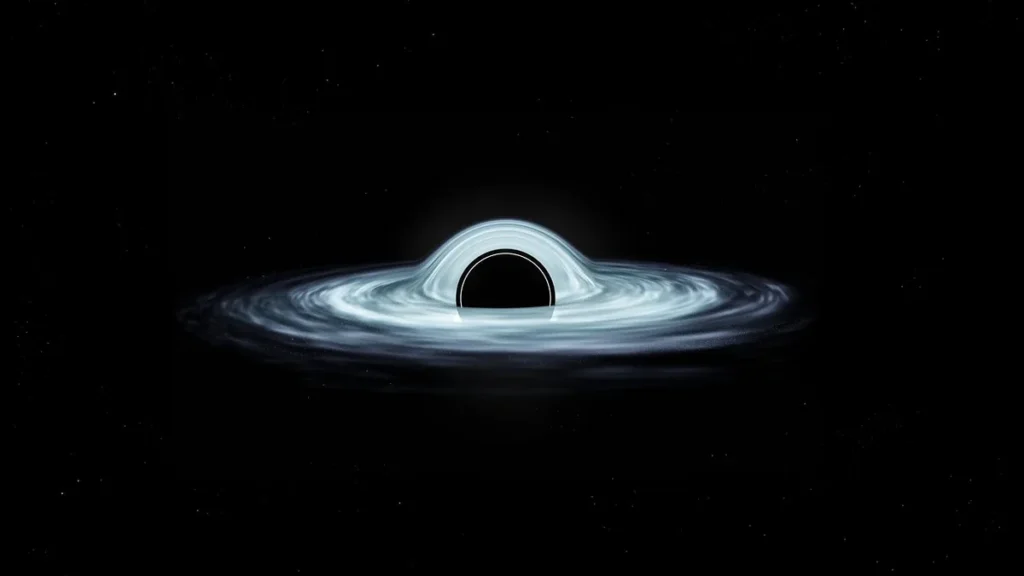
Gravitational lensing occurs when a massive galaxy cluster sits between Earth and a distant galaxy. The cluster’s gravity bends and magnifies background light to create multiple images. Light rays that follow slightly different paths reach Earth at different times, with gaps ranging from hours to decades for images of the same galaxy. Well-known cases of multiple-image lensing include Einstein Cross, Molten Ring and Smiley Face.
Using three lens models, the team showed that two additional images of SN Ares have not yet reached Earth. Forecasts indicate the two extra images will arrive in roughly 73 and 76 years, in that order. Using a 70-year assumed timeline, the team states that the SN Ares system holds the largest predicted delays among all discovered lensed supernova systems. Conor Larison leads the team at the Space Telescope Science Institute.
The team said, “the SN Ares system has by far the highest predicted delays of any discovered lensed SN system so far.” Arrival timing for the lensed images relies on the geometry of space. The universe is expanding as galaxies move away and light stretches, so measuring the delay between image arrivals helps pin down the Hubble constant, the universe’s expansion rate. The team states that delays and geometric distance share a direct relationship, so measuring arrival time offsets constrains H0 and other cosmological parameters tied to cosmic expansion.
Should astronomers observe the return in 70 years, they can measure the delay with extreme precision, yielding an especially precise single measurement of how fast the universe expands. The delay depends on the geometry of space while the universe expands. The group intends to carry out more spectroscopic redshift measurements in early 2027. The work should let researchers understand the lens better and refine predictions for the delays.
The research provides a chance to observe gravitational lensing unfolding across generations. Scientists state that they cannot foresee the state of cosmic science in 70 years, though they are certain the return of SN Ares will be scientifically valuable.
Join the discussion