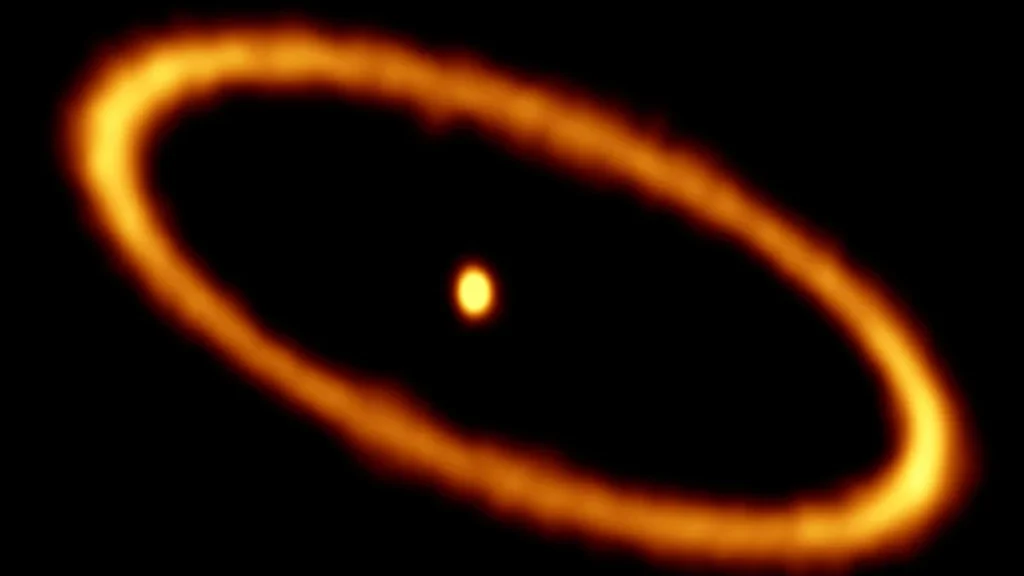
The James Webb Space Telescope detected water ice and carbon dioxide ice in the disk around Beta Pictoris, a star roughly 20 million years old about 64 light-years from Earth, according to a new study in Science led by Sarah Betti of the Space Telescope Science Institute in Baltimore, and the star is among the most heavily observed in astronomy.
The water ice is glassy rather than crystalline and blends with carbon dioxide in roughly the same proportions seen in comets of our own Solar System. Water ice is solid water; carbon dioxide ice is solid carbon dioxide. Researchers say that mixture points to the possibility that materials needed for water-rich planets could be widespread around young stars. Beta Pictoris is one of the best studied stars in the sky.
A disk of dust and rubble surrounds the star, and planets are still forming there. Astronomers have already found three planets around Beta Pictoris, including Beta Pictoris b, whose properties suggest it formed from ice-rich material. The disk was among the first ever imaged, back in 1984, and it appears almost exactly edge-on.
Because it is a debris disk—a ring of dust produced by collisions—its dust is constantly replenished by collisions among comets and planetesimals, small bodies that serve as building blocks for planets.
Farther out in the Beta Pictoris disk, cold temperatures let water and volatile molecules solidify into ice. Volatiles are molecules that evaporate easily, and the cold outer disk lets them turn to solid ice.
The disk holds a large reservoir of carbon monoxide gas that ultraviolet light from the star should destroy within 50 to 300 years. Carbon monoxide is a gas made of carbon and oxygen. Ultraviolet light is high-energy radiation from the star.
The gas remains present despite that rapid destruction, so something must keep replenishing it. The most likely source is ice released when volatile-rich comets collide. This connects the gas reservoir to ongoing collisions among icy bodies in the debris disk.
Earlier searches for ice in the Beta Pictoris system failed, including attempts to detect water vapor and a search for the water ice absorption dip in starlight at a wavelength of 3 micrometers, a feature where ice absorbs starlight. Water vapor is water in its gaseous state. Even though many signs pointed to abundant ice, earlier observations had not detected it before the James Webb findings.
To spot ice, the telescope spreads an object’s light into a rainbow that includes infrared light, radiation just beyond visible red. Water ice absorbs light at specific spots in that pattern, making detection possible like a fingerprint.
A Southwest Research Institute team pointed NASA’s James Webb Space Telescope at interstellar comet 3I/ATLAS three times between August 2025 and April 2026. The observations captured the object before and after it approached the sun most closely.
Ice normally leaves one deep spectral mark and two faint ones, and most comets around our sun show all three. A spectral mark is a dip in reflected light at a particular wavelength. In 3I/ATLAS, however, the two faint marks barely registered or did not appear at all. Researchers used computer simulations to investigate how light interacts with grains that blend tiny ice particles with additional dust.
The simulations found that light scatters off comet grains similarly when tiny bits of ice are blended with more dust, since dust blocks light before it penetrates far through the ice. That result accounts for the comet’s unusual appearance compared with familiar icy comets in our solar system.
The makeup of interstellar comet 3I/ATLAS lines up with ice on some frozen worlds far past Neptune. That suggests ice may form similarly around different stars as small grains ranging from nearly pure to heavily dusty. Should the pattern hold, the ingredients used to construct planets could resemble each other across different stellar systems.
Comets such as 3I/ATLAS come from swirling clouds of gas and dust forming around young stars. Gravity can hurl leftover icy chunks clear out of a system as worlds assemble. That mechanism could account for why certain interstellar objects ended up far from their original systems.
Astronomers have caught just three interstellar objects passing through our solar system. Telescopes detected no coma around the first, ‘Oumuamua, but both 2I/Borisov and 3I/ATLAS showed signs of a coma. A coma is the fuzzy atmosphere of gas and dust around a comet. The absence of a coma around ‘Oumuamua led many to question whether it was a comet.
Researchers matched 3I/ATLAS’s halo against earlier Webb observations of Trans-Neptunian objects, icy bodies orbiting the sun beyond Neptune. Some of these distant bodies display the same strong water-ice signature with weak marks absent. The closest matches additionally contain carbon dioxide ice and carbon-rich compounds.
Silvia Protopapa, lead author of the Astrophysical Journal Letters paper, said ice used to build planets in our system and elsewhere may come as tiny grains measured in microns. She said the grains span from nearly pure ice to ice blended with dust, and she placed 3I/ATLAS at the dusty extreme. “At first glance, 3I/ATLAS looks different from the icy comets we know,” Protopapa said.
By April 2026, Webb found a second crop of ice-rich grains around 3I/ATLAS slightly larger than earlier ones but still roughly a micron, one-millionth of a meter. The grains range from pure ice to ice mixed with dust, with 3I/ATLAS toward the dusty end. The researchers aim to determine whether solar heating or surface erosion drove the changes.
The Beta Pictoris detection suggests ingredients necessary to form water-rich worlds might be common around young stars. Its system serves as a natural laboratory for studying how planetary systems grow. The new findings add to observations of its edge-on debris disk.
The two Webb results show ice in different settings: a debris disk around a young star and a visitor from another star.

Join the discussion