Key facts
- The American Meteor Society predicts the 2026 Leonid meteor shower will peak at 0 UTC on November 18, 2026.
- EarthSky advises that the best viewing for the 2026 Leonids occurs from midnight until dawn on the mornings of November 17 and November 18, 2026.
- The first-quarter moon falls at 11:48 UTC on November 17, 2026, and sets around midnight, so moonlight will not interfere with the Leonids in 2026.
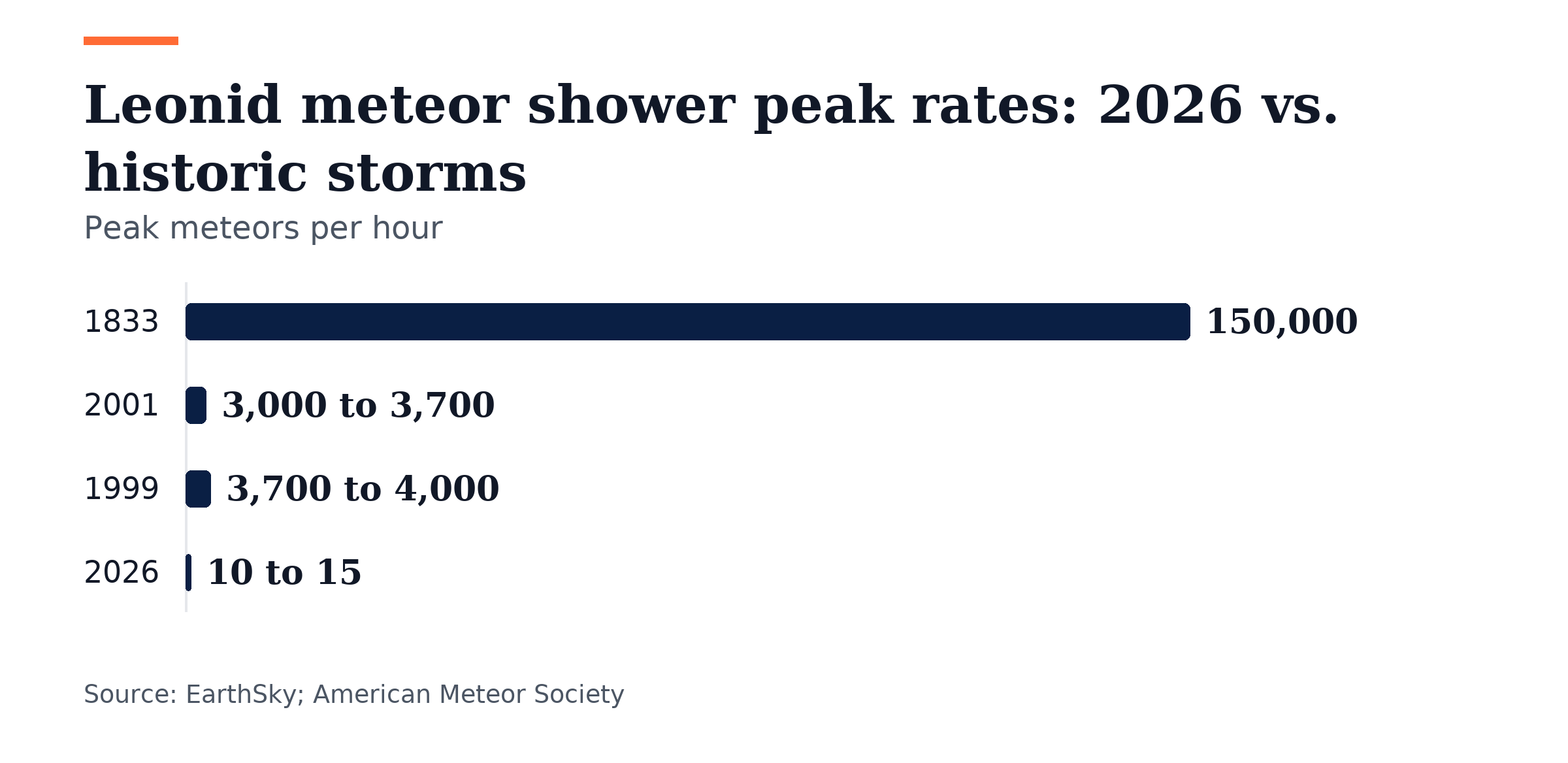
- Under ideal dark-sky conditions with no moon, observers might see 10 to 15 Leonid meteors per hour at the 2026 peak.
EarthSky’s 2026 guide says skywatchers can watch the Leonid meteor shower from midnight until dawn on the mornings of November 17 and November 18, 2026, once the first-quarter moon sets around midnight and leaves dark skies for the prime viewing hours. This pre-dawn window matches the time when the radiant — the point in the sky the meteors appear to stream from — is highest in the sky and moonlight is no longer a factor, making the hours after moonset the best time to look.
The American Meteor Society predicts the shower will peak at 0 UTC on November 18, 2026, and EarthSky attributes the peak forecast to the American Meteor Society while cautioning that predicted peak times can vary. EarthSky released this guide on November 17, 2026, and it frames the American Meteor Society’s prediction as the expected timing for the annual maximum.
On November 17, 2026, the first-quarter moon reaches its phase at 11:48 UTC and sets around midnight, leaving dark skies for the Leonids after moonset. EarthSky explains that the moon’s setting removes moonlight from the prime post-midnight viewing hours.
Scientists do not expect a Leonid meteor storm in 2026, and most astronomers require more than 1,000 meteors per hour to classify a shower as a storm, well above the typical Leonid rate of 10 to 15 per hour. This threshold helps explain why astronomers consider the 2026 display ordinary rather than extraordinary. EarthSky explicitly states that no storm is forecast for this year.
The Leonid radiant rises around midnight and is highest at dawn, and although meteors travel from that point, they can appear anywhere in the sky. EarthSky explains that viewers do not need to look directly at the radiant because meteors will appear across the whole sky, so watchers can take in a wide view rather than fixating on one spot.
Jupiter and Mars will appear near the Leonid radiant in 2026, separated by about two full-moon widths. EarthSky lists this planetary pairing as a nearby visual feature for watchers during the shower mornings.
With dark skies and no moon, viewers could spot 10 to 15 Leonid meteors per hour when the 2026 peak arrives. EarthSky calls this hourly range a realistic expectation under optimal conditions, and notes that most Leonid years stay modest.
Earth passes through the Leonid meteor stream from October 28 through December 7, so a Leonid meteor could appear at any point during that span, particularly under dark skies. This date range defines the broader activity window around the November peak, framing the shower as a multi-week event rather than a single night.
Periodic Comet Tempel-Tuttle, officially designated 55P/Tempel-Tuttle, is the parent comet responsible for the Leonid meteor shower. EarthSky identifies the comet as the source of the debris that creates the annual Leonid meteors, establishing the connection between the comet and the recurring display.
Wilhelm Tempel, at Marseille Observatory in France, spotted the comet on December 19, 1865, in the evening, placing it in northern skies close to Beta Ursae Minoris and the North Star. EarthSky calls this the first recorded sighting of the comet later tied to the Leonids.
Horace Tuttle of Harvard College Observatory independently found the comet 17 days later, on the evening of January 5, 1866, leading to the addition of his name to the comet. The independent discovery is why the comet carries both discoverers’ names.
Based on measurements from the comet’s 1866 visit, scientists calculated an orbital period of 33.17 years and connected the comet to the 1833 meteor storm and annual mid-November showers. Tempel-Tuttle orbits the sun about once every 33 years and releases fresh material each time it approaches the sun. EarthSky explains this cycle as the mechanism behind the recurring Leonid meteor shower.
Observers failed to recover Tempel-Tuttle on its expected returns in 1899 and 1932, and no major meteor storm materialized in either year. EarthSky notes these missed returns as part of the comet’s spotty observation history.
Astronomers recovered Tempel-Tuttle in 1965 when it reached 16th magnitude, visible only through large telescopes, and the spectacular 1966 Leonid storm followed. The faint 1965 recovery preceded the famous outburst the next year.
55P/Tempel-Tuttle is expected to return in early 2031. EarthSky gives the next predicted apparition of the parent comet, giving observers a future date to watch for the source of the Leonids.
The Leonids generated the first major meteor storm of modern times on November 12-13, 1833, an event often called The Night the Stars Fell. EarthSky cites this historic storm as the origin of the shower’s fame.
A widely accepted estimate puts the 1833 Leonid storm at up to 2,500 meteors per minute, about 150,000 per hour, with some observers counting 20 to 70 meteors per second at the peak. This figure quantifies the extraordinary intensity of the 1833 event.
On November 17, 1966, during the morning hours, the Leonid storm over the Americas reached 1833-level rates for roughly 15 to 20 minutes, with observers in the southwest United States counting up to 70 meteors per second. EarthSky gives the storm’s duration, location and peak strength.
An observer quoted by EarthSky said of the 1966 storm, “I almost felt as if I needed to grip the ground,” conveying a sensation of Earth moving through space. EarthSky includes this personal account to illustrate the dramatic experience of witnessing the outburst.
Leonid storms sometimes recur in cycles of 33 to 34 years, but displays around the turn of the century did not equal the 1966 storm. EarthSky outlines the historical cycle and notes the underwhelming turn-of-the-century returns.
No great meteor storm resulted from the 1899 Leonid return, and the disappointing outcome led many astronomers to call it a severe blow to astronomy in the public’s eyes. EarthSky describes high public anticipation for an 1899 storm that went unmet.
On November 18, the 1999 Leonid shower peaked at roughly 3,700 to 4,000 meteors per hour in a brief window best viewed from Europe, North Africa, and the Middle East. EarthSky includes 1999 as part of the strong 1999-2001 shower sequence.
During 2000, Leonid rates dropped to roughly 130 to 480 meteors per hour while Earth passed through dust trails, and bright moonlight made viewing difficult. EarthSky sets this weaker year beside the stronger 1999 shower.
The 2001 Leonids featured a double peak on November 18-19, with 1,500 to 2,000 meteors per hour visible from North America and Hawaii first, followed by 3,000 to 3,700 per hour visible from East Asia and Australia. EarthSky details the two maxima and their geographic visibility.
On its early 1998 return, 55P/Tempel-Tuttle became bright enough to see in binoculars, and that apparition produced impressive meteor showers across 1999-2001. EarthSky connects the comet’s 1998 brightness to the strong Leonid displays.
EarthSky recommends observing from a dark location and refers readers to its Best Places to Stargaze page. This is practical guidance for viewers planning to watch the 2026 shower.

Join the discussion