Key facts
- CW39 Houston lists the Leonids as active November 6-30, 2026, peaking November 17-18, while Action News 5 sets the peak for the night of November 17 into the morning of November 18.
- Astronomy Magazine calls the shower modest, expects roughly a half-dozen or more Leonids per hour, and states they streak at some 44 miles or 70 kilometers per hour.
- The November 2026 Leonids arise from dusty debris of Comet 55P/Tempel-Tuttle as Earth passes through the stream of particles the comet shed near the sun.
- Epoch Times reports the Leonids run November 6-30, 2026, peaking around the morning of November 17-18, with no great storm predicted for 2026 and a typical 10 to 15 meteors per hour.
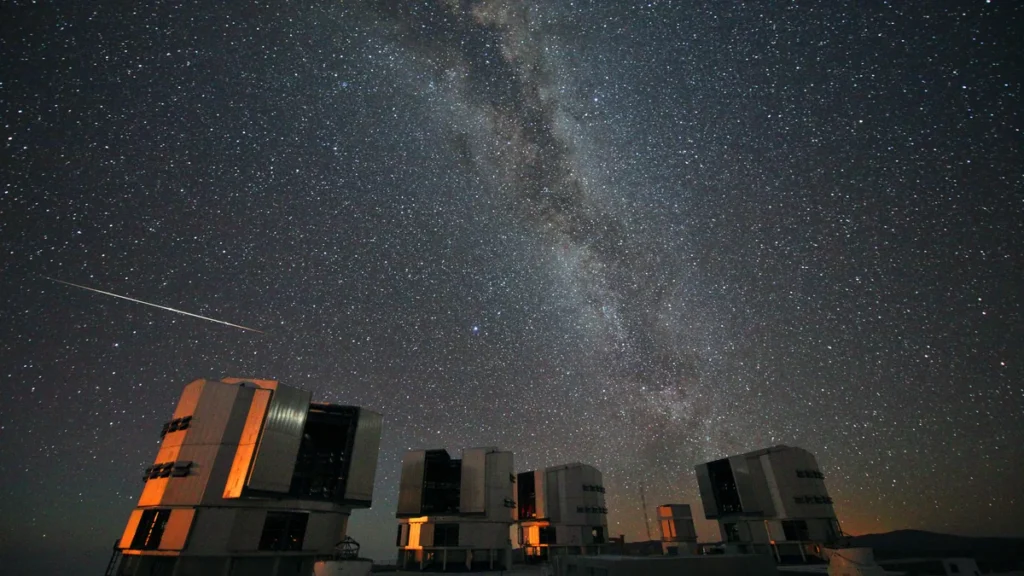
The 2026 Leonid meteor shower peaks on the night of November 17 into the early-morning hours of November 18, 2026, and Astronomy Magazine’s sky column says the best viewing comes after the Moon sets around midnight.
Astronomy Magazine’s sky column says that on November 18, the Moon will be a waxing gibbous at 67% illumination, meaning more than half lit but not full, and will set at 12:03 A.M., with sunrise at 6:49 A.M. and sunset at 4:41 P.M. local time from 40° N, 90° W. The First Quarter Moon will occur at 6:48 A.M. EST on November 17 among the stars of Aquarius, when the Moon will be a waxing gibbous at 57% illumination. The column’s rise, set, and phase times are local for 40° N, 90° W, with illumination measured at 10 P.M. local time.
Astronomy Magazine’s sky column places the radiant, the point from which the meteors appear to stream, just inside Leo’s Sickle asterism, a curved star pattern, near 3rd-magnitude Zeta Leonis, north of Mars and Jupiter. Action News 5 says the Leonids are named because the meteors appear to come from Leo. The Epoch Times notes Leo has no tangible link to the debris and sits hundreds of light-years away; it says meteors near the radiant look stunted by perspective while trails farther from Leo run longer, and that Leo climbs to its height around 4 A.M. to 6 A.M. local time. Viewers should look about 40° to 60° to the left or right of Leo rather than straight at the radiant.
CW39 Houston lists the Leonids as active November 6-30, 2026, peaking November 17-18, and Action News 5 sets the peak for the night of November 17 into the morning of November 18. The Epoch Times gives the same active dates and peak window, expects no great storm for 2026, and puts a typical rate at 10 to 15 meteors per hour. Astronomy Magazine expects roughly a half-dozen or more Leonids per hour.
Astronomy Magazine and The Epoch Times trace the Leonids to dusty debris from Comet 55P/Tempel-Tuttle as Earth passes through the particle stream the comet shed near the sun. The Epoch Times describes the debris as pieces of comets or asteroids that ignite from friction at up to 45 miles per second in Earth’s atmosphere. Astronomy Magazine clocks the Leonids at about 44 miles, or 70 kilometers, per hour and calls this year’s shower modest rather than storm-level.
The Epoch Times dates the last great outburst to 2001 and the comet’s return to 2031, while Action News 5 dates the last big storm to 2002. The Epoch Times recalls a 1966 storm of thousands of meteors per minute over 15 minutes over the United States and an 1833 event reportedly above 100,000 meteors per hour, and it describes Comet 55P/Tempel-Tuttle as a 2.24-mile nucleus shedding sunward particles into a debris complex millions of miles long that has disappointed observers before despite storm hopes around its returns.
The Epoch Times calls the Moon the main meteor-viewing danger because its light washes out shooting stars and cuts visible numbers. It urges viewers to pick a dark, open site with little light pollution after midnight and warns that clouds are the wildcard. Action News 5 advises viewers to get away from city lights, stay up late or wake early, and pick a dark, open site after midnight, with after midnight through dawn the best viewing time. Eliot Herman advises observers who cannot avoid the Moon to include it in their photos because a few meteors will probably still crop up.
Eliot Herman, a Tucson astrophotographer, described hunting the Leonids from his backyard to The Epoch Times. “The Leonids are always early morning before dawn,” he told The Epoch Times. He noted they are the “greenest” meteors he sees.
Astronomy Magazine’s sky column and Yahoo Tech’s sky listing say that on November 20, M33, the Pinwheel Galaxy in Triangulum, will stand 60° high in the east by 8 P.M. local time, about 4.3° west-northwest of Alpha Trianguli, glowing at 6th magnitude, a measure of its faintness. They describe M33 as lying some 2.7 million light-years away, with a light-year the distance light travels in a year, and as the Local Group’s third-largest galaxy after Andromeda and the Milky Way, a bar-less spiral with a bright nucleus and dusty arms. It spans about 70 arcminutes along its longer axis and has low surface brightness, so any telescope shows it, while 10-inch or larger instruments reveal spiral-arm detail and star-formation knots.
The column’s November 20 entry gives sunrise at 6:51 A.M., sunset at 4:40 P.M., moonrise at 2:04 P.M., moonset at 2:12 A.M., and a waxing gibbous Moon at 84% illumination, all local for 40° N, 90° W. On November 20, the Moon will pass 5° north of Neptune at 8 A.M. EST and 7° north of Saturn at 8 P.M. EST, forming a triangle in the southeast two hours after sunset.
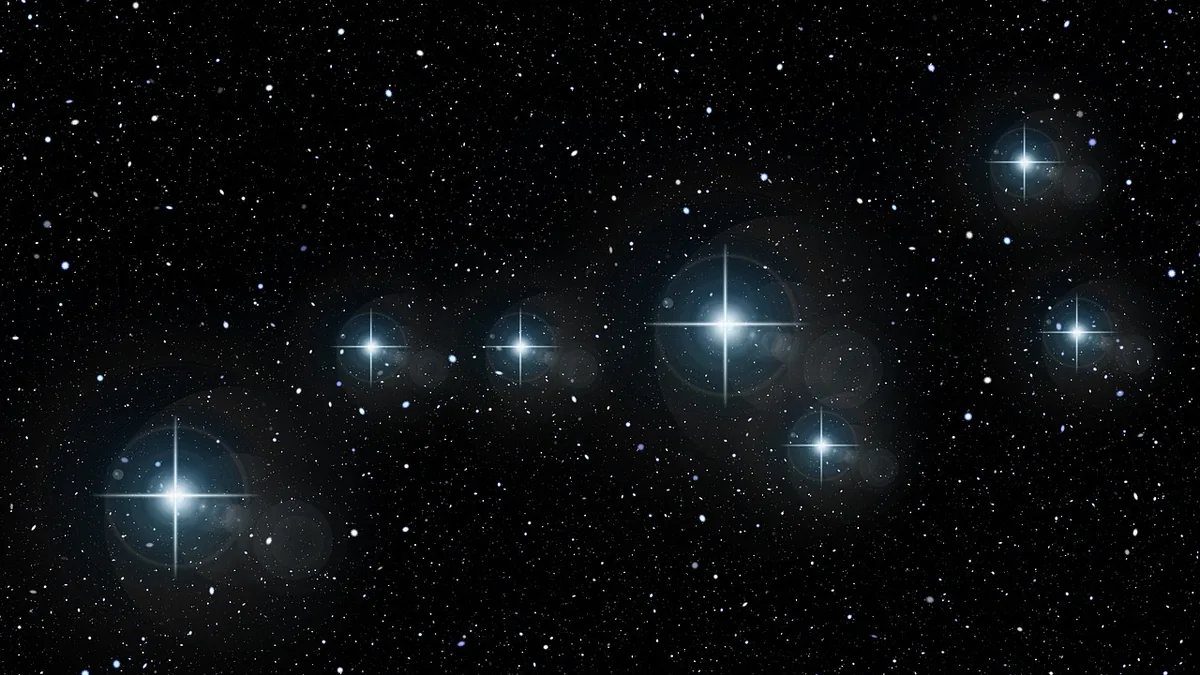
Astronomy Magazine’s sky column says that on November 17, the Pleiades, or M45, in northwestern Taurus will shine at collective magnitude 1.6, span roughly 110 arcminutes, and stand 30° high by 7:30 P.M. local time. Known since antiquity, the cluster looks like a dipper to the naked eye and is sometimes mistaken for the Little Dipper anchored by Polaris; most observers see six or seven stars. Binoculars or a finder scope will reveal many more stars, while higher magnification limits the field, and a faint grayish haze around the stars is nearby dust reflecting starlight.
Astronomy Magazine’s sky column says that two hours before sunrise on November 18, Leo will stand high in the southeast with Jupiter and Mars beside the curved Sickle asterism and Regulus just to their lower left. Mars will pass 1.2° north of Jupiter at 10 P.M. EST on November 14, and by 3 A.M. local time on November 15 the pair will stand 40° high in the east with Mars north of Jupiter. Jupiter and Mars are approaching opposition in February of the following year.
Astronomy Magazine’s column lists Jupiter’s moon events for November 15. Around 3 A.M. EST, Callisto will stand alone west of Jupiter while Io and Ganymede lie to the east. Io’s shadow will begin a transit at Jupiter’s eastern limb at 3:22 A.M. EST. Europa will reappear from an occultation at 4:27 A.M. EST, just south of Io, which will pass due north of Europa at 4:34 A.M. EST, while Io’s shadow will reach Jupiter’s western limb and disappear at 5:38 A.M. EST as Io ends its transit at 5:52 A.M. CST.
Astronomy Magazine’s sky column says that on the morning of November 14, Mercury at magnitude 0.3 will stand about 5° above the eastern horizon an hour before sunrise, lower left of Venus at magnitude -4.8 beside Spica. Mercury will be less than 1° south of 4th-magnitude Kappa Virginis as a 32%-lit disk 8 arcseconds across, while Venus will be 13% lit and 51 arcseconds across. Mercury is moving east and will pull away from Kappa Virginis to the lower left over the next few days.
Astronomy Magazine’s sky column says that Venus will pass 1.8° due north of Spica at 6 P.M. EST on November 19, when Mercury will be 55% lit and 7 arcseconds across while Venus is 18% lit and 47 arcseconds across. After a recent stationary point, Venus moves eastward, briefly curving northeast above Spica for several days before settling into a steadier eastward course. Mercury reaches greatest western elongation of 20° at 7 P.M. EST on November 20.
Astronomy Magazine’s sky column says that two hours after sunset on November 16, Saturn will be roughly 40° high in the southeast, lower left of the Circlet of Pisces and upper left of Fomalhaut, with rings spanning 43 arcseconds tilted 8° and a disk measuring 19 arcseconds across. Saturn currently presents its southern side and entire southern hemisphere to observers. On November 16, Titan will shine at mid-8th magnitude just south of Saturn, with a fainter 10th-magnitude star just west of Titan and the 10th-magnitude moons Tethys, Dione and Rhea closer to the planet. By November 20, Titan will sit about 3.2 arcminutes to Saturn’s west in line with the rings, though bright moonlight may make the fainter moons hard to see.
Astronomy Magazine’s sky column says that shortly before 8 P.M. EST on November 16, Tethys will sit about 40 arcseconds west of Saturn’s center while Dione is just west of the limb and Rhea just east. Dione and Rhea will move westward, with Rhea skimming north of Saturn’s pole and standing due north around 10:40 P.M. EST. Tethys will move east and disappear behind Saturn’s southwestern limb in an occultation around 2:35 A.M. EST, still late on November 15 along the Pacific Coast.
The column’s daily listings for 40° N, 90° W show sunrise at 6:44 A.M. and sunset at 4:44 P.M. on November 14, 6:45 A.M. and 4:43 P.M. on November 15, and 6:46 A.M. and 4:43 P.M. on November 16, with 6:50 A.M. and 4:40 P.M. on November 19. Moonrise runs from 11:33 A.M. on November 14 to 1:41 P.M. on November 19, while moonset runs from 8:56 P.M. on November 14 to 1:07 A.M. on November 19. The Moon waxes from a crescent at 29% illumination on November 14 to a gibbous at 76% illumination on November 19.
CW39 Houston lists the Southern Taurids as active September 20-November 20, 2026, with a peak between November 4 and November 5; known for bright fireballs rather than large numbers, they bring only a handful of meteors per hour from Taurus. The Northern Taurids run October 20-December 10, 2026, and peaked the night of November 11 into November 12 from a different part of Taurus. During the Southern Taurids peak the moon was about 22% illuminated, but only about 5% during the Northern Taurids peak, meaning darker skies for faint meteors.
CW39 Houston lists November’s full moon as peaking on November 24 and calls it the first of three consecutive supermoons. It lists the event alongside the meteor showers as part of the month’s sky events.
The November 6-13 column carries the byline of Alison Klesman, senior editor of Astronomy magazine. Klesman holds a Ph.D. in astronomy and has studied topics from minor planets to supermassive black holes.

Join the discussion