Key facts
- Astronomers have detected a new Type Ia supernova, SN 2026ahvu, in the spiral galaxy NGC 1433, roughly 50 million light-years from Earth, close enough for detailed follow-up as it fades.
- SN 2026ahvu is a Type Ia supernova, an exploding white dwarf, rather than a core-collapse event in which a massive star burns through its fuel, collapses, and explodes.
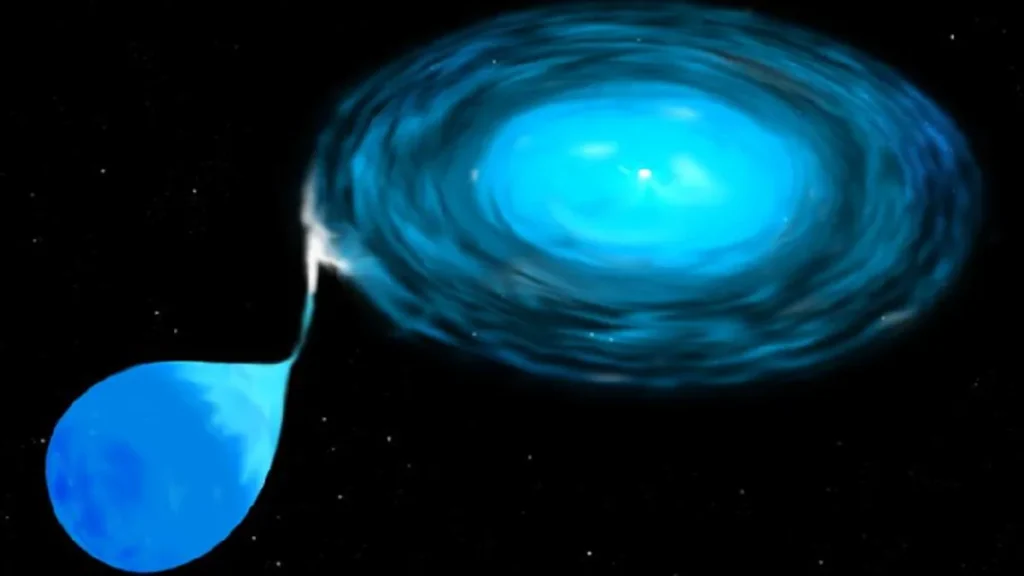
- A white dwarf called the accretor draws material from a donor star until material on its surface reaches the Chandrasekhar limit of about 1.44 solar masses, when the dwarf explodes and is obliterated.
- The object was first detected on November 2, 2026 by ATLAS, the Asteroid Terrestrial-impact Last Alert System, and follow-up examination of its light identified it as a young Type Ia supernova.
ATLAS, the Asteroid Terrestrial-impact Last Alert System, detected Type Ia supernova SN 2026ahvu in spiral galaxy NGC 1433 on November 2, 2026, roughly 50 million light-years from Earth.
The object is an exploding white dwarf rather than a core-collapse event in which a massive star burns through its fuel, collapses, and explodes. Universe Today explains the event happens in a binary system where the exploding star is a white dwarf, while Knowridge Science Report describes the white dwarf as the dense leftover core of a star. Universe Today says the galaxy’s relative proximity makes detailed follow-up study possible and notes researchers detected the object early. Knowridge Science Report calls it a young explosion evolving quickly night by night, giving scientists an unusually early look.
Type Ia supernovae act as standard candles within the cosmic distance ladder, the framework used to gauge distances to objects beyond the reach of direct methods such as parallax. A standard candle is an object with a known intrinsic brightness, so astronomers can infer its distance from how faint it appears. Astronomers use Type Ia supernovae to measure distances across the universe, and patterns in their brightness help researchers estimate cosmic distances. Universe Today says more opportunities to study Type Ia supernovae make the cosmic distance ladder more accurate.
A light-year equals the distance light covers in a year, placing even a nearby galaxy beyond spacecraft reach. Astronomers depend on the light that arrives at their telescopes to learn about the distant star rather than on visiting it. Parallax measures distance by tracking a star’s apparent shift against more distant background objects as the observer’s position changes. Knowridge Science Report uses the light-year definition to explain why astronomers learn about the distant star from arriving light rather than spacecraft.
One route involves a white dwarf called the accretor drawing material from a donor star until material on its surface reaches the Chandrasekhar limit of about 1.44 solar masses, when the dwarf explodes and obliterates itself. Once its mass crosses the limit, it explodes and obliterates itself, Universe Today adds. The alternative happens in a double white dwarf binary when the two stars merge and explode. Universe Today presents this merger path as the alternative to the single-accretor route in which a white dwarf draws material from a companion donor star.
Researchers are still studying the exact ways these blasts begin, even though they rely on them to estimate cosmic distances from patterns in brightness. Knowridge Science Report places distance measurement among the uses of such supernovae. Knowridge Science Report adds that watching an unusually accessible example develop may improve understanding of the stellar blasts used to map the wider cosmos.
ATLAS first detected the object on November 2, 2026, when its apparent magnitude was 17. A few days later it had reached about 13.5, and lower magnitude numbers indicate brighter objects. Universe Today raises the point that the supernova was still brightening when found, which matters because it gives researchers a chance to watch the blast earlier in its evolution.
Early observations are especially valuable because clues fade as the explosion grows and debris spreads into space, so researchers must respond quickly when a new supernova is found. Knowridge Science Report says the young explosion changes rapidly from night to night. The object’s name, SN 2026ahvu, uses ahvu as a chronological suffix and marks it as the 41,855th transient discovered in 2026.
Universe Today notes thousands of transients and supernovae have been found in 2026, yet this one stands out for its relative proximity to Earth and early detection. Knowridge Science Report calls it a young explosion evolving quickly night by night, giving scientists an unusually early look. The Transient Name Server, an International Astronomical Union-sanctioned registry, records new transients. It also hosts AstroNotes, short notes describing new transients when they are discovered.

Imagers on the Víctor M. Blanco 4-meter Telescope’s Dark Energy Camera and on Gemini South captured SN 2026ahvu, while archival Dark Energy Survey frames show NGC 1433 before the blast for comparison. Gemini South gives sharper views, and together the observatories can track changes that a single instrument might miss. Knowridge Science Report says older Dark Energy Camera images show NGC 1433 before the explosion for comparison. Universe Today says astronomers are alerted when supernovae are detected and other telescopes watch closely.
ATLAS operates four 0.5m telescopes at Haleakala and Mauna Loa in Hawaii, at El Sauce in Chile, and at Sutherland in South Africa. The network also includes a fifth unit in Tenerife in the Canary Islands.
A Type Ia supernova typically shines brightest for about six months, with a multi-day peak powered by Nickel-56 decay followed by a weaker tail as 56Co decays to 56Fe. Universe Today calls the brightening and fading sequence well understood but says more observations can refine it.
Roughly two or three months after the blast, the expanding ejecta thins enough to form a nebula, when spectra show the makeup of the whole exploded star rather than only its core. Ejecta is the material thrown out into space by the blast. Universe Today describes the nebula stage as part of a well-understood progression.
Forecasters predicted the blast would peak between November 18 and 23, 2026, giving a window to watch it develop through several stages. Knowridge Science Report presents the forecast as a window for watching the explosion’s development through several stages. The blast ranks among the closest Type Ia supernovae seen since the 2011 Pinwheel Galaxy blast, so its relative closeness makes detailed study more practical. Knowridge Science Report ties the event’s relative closeness to the practicality of detailed study.
The supernova lies within reach of advanced amateur astrophotographers, and more images and observations, including study of how its light changes over time, will follow. Universe Today’s closing paragraph says follow-up images and observations will arrive as the explosion’s light changes over time.



Join the discussion