Key facts
- Jupiter and Mars reach their closest approach of November 2026 on the mornings of November 14-17, passing within about one degree of each other.
- Around the closest approach Mars shines at magnitude +0.7 and Jupiter at magnitude -2.0, making both bright naked-eye objects.
- Mars, Jupiter and Regulus, the brightest star in Leo, form a line of roughly equally spaced objects in the predawn sky.
- Jupiter and Mars appear as bright objects in the southeast before sunrise during November 2026.
Jupiter and Mars reach their closest approach of November 2026 on the mornings of November 14 through 17, passing within about one degree of each other in the constellation Leo.
BBC Sky at Night Magazine reports that the two planets have been drawing closer throughout November as Mars catches up with Jupiter. Jupiter and Mars appear as bright objects in the southeast before sunrise during November 2026, and the pair has been visible as a morning pair for weeks. Their apparent separation changes noticeably from one morning to the next as the red planet closes the gap.
Around the closest approach, Mars shines at magnitude +0.7 and Jupiter at magnitude -2.0, making both bright naked-eye objects. Magnitude is a measure of brightness, with lower numbers indicating brighter objects. At the start of the month, the planets are 5.7 degrees apart, about the width of the middle three fingers held together at arm’s length.
Mars, Jupiter and Regulus, the brightest star in Leo, form a line of roughly equally spaced objects in the predawn sky. The three objects make up the western half of an odd Orion’s Belt-type configuration. After the mid-month closest approach, Mars continues slipping east past Jupiter and closer to Regulus.
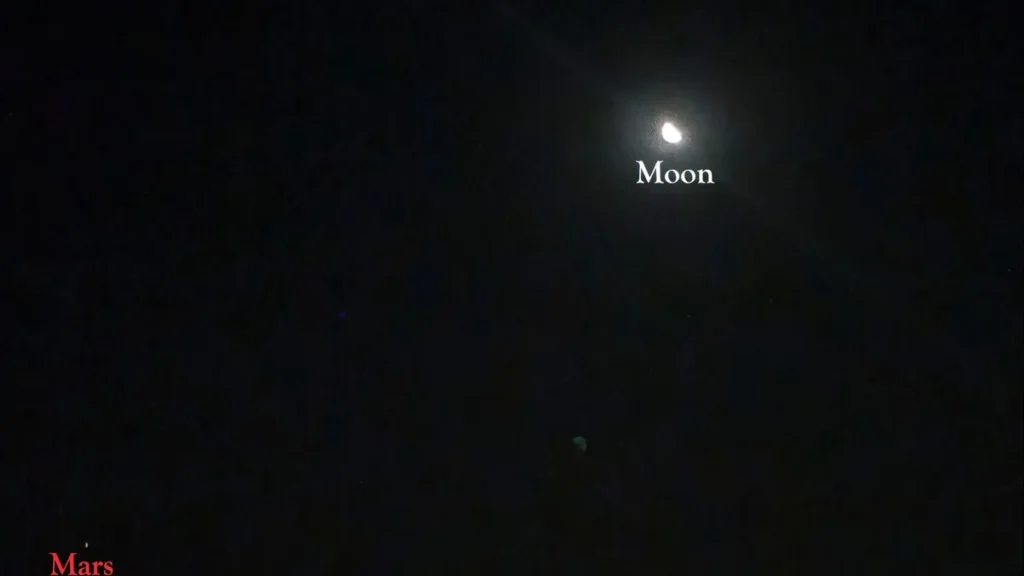
On November 1, 2026, the Moon lines up with Mars and Jupiter while 57 percent lit in a gibbous phase. Jupiter shines at magnitude -1.9, Mars at magnitude +0.9, and Regulus at magnitude +1.3 on that date, while the Moon dominates the view in the early hours.
The same morning, the Moon sits 7.5 degrees west of the Beehive Cluster, also known as M44. Later, the Moon occults the cluster—that is, passes in front of it—after the planetary pair have set, as seen from the UK. British observers can watch the Moon move in front of the star cluster once the planets have dropped below the horizon.
On November 2, 2026, the waning Moon at 46 percent lit forms a straight line with Regulus, Jupiter and Mars, with all four objects roughly equally spaced. The Moon has slid closer to Mars by this date, creating an impressive alignment that remains visible in the morning sky.
From the eastern horizon an hour after midnight on November 1 through 2, 2026, the 45 percent lit waning Moon shines less than 5 degrees from Mars. Yahoo Tech reports the timing for this predawn rendezvous, placing the slender Moon near the red planet before dawn.
On the night of November 1 through 2, Jupiter gleams just below Mars, with Regulus lining up beyond to form a procession leading back to the horizon. The Beehive Cluster, M44, lies about 10 degrees from the unlit side of the lunar disk, in the middle of Cancer, shining nearby during the same predawn rendezvous. Yahoo Tech describes the Moon diving toward the heart of Leo for a rendezvous with Mars and Jupiter.
Yahoo Tech reports that observers in Australia, Indonesia and other island nations see the Moon occult Jupiter starting at 3:45 p.m. EST (2045 GMT) on November 2, 2026. The timing comes from In-The-Sky.org, and exact visibility and timings depend on location.
By moonrise on November 3, 2026, the lunar crescent appears just 1 degree from Regulus for viewers in the United States. Observers in Brazil, Peru, Argentina and Bolivia see the Moon occult Regulus beginning at 6:59 EST (1024 GMT), and the exact timings for a selection of South American countries come from In-The-Sky.org.
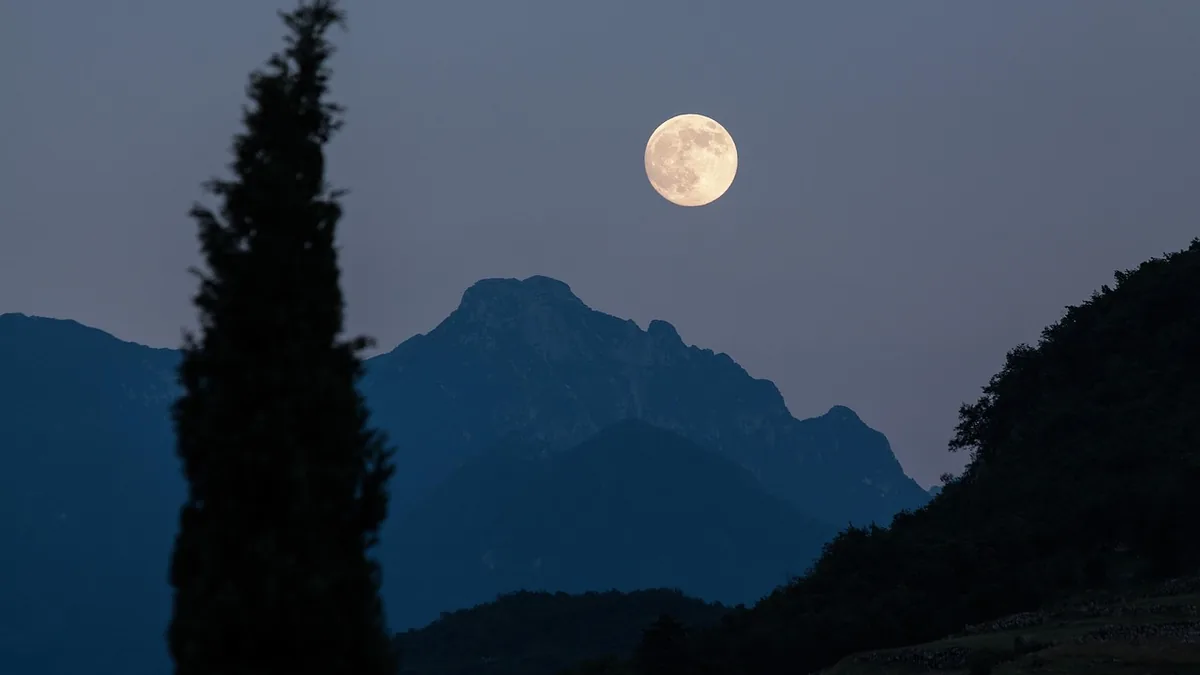
On November 3, 2026, the 35 percent lit crescent Moon sits just south of the midpoint between Jupiter and Regulus. By this date the Moon has moved past the planetary pair and is approaching Regulus, making the crescent less dominant in the sky than earlier in the week.
On the morning of November 22, 2026, the triangle formed by Mars, Jupiter and Regulus fits inside a circle less than 4 degrees across. The three-object pattern remains visible in the predawn sky as the planets continue to shift position from day to day.
On November 26, 2026, Mars has switched sides, forming the narrow base of another isosceles triangle with Regulus. The red planet has moved to the opposite side of the star as it continues its eastward motion past Jupiter.
The triangular pattern of Mars, Jupiter and Regulus remains visible into early December 2026, rising before midnight Universal Time (UT). Observers can follow the trio into the late evening as the pattern endures past the mid-month encounter.
Skywatchers can photograph the arrangement over multiple mornings to track how quickly the pattern changes. The apparent separation changes noticeably from one morning to the next, giving photographers a different alignment to capture on each clear morning.
Jupiter reaches opposition on February 11, 2027, and Mars reaches opposition on February 19, 2027, just eight days apart, with both planets in Leo. Sterngucker.de calls the pairing the best planet show for years. The two opposition dates fall in the same constellation.
Opposition is the moment when Earth stands exactly between the Sun and a planet, so the planet rises at sunset, stands highest around midnight, and is particularly close to Earth. The definition applies to both Jupiter on February 11 and Mars on February 19, 2027.
Sterngucker.de reports that Mars at opposition on February 19, 2027, makes its closest approach to Earth until 2029, appearing as a disc just under 14 arcseconds across. An arcsecond is a unit of angular measurement. The event follows Jupiter’s opposition by just eight days.
Jupiter reaches opposition on February 11, 2027, when it rises at sunset, stands highest around midnight, and shines as by far the brightest star of the night after the Moon. Its cloud belts and four Galilean moons are visible in binoculars or a telescope.
Another Jupiter-Mars close approach occurs on March 31, 2027, when the planets pass within 4°17′ of each other. From Petrópolis the pair becomes accessible around 18:12 GMT-03, reaches its highest point at 20:36, and remains observable until about 01:25. Jupiter shines at magnitude -2.4 in Cancer while Mars is at magnitude -0.4 in Leo. The pair is visible to the naked eye or through binoculars but too widely separated for a telescope field of view.


Join the discussion