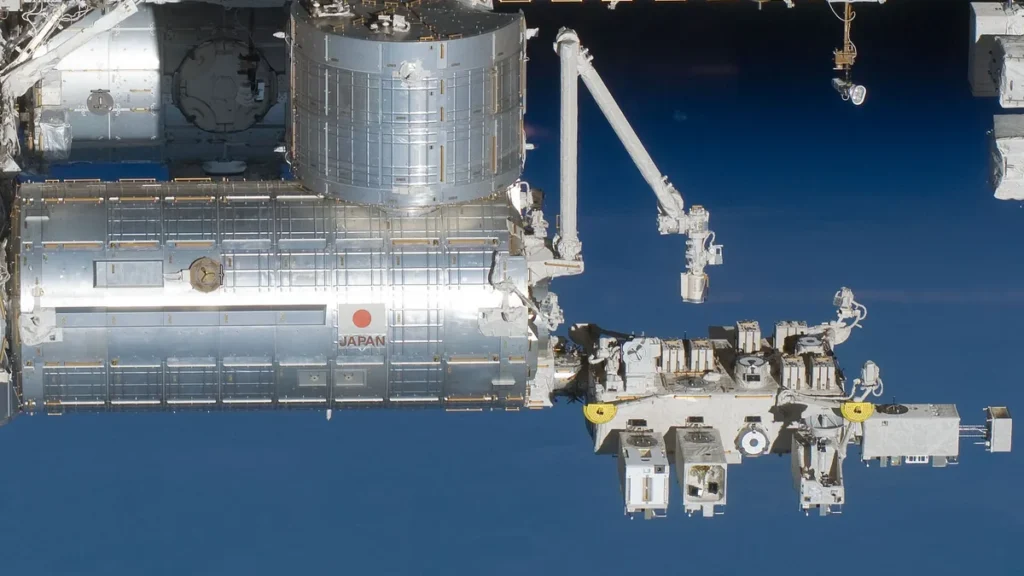
This is a new development in a story we reported earlier: NASA Sets media coverage for Northrop Grumman CRS-25 launch.
Key facts
- The Cygnus XL is slated to reach the station two days after liftoff, on December 1 at 2:35 a.m. EST (0735 UTC), and will be grappled and berthed to the Unity module for cargo unloading.
- Investigations impossible on Earth are conducted in space environments by NASA's Biological and Physical Sciences Division, which advances knowledge for longer and farther space travel while benefitting life on Earth.
- Northrop Grumman's Cygnus XL, described as a larger, more cargo-capable form of the company's solar-powered spacecraft, will make its third flight on this mission.
- NASA astronauts Jessica Watkins and Luke Delaney will monitor Cygnus arrival and use Canadarm to capture and berth the spacecraft to the Unity module.
NASA said on Nov. 27, 2026 that its Biological and Physical Sciences experiments, including a first-of-its-kind space crop production system, will fly to the International Space Station on Northrop Grumman’s 25th resupply mission.
The Cygnus XL spacecraft is set to lift off at 10:47 a.m. EST, or 1547 UTC, on Nov. 29, 2026 from Space Launch Complex 40. It should reach the station two days later, on Dec. 1, 2026 at 2:35 a.m. EST (0735 UTC), where astronauts will grapple it and ground controllers will install it to the Unity module’s Earth-facing port for cargo unloading.
The Cygnus XL, a larger and more cargo-capable version of Northrop Grumman’s solar-powered spacecraft, is making its third flight. The vehicle is named S.S. James “Jim” Lovell, continuing the company’s tradition of naming Cygnus spacecraft for pioneers in human spaceflight. Gaurang Patel, operations integration manager for NASA’s Low Earth Orbit Program, said the vehicle carries fresh food along with hatch seal covers and spacewalk tools for upcoming EVAs. He said the total cargo, science, and hardware comes to about 11,000 pounds.
Additional mission hardware includes crew quarter blankets and covers, hatch seal covers for U.S. segment seals, a modified toilet pretreat hose, spacewalk tools for the Alpha Magnetic Spectrometer, and batteries for the Anomaly Gas Analyzer. Jessica Watkins and Luke Delaney, NASA astronauts, will monitor the spacecraft’s arrival and help capture it with the station’s robotic arm before ground controllers install it at the Unity module’s Earth-facing port.
The new space crops experiment centers on Ohalo III, a plant growth facility that NASA described as mostly automated and built to support food crop production on future long-duration missions. It uses innovative water recovery and air exchange technologies to grow a variety of crops. The chamber will test how water is delivered and how growing space is optimized while the facility operates in orbit. NASA said the resulting knowledge could aid indoor agriculture and vertical farming on Earth, and that the chamber will offer critical insights for future Moon Base and Mars missions.
NASA is launching the novel space crops experiment to learn how crop production works in microgravity, driven by the need for sustainable food on longer and farther trips. NASA’s Biological and Physical Sciences Division conducts investigations in space environments to advance knowledge for longer and farther space travel and to benefit life on Earth.
One precision health investigation will test a miniature fluid-handling system that mixes, delivers, and maintains nutrient-rich liquid to sustain lab-grown human brain tissue models known as miBrains on the station. The miBrain research follows an earlier flight that carried small, lab-grown human brain models to the station and could help identify potential neurological risks associated with spaceflight. It may also support astronaut health strategies and further research into human tissue and neurological disease on Earth.

Other investigations include Cardinal Muscle 2.0, which will use a muscle tissue model in microgravity to see if repurposed FDA-approved drugs can prevent or reduce muscle loss. Muscle atrophy and strength loss resemble age-related decline on Earth but happen faster in microgravity without exercise. DNA Nano B will produce tiny DNA-inspired particles designed to carry medicine into dense tissues such as cartilage and solid tumors in microgravity.
The Active Radiation Environment Sensor will test a compact device that links with spacecraft systems to monitor radiation in real time in crew living areas on Artemis and lunar missions. Encapsulate-1 will examine how cancer cells move, invade surrounding tissue, and spread using miniature replicas of patients’ tumors, with the aim of creating a space-based diagnostic tool that could forecast cancer progression months or years ahead. JOining demonstrations IN-Space, or JOINS, will mature robotic methods for joining materials in space, so large structures can be built after launch rather than being sized by launch vehicle limits.
The mission will use SpaceX Falcon 9 booster B1096.9 for a return-to-launch-site landing at Landing Zone 40. It is the third SpaceX cargo flight to the station. Jared Metter, SpaceX’s director of flight reliability, said the Cargo Dragon spacecraft from the CRS-35 mission splashed down off California’s coast during the Nov. 21-22, 2026 weekend.
Patel said teams are watching the weather after heavy recent flooding in Brevard County affected several team members, and they are not following spacecraft or launch vehicle issues. Leadership from NASA, Northrop Grumman and SpaceX held a prelaunch teleconference on the planned launch. Jennifer Buchli, chief scientist for NASA’s Low Earth Orbit Program, said station science features a muscle-loss study that first flew during Expedition 65 and a nanomedicine study focused on cancer and osteoarthritis.
Dave Schiller, Northrop Grumman vice president for civil space and sciences, said Northrop Grumman has not set a readiness date for Antares 330 Cygnus launches, though details will be shared when available. He added that a single Falcon 9 remains available for Cygnus and that Northrop Grumman does not expect a gap in launch provider manifests. Work on the NG-22 spacecraft continues with plans for a future flight, although Schiller offered no timeline. Schiller said, “We will share any additional details about availability as they become available.”
Schiller said the NG-25 Cygnus could carry out one or more station reboosts at NASA’s request. Northrop Grumman plans to launch its Lunar Infrastructure Demo missions, using repurposed Gateway hardware, to the Moon at the end of 2027, with additional missions planned for the end of 2028 and the end of 2029. Schiller said Cygnus vehicles have flown to the station since a 2013 demonstration and a 2014 first operational flight, delivering over 169,000 pounds of science and supplies so far.



Join the discussion