Key facts
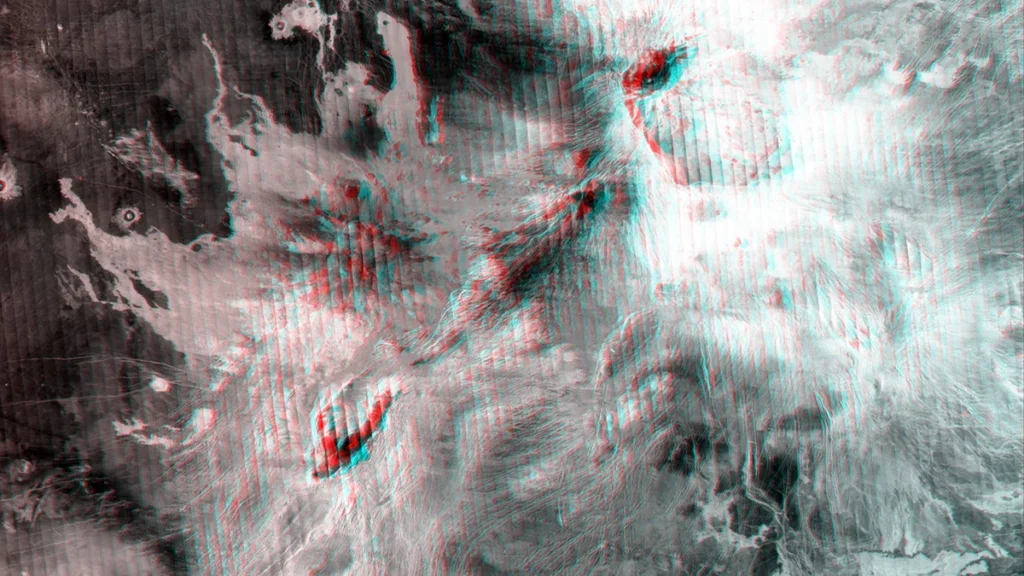
- A Magellan radar image shows a dark spot roughly 20 kilometers wide on Venus surrounded by two bright halos and lacking a central crater.
- Researchers suggest a space rock created the entire 20-kilometer marking pattern by exploding in Venus's thick atmosphere.
- A team led by T. J. Austin of Arizona State University mapped 592 probable airburst scars on Venus.
- The mapped airburst scars cover at least 2.7% of Venus's surface.
A research team led by T. J. Austin of Arizona State University mapped 592 probable meteor airburst scars on Venus in a 2026 study, identifying a dark marking roughly 20 kilometers wide surrounded by two bright halos and lacking a central crater.
Phys.org reported the research, which draws on Magellan radar images of Venus. The marking appears in views labeled C and D, and an outer halo around it is fainter and extends about 180 kilometers. Because no central crater is visible, researchers considered an atmospheric explosion rather than a direct impact.
Researchers suggest a space rock created the entire 20-kilometer pattern by exploding in Venus’s thick atmosphere. To spot similar events, the team searched for concentric rings or rays radiating outward from a shared center. These search criteria helped distinguish airburst scars from other surface markings.
An airburst does not need to form a crater to be detectable, because radar can see changes in surface texture caused by the explosion. In one location, a dark marking appears on flat terrain and between adjacent highland ridges, though it is difficult to discern on the ridges. Visibility varies by terrain type. Wind can also spread impact debris over older scars, further complicating detection.
A pair of dark centers within one bright halo indicates that a single incoming rock split into pieces that detonated near each other. The team treated each such breakup as one event in its count. Some of the mapped scars encircle craters while others exist independently.
The researchers compared 359 locations on plains without known windblown impact debris to 10,000 randomized point distributions. The random simulations used the same number of points across the same plains. Actual scar locations were spaced more closely together than random chance would likely produce, supporting the conclusion that the scars cluster rather than occur randomly.
The mapped airburst scars cover at least 2.7% of Venus’s surface. The planet’s impact craters number about 1,000 and appear scattered at random, in contrast to the clustered airburst scars. This contrast motivated the team’s analysis of the planet’s surface history.
The study authors state that the spread of airburst scars does not fit a surface of the same age everywhere. The team proposes that lava flows could remove old airburst scars in certain areas, accounting for differences between the scar and crater maps. The suggestion is offered to explain why airburst scars and impact craters show different spatial patterns. Lava might cover a slender airburst scar completely yet only partially fill a crater, leaving the crater rim exposed.
One explanation says internal heat accumulated until volcanic eruptions covered almost all of Venus’s surface in a geologically brief interval. This hypothesis posits that volcanic resurfacing happened quickly across the planet, giving all regions similar crater accumulation time. Because the craters sit far apart, regional eruptions may have blanketed broad areas between them across an extended time span. This offers an alternative to a single global resurfacing event.
In a model, scars appeared at random on a virtual Venus while marks inside random circles were removed at intervals to simulate lava covering the ground. Each simulated clearing represented lava covering a circular area, and areas that avoided burial longer accumulated more scars and produced clustered survivors. Simulations indicated that erased zones measuring about 2,000 to 6,000 kilometers across could generate the detected clustering pattern. Smaller patches in this range also matched earlier crater simulations.
The study, Nonrandom Spatial Distribution of Venusian Meteor Airburst Scars by T. J. Austin et al., appeared in AGU Advances.

Join the discussion