Key facts
- The agency says the flight will prove the instrument and assess whether small, lower-cost satellites can support long-term atmospheric monitoring.
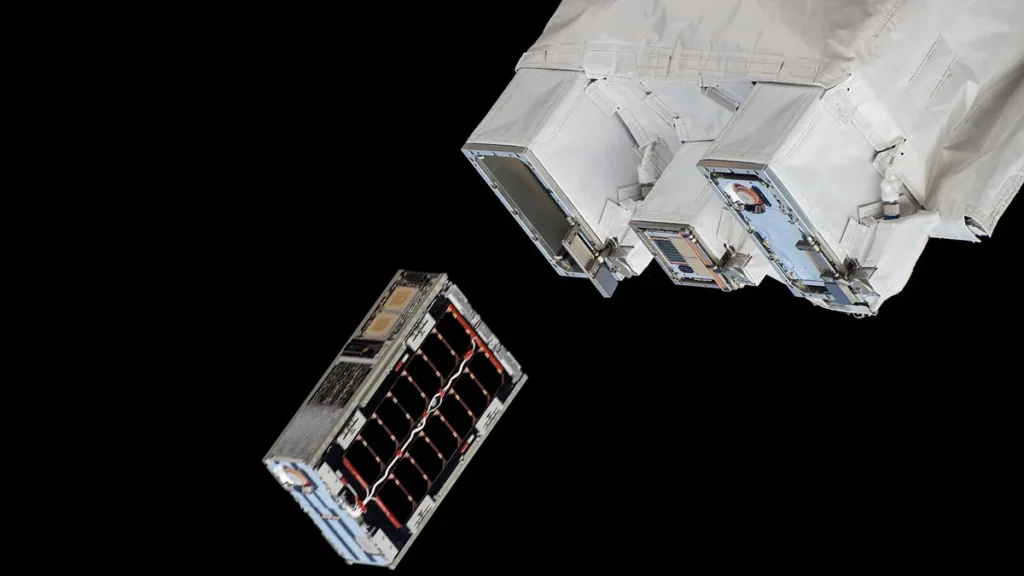
- The Osiris-3 payload will fly on CubeSat Mission 1 (CM-1), a 16U CubeSat, for a 12-month mission set to launch in 2029 per the CSA's mission page.
- The Optical Spectrograph and InfraRed Imaging System payload launched aboard Odin in 2001 for a two-year planned mission.
- A $100,000 grant in 2022 from the CSA's Flights and Fieldwork for the Advancement of Science and Technology (FAST) program funded USask to build a prototype for a smaller 6U CubeSat.
The Canadian Space Agency announced a $2.6-million contract on Nov. 24, 2026, in a post on X, tasking the University of Saskatchewan with building Osiris-3, an instrument that continues the country’s ozone-monitoring work after the OSIRIS instrument on Sweden’s Odin satellite ended service earlier this year. SpaceQ Media Inc. reported the award.
Osiris-3 will study sunlight scattered by the atmosphere while looking edge-on along Earth’s horizon, gauging how ozone, nitrogen dioxide and aerosols change with altitude and producing vertical profiles of trace gases and particles. The agency says the flight will demonstrate the instrument and test whether small, lower-cost satellites can sustain atmospheric monitoring over the long term.
Osiris-3 is assigned to CubeSat Mission 1 (CM-1), a 16U CubeSat; the mission will last 12 months, and the CSA’s mission page sets launch for 2029. An advance contract award notice from the CSA closed Aug. 30, 2026, saying the agency intended to give USask the contract without competition unless another firm showed it could do the work.
According to the notice, USask is the sole supplier able to do the work: the university developed Osiris-3, holds the design rights and know-how, and knows the design, calibration and operation well enough to finish construction, testing and operations. The notice warned that choosing another supplier would raise cost, push back the schedule and add technical risk.
The Optical Spectrograph and InfraRed Imaging System, known as OSIRIS, launched aboard Odin in 2001 on a planned two-year mission. The Swedish Space Corporation reported that Odin, with no onboard propulsion to raise its orbit, was lowered by atmospheric drag from about 600 kilometres, and by 2025 it was at 450 kilometres; tracking records put the burn-up on Aug. 3.
Canada included OSIRIS and SCISAT observations in the national ozone report it submitted to the United Nations in 2024. SCISAT launched in 2003 and is still measuring ozone; the CSA extended the mission through March 31, 2029, in the 2028-29 period, close to the planned CM-1 launch. Atmospheric scientists have warned of a worldwide shortfall in stratospheric measurements as older instruments retire, since few replacements have been confirmed.
In 2022, the CSA’s Flights and Fieldwork for the Advancement of Science and Technology (FAST) program provided a $100,000 grant to USask, funding work on a prototype for a smaller 6U CubeSat. The prototype flew in June 2024 on CNES’s inaugural transatlantic stratospheric balloon mission, which lifted off from Kiruna, Sweden; it recorded readings above 30 kilometres for almost four days before coming down on Baffin Island. Projected optics specifications put the package at roughly 2 kilograms and 15 to 20 watts of power consumption on a CubeSat.
Osiris-3 will be integrated with the spacecraft by the CSA, which will also run system-level testing and operations and buy the launch; another contractor will supply the satellite platform. Adam Bourassa of USask leads Osiris-3 as principal investigator, with Doug Degenstein as co-investigator. Separately, USask sought quotes for a CM-1 camera system starting Nov. 13, 2026, with bids due Dec. 9, 2026.

Join the discussion