Key facts
- In the photo, the four Artemis III astronauts held up three fingers during a brief pause in rigorous training for lighthearted crew bonding.
- Months of critical training are required so the crew can be physically ready and able to handle any situation that might arise during the mission.
- Artemis III is not planned to land astronauts on the Moon, but serves as a critical step toward that goal.
- Victor Glover plans to share what he knows about Orion and spacecraft systems with teams working on future Artemis missions.
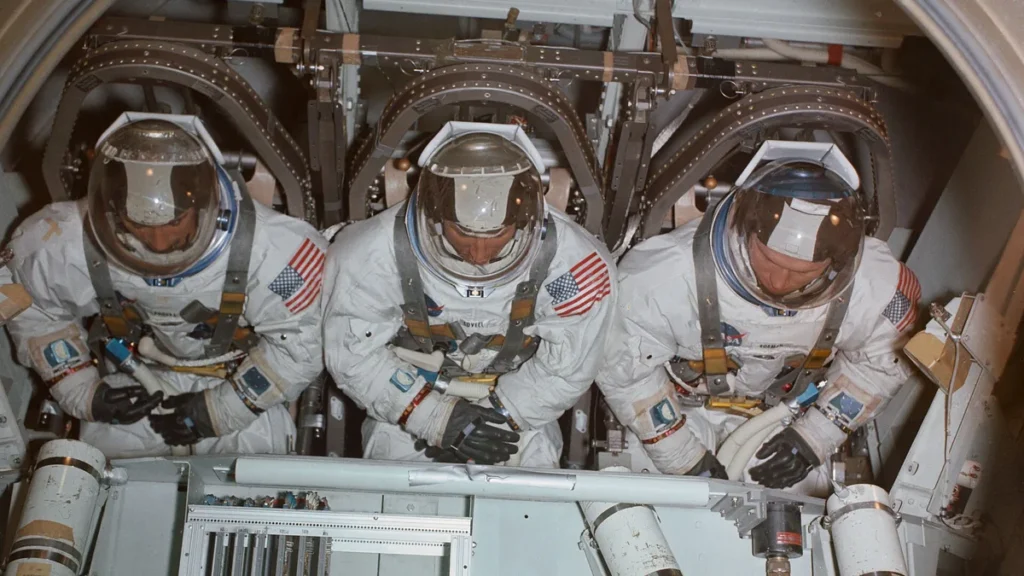
Four Artemis III astronauts posed with their Orion spacecraft at Kennedy Space Center’s Neil A. Armstrong Operations and Checkout Building on Nov. 27, 2026, during a pause in training, Space.com reported.
The photo caption lists NASA astronaut Randy Bresnick as mission commander, NASA astronaut Frank Rubio and NASA astronaut Andre Douglas as mission specialists, and European Space Agency astronaut Luca Parmitano as mission pilot; Mashable spells the commander’s name Randy Bresnik. In the image, the crew held up three fingers for a brief moment of levity.
The crew is already around the same Orion vehicle they will fly, and Space.com said months of critical training are required so astronauts can be physically ready and able to handle any situation that might arise.
NASA plans Artemis III as a low Earth orbit mission in which the crew will practice rendezvous and docking with Blue Origin’s Blue Moon and SpaceX’s Starship lunar landing vehicles using Orion; the flight is not planned to land on the Moon but serves as a step toward that goal. Artemis IV could put astronauts on the Moon for the first time since 1972 if Artemis III succeeds, NASA has a lunar landing vehicle, and the vehicle undergoes docking tests with Orion.
The agency’s SLS rocket sent Artemis II and its crew aboard Orion around the Moon. Glover and Wiseman flew with NASA astronaut Christina Koch and CSA astronaut Jeremy Hansen on the 10-day mission, which concluded with a splashdown on April 10 after the team became the first humans in more than 50 years to reach lunar orbit.
Glover and Wiseman will move to emeritus status at NASA’s Johnson Space Center in Houston in September 2026, joining a program that lets experienced personnel volunteer expertise in specialized consulting roles while mentoring current employees. Glover plans to share what he knows about Orion and spacecraft systems with teams working on future Artemis missions. NASA expects the Artemis II experience of Glover and Wiseman to matter significantly as it prepares for Artemis III and works to return American astronauts to the Moon with Artemis IV in 2028. NASA Administrator Jared Isaacman said Glover and Wiseman will continue sharing lessons with astronauts, flight controllers, and engineers as the agency prepares for Artemis III in 2027 and later missions.
In a Sunday email to employees on Sept. 20, 2026, NASA Administrator Jared Isaacman said Artemis III is roughly three months behind schedule and offered summer 2027 as the best-case launch window, which would keep two Moon-landing opportunities open for 2028. He called the 90-day delay a setback for NASA’s push to accelerate Artemis after Artemis II flew around the Moon, and he framed returning to the lunar surface as a broader competition with China.
NASA is targeting 2028 for Artemis IV and V, the first two landing missions, but Isaacman said continued slippage on Artemis III could leave the agency with only one late-2028 Moon landing opportunity. Isaacman said NASA is engaging suppliers and subcontractors directly to get late components such as rocket steering parts and valves back on schedule, and the agency is building some hardware itself to speed up production.
The February 2026 overhaul of the Artemis architecture placed the 2027 Artemis III flight between the Artemis II lunar flyby and the initial crewed landing, setting aside Gateway in favor of constructing a Moon base on the surface. NASA expects the base at the lunar south pole, an area about the size of Virginia with deep shadowed craters that may contain ancient ice and other frozen material.
NASA confirmed to Mashable the authenticity of Isaacman’s email, which was published online Monday by NASA Watch, Keith Cowing’s blog.



Join the discussion