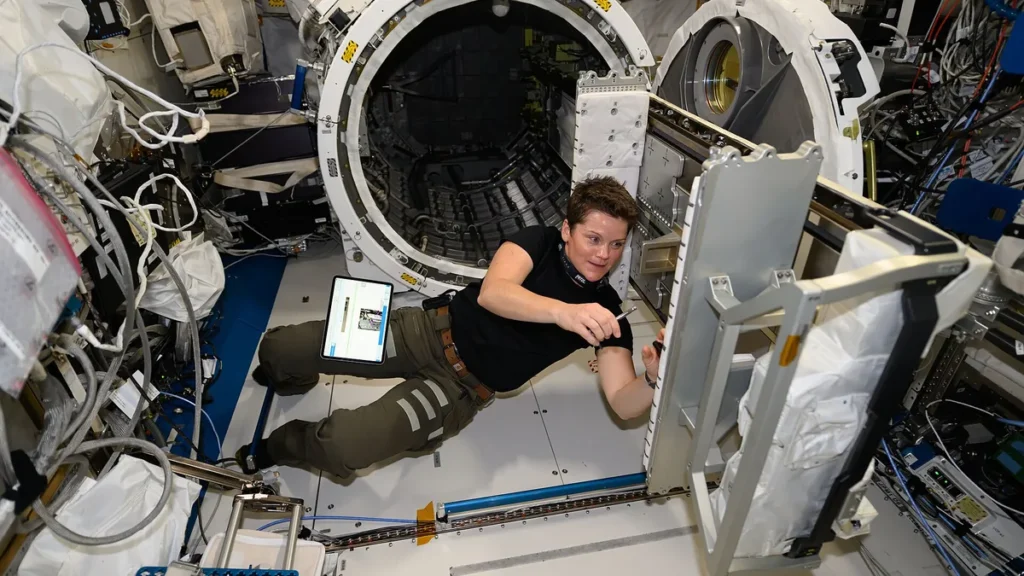
NASA’s Encapsulate-1 investigation examines tumor samples taken from patients aboard the International Space Station, the agency said Nov. 23, 2026. The investigation flies a person’s own tumor tissue to the orbiting laboratory. Researchers observe the cells where gravity is removed as a variable.
The investigation seeks to observe how cancer cells move and interact in a microgravity environment, NASA said. Microgravity is the near-weightlessness that exists when gravity is removed as a variable.
Taking Earth‘s gravity out of the experiment creates conditions under which cell movement and interaction can be studied. Those observations are not achievable on the ground.
A Nov. 19, 2026 picture reveals gastric microtumors developing within an Encapsulates biochip. Gastric refers to the stomach. The chip holds stomach-cancer tissue derived from patients.
It is flown aboard the station as part of Encapsulate-1. Encapsulate Inc. is credited for the image.
The station circles Earth at an altitude of more than 200 miles (320 km). That height keeps the research facility in orbit above the planet. Experiments aboard the station sit in a microgravity setting.
NASA describes the station as a hub of advanced science producing findings that cannot be made on Earth. The agency frames the orbiting laboratory as enabling research that ground-based facilities cannot reproduce.
Metastasis is the spread of cancer from where it first formed. Results could help researchers build testing that predicts metastasis risk for an individual patient, NASA said. Forecasting how likely a patient’s cancer is to spread is the intended clinical payoff of the space-based observation.
Personalized treatment means tailoring care to each person. The work could also support cancer care tailored more closely to each patient, the agency said. Adapting therapy to how a particular person’s tumor responds is the broader aim behind the personalized-treatment goal.



Join the discussion