Key facts
- In 2025, governments spent roughly $71.8 billion on space defense and security worldwide, according to Novaspace's Space Defense & Security, 2nd Edition report.
- At least 49 countries spent $10 million or more on space defense and security capabilities, the report found.
- Five countries — the United States, China, Russia, Japan, and France — made up about 90% of 2025 spending on space defense and security.
- Industry received roughly $33.6 billion in contracts from the $71.8 billion governments spent globally on space defense and security in 2025.
Worldwide government spending on space defense and security reached roughly $71.8 billion in 2025, according to a Novaspace report released in November 2026.
The report counted governments in at least 49 countries spending $10 million or more on these capabilities during 2025. Those five nations — the United States, China, Russia, Japan and France — accounted for about 90% of the 2025 total. Industry received roughly $33.6 billion in contracts from the global total.
In 2025, government buying concentrated most heavily on secure satellite communications, counterspace (anti-satellite systems), and intelligence, surveillance and reconnaissance. Novaspace says resilient communications and intelligence-led military operations created the demand for those areas.
The report says rising geopolitical competition is pushing governments to spend more quickly on sensing, communications, navigation, intelligence, decision-making and military operations across all domains. The spending supports operations in every domain as nations seek strategic advantage in orbit.
“Governments no longer view space solely as supporting operations on Earth,” said Rachel Hughes, a Novaspace senior consultant. She said investment in those areas means future military advantage hinges on freedom of action in space. She said space is now an operationally contested domain, not merely a support one. She said winning defense organizations will blend sovereign capabilities with commercial innovation to deliver space-enabled military advantage quickly.
According to a Novaspace report issued from Paris in November 2026, governments are mixing national and commercial space capabilities through hybrid sovereign-commercial architectures to increase resilience, speed deployment and add flexibility. The report states that winning military advantage now depends on assured access to capabilities rather than outright ownership. The report ties assured access to the wider shift toward hybrid sovereign-commercial architectures.
The report examines five shifts in the market: the militarization of space, hybrid sovereign-commercial architectures, a broader range of suppliers, resilience and space domain awareness, and demand for counterspace and sovereign defense capabilities. The study covers seven capability domains. It includes multinational stakeholder coverage, country profiles, spending forecasts, industry revenue assessments and supporting datasets. Taken together, the shifts define the global space defense ecosystem assessed in the report.
The consultancy projects 2,306 defense-owned intelligence, surveillance and reconnaissance satellites slated to launch from 2026 through 2035. That compares with 485 such satellites launched during the previous decade, a more than fourfold increase. The consultancy’s chief executive officer, Pacôme Révillon, presented the figures at the Space Defense and Security Summit in Paris on Sept. 15, 2026.
Most defense intelligence, surveillance and reconnaissance satellites launching in the coming decade will be part of constellations instead of standalone satellites, according to Novaspace. The consultancy said the war in Ukraine underlined how important space-based intelligence is on the battlefield. Révillon called intelligence, surveillance and reconnaissance a top priority for most nations at the Paris summit.
Novaspace said a halt in U.S. data sharing in March 2025 demonstrated that governments require assured access to space-based intelligence. The pause in data sharing demonstrated that requirement and aided commercial intelligence, surveillance and reconnaissance satellite providers such as Finland’s ICEYE.
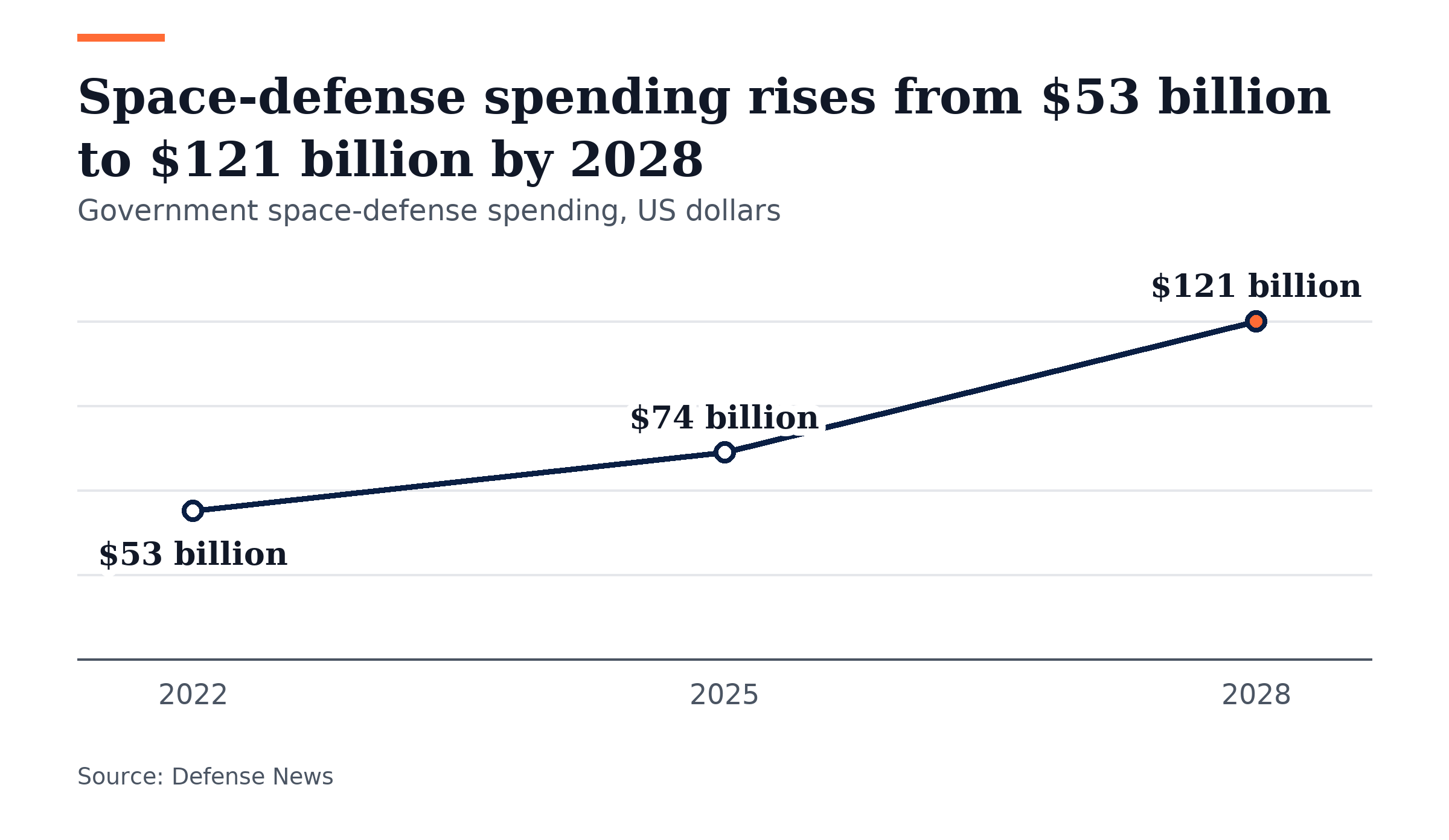
The forecast puts government space-defense budgets at $121 billion in 2028, up from $74 billion in 2025 and $53 billion in 2022. At least 55 countries fund space defense, according to Novaspace.
Novaspace expects the number of operational systems in space to increase as much as fivefold, reaching 50,000 to 100,000 by 2036 from 18,000 satellites in 2026. The consultancy says this growth adds to tracking needs.
More than 400 space-situational-awareness satellites are slated to launch between 2025 and 2034. The forecast puts global spending on space situational awareness at $61 billion, with defense programs covering $52 billion. Defense programs provide most of that spending, Novaspace says.
On Oct. 1, 2026 in Paris, Novaspace released its Satellite Communications for Defense & Security report. The study provides a ten-year forecast through 2035 covering defense satellite communications demand and capacity on both commercial and military systems. It compares government-owned capacity with multi-orbit commercial services.
According to the report, rising geopolitical tensions, military digitization and new defense operating concepts are increasing military satellite capacity use across land, naval, air and unmanned forces. Novaspace says military forces are sending more data, operating tactical command networks and flying remote uncrewed platforms.
Defense ministries are balancing government-owned satellite capacity against multi-orbit commercial services, while commercial GEO and NGSO operators take on larger roles in hybrid government networks. Continuous, tamper-resistant, low-latency connectivity is driving the shift.
The consultancy’s defense-satcom framework follows deployment region, the originating defense force, orbital altitude and frequency band. It covers military X-band and Mil-Ka band along with commercial Ku-band and Ka-band. It benchmarks defense-focused commercial satellite operators and prime suppliers, linking larger budgets to long-term capacity agreements and custom constellations.
Novaspace expects military satellite communications spending to keep growing through 2035. Governments are treating communications resilience as a priority because of electronic warfare and satellite jamming, according to the consultancy.
The consultancy calls Space Defense & Security, 2nd Edition a comprehensive assessment of government spending, industry revenues, policy and capability trends.




Join the discussion