Key facts
- Space.com featured a photo, taken by crewmate Anil Menon, of Watkins working in the glovebox as its space photo of the day on Nov. 17, 2026.
- While gloved inside the sealed glovebox, Watkins mixed samples of living cells with a bioink and inserted the mixture into a specialized cartridge, NASA said.
- Space.com explains that station occupants and objects remain in constant freefall, producing total weightlessness that mimics the absence of gravity and enabling biological research beyond Earth's gravitational confines.
- Auxilium's work addresses controlling the precise distribution of cells inside a three-dimensional structure, since wrongly clustered or uneven cells may keep engineered tissue from functioning properly, Koffler said.
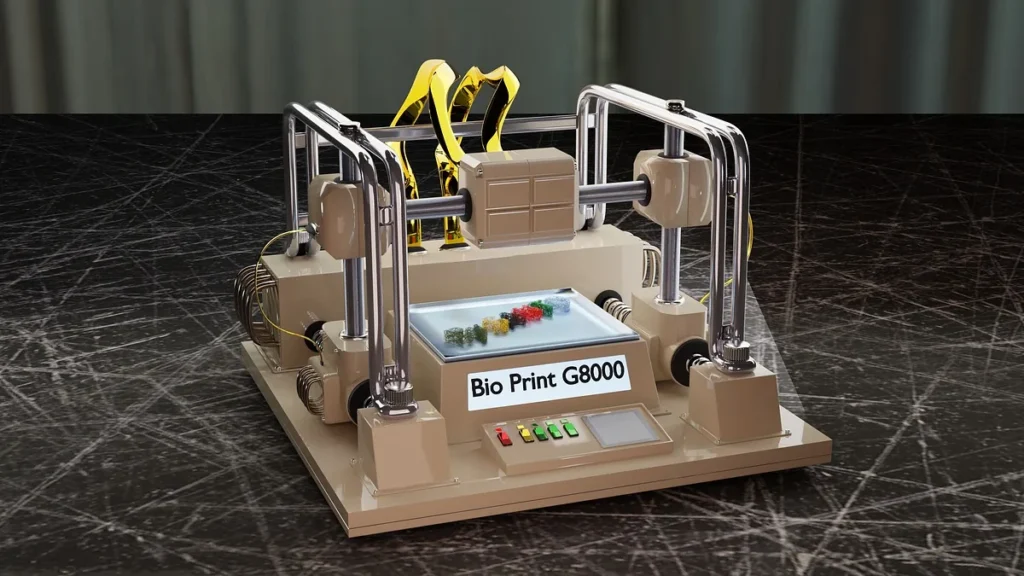
NASA astronaut Jessica Watkins, commander of Crew-13, worked inside the International Space Station’s Life Sciences Glovebox running the InSPA-Auxilium Bioprinter-Cell Printing experiment, which 3D-prints human cells and tissues in microgravity. Space.com published the item on Nov. 17, 2026 as its space photo of the day, identifying Watkins as a NASA astronaut and Crew-13 commander and describing the glovebox as a contained research space and one of her favorite places to work aboard the station.
Space.com featured a photo, taken by crewmate Anil Menon, showing Watkins gloved up with her hands and arms inside the sealed glovebox while working on the cell-printing experiment. While wearing gloves inside the sealed glovebox, Watkins mixed samples of living cells with a bioink and inserted the mixture into a specialized cartridge, NASA said. The agency shared details of the procedure after Watkins posted about the experiment on social media; the glovebox is a sealed research workstation on the station.
“leverages the microgravity environment of ISS to 3D print cells and manufacture human liver, kidney, and cartilage tissue,” Watkins said. Space.com explains that station occupants and objects remain in constant freefall, producing total weightlessness that mimics the absence of gravity and enabling biological research beyond Earth’s gravitational confines. The article frames the station as the perfect home for biological experiments because of the unique microgravity environment, where weightlessness lets researchers test beyond Earth’s gravity.
Watkins described the work online as an example of using the ISS orbital national laboratory to reshape understanding of biology, medicine, and engineering and to improve life on Earth. The experiment explores 3D printing human cartilage tissue in microgravity and aims to one day support future human patients both in space and on Earth. Space.com notes that cell printing is not the first research people associate with the station.
San Diego-based Auxilium Biotechnologies said it successfully used its 3D bioprinter aboard the ISS to manufacture structures containing human liver, kidney, and cartilage cells. Auxilium said the recently completed mission marked the first time the company bioprinted liver and kidney tissues in space, framing the result as a milestone in space bioprinting. Wake Forest University researchers supplied the cells used in the run, according to Auxilium co-founder Jacob Koffler of the University of California, San Diego.
Auxilium’s work addresses controlling the precise distribution of cells inside a three-dimensional structure, since wrongly clustered or uneven cells may keep engineered tissue from functioning properly, Koffler said. Koffler used the analogy of blueberries sinking to the bottom of muffin batter to describe how cells can cluster in the wrong places under gravity, which can stop tissue from working as intended. He said microgravity enables precise control over cell location because cells and drug particles do not sink under gravity as they do on Earth, allowing uniform placement. He said the company originally turned to the station so drug particles in implants would not sink under gravity, and he extended that reasoning to placing cells in tissue structures.
Auxilium sent its 3D bioprinter to the ISS in 2024, originally to improve its nerve-repair implants, for which versions are in clinical trials. For the latest mission, Auxilium sent bio-inks to the station to expand the printer’s capabilities into tissue printing, Koffler said. Koffler’s team monitored the printing from Earth through station cameras and uploaded new instructions to the printer as necessary during the run. Controllers on the ground watched through station cameras and could send new instructions to the printer during the run.
Koffler said the liver and kidney tissues created on the ISS returned to Earth about two weeks before July 9, 2026, and are under analysis. Koffler said commercial medical products remain years away from patient use. He said the printed structures are not functioning organs and that the field will focus on smaller tissue patches, such as for the liver, before attempting entire replacement organs.
Koffler said regulatory pathways are only beginning to take shape, he attended an FDA workshop on space biomanufacturing earlier in 2026, and starting to build the framework now is important. Koffler said Auxilium signed agreements with companies developing commercial space stations and orbital platforms meant to succeed the ISS as NASA prepares for its eventual retirement.
Dr. Anthony Atala of the Wake Forest Institute for Regenerative Medicine said uniform cell distribution aboard the station points to real possibilities for manufacturing medical devices and tissues in space. His team provided the liver and kidney cells used in the experiment, and he viewed the even cell spacing as evidence that space manufacturing of devices and tissues is plausible.
Watkins and Auxilium describe the bioprinting work as advancing regenerative medicine and in-orbit manufacturing to support future patients on Earth and crew health on long-duration missions, with commercial platforms expected to continue the research after the ISS. Koffler and Space.com describe microgravity as enabling cell and tissue work that is difficult on Earth because cells and particles do not sink under weightlessness.


Join the discussion