Key facts
- The mission is designated NASA's Northrop Grumman Commercial Resupply Services 25, or Northrop Grumman CRS-25.
- Approximately 11,000 pounds of cargo will fill the Northrop Grumman Cygnus XL spacecraft launching aboard a SpaceX Falcon 9 rocket.
- The spacecraft will launch from Space Launch Complex 40 at Cape Canaveral Space Force Station in Florida.
- Ground controllers will install the Cygnus XL to the Earth-facing port of the Unity module for cargo unloading after capture.
NASA set media coverage for Northrop Grumman’s Commercial Resupply Services 25, or CRS-25, mission, targeting liftoff at 10:47 a.m. EST on Nov. 29, 2026, from Space Launch Complex 40 at Cape Canaveral Space Force Station in Florida.
The Cygnus XL, named the S.S. James “Jim” A. Lovell for former NASA astronaut James Lovell, will launch aboard a SpaceX Falcon 9 rocket carrying approximately 11,000 pounds of cargo. Cargo includes experiments to improve drug delivery for cancer and osteoarthritis, predict cancer spread, advance treatments for muscle loss, improve radiation sensing, and advance food production for future long-duration missions.
Launch coverage begins at 10:25 a.m. on Nov. 29, 2026, with liftoff targeted for 10:47 a.m. EST. NASA will provide live-streaming and blog updates on its website beginning no earlier than 10 a.m. on Nov. 29, and on-demand streaming video and photos will be available on NASA+ shortly after liftoff. Updates will follow on the International Space Station blog.
NASA will hold a prelaunch media teleconference at 12 p.m. on Monday, Nov. 23, 2026. Participants include Gaurang Patel and Jennifer Buchli of NASA’s Low Earth Orbit Program, Dave Schiller of Northrop Grumman, and Jared Metter of SpaceX. Media must contact the NASA Johnson Space Center newsroom by 11 a.m. on Nov. 23, 2026, at jsccommu@mail.nasa.gov or 281-483-5111 for call details, and those wishing to ask questions must dial in no later than 10 minutes before the teleconference starts.
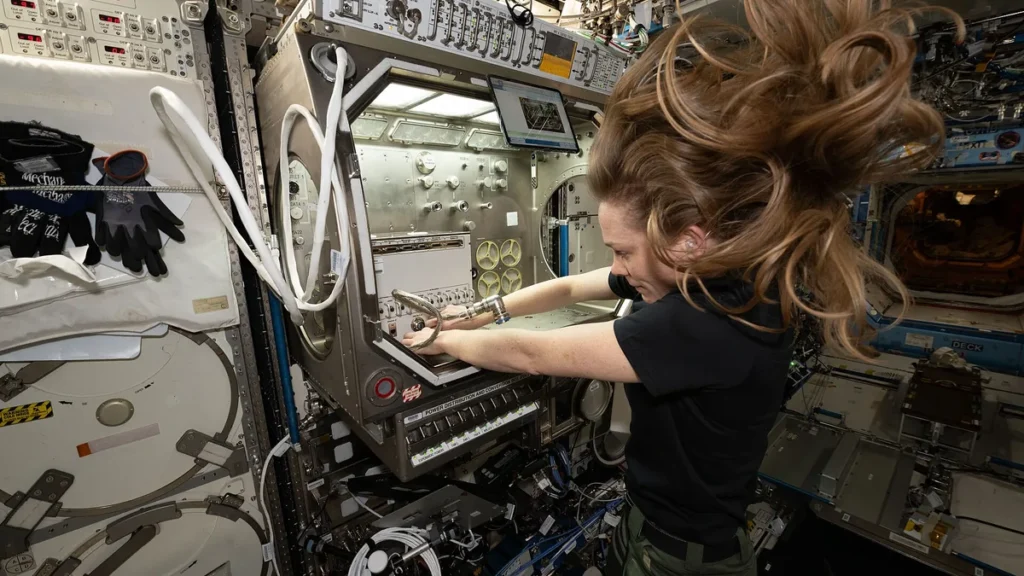
Astronauts Jessica Watkins and Luke Delaney of NASA will use the Canadarm2 robotic arm to capture the Cygnus XL on Tuesday, Dec. 1, 2026, aboard the International Space Station. Arrival coverage begins at 1:10 a.m., and capture will occur at 2:35 a.m. Ground controllers will then install the spacecraft to the Earth-facing port of the Unity module, so crew members can unload cargo. The spacecraft will remain at the station until May 2027 before departing with several thousand pounds of disposal items that will burn up during re-entry.
The International Space Station National Laboratory is sponsoring more than 35 payloads on the mission, focusing on technologies needed for future space infrastructure, autonomous operations, and commercial activity in low Earth orbit, the region of space close to Earth. Aegis Aerospace’s MISSE Flight Facility will expose materials and hardware to radiation, atomic oxygen, and extreme temperature cycling outside the station. Melagen Labs will test radiation-shielding technology using shielded and unshielded dosimetry sensors, with traditional aluminum shielding controls as the comparison.
Dunlop Tires will test newly developed rubber compounds to assess how they withstand radiation and temperature extremes. Amplified Space will test a software-defined spacecraft power system that can change voltage and current characteristics through software commands. A third Astrobee robot named Queen will rejoin Honey and Bumble on the station through Arkisys.
TESSERAE, developed by Aurelia Institute with mission management transferred to Rendezvous Robotics and supported by Axiom Space, will test whether 32 individual tiles can autonomously assemble into a larger structure in microgravity. Rendezvous Robotics is advancing the research into modular spacecraft designed to autonomously assemble and reconfigure in orbit.
NASA listed accounts on X, Facebook, and Instagram for the public to follow and tag, and questions about countdown coverage can go to the NASA Kennedy Space Center newsroom at 321-867-2468. Members of the public can register for the virtual guest program, which provides curated launch resources, notifications, and a passport stamp after launch.




Join the discussion