Key facts
- Water ice in interstellar comet 3I/ATLAS combines with dark rocky material inside tiny grains, astronomers using the NASA/ESA/CSA James Webb Space Telescope found.
- The team's modeling points to grains below a few micrometers in size, with each grain combining water ice and refractory material.
- Protopapa said the grains match the size of grains in our own comets but differ because more dust is mixed into the ice.
- The spectra of these grains do not match ice grains from Solar System comets, though they look like spectra from certain icy worlds past Neptune.
Astronomers using the NASA/ESA/CSA James Webb Space Telescope found water ice mixed with dark rocky material inside tiny grains in interstellar comet 3I/ATLAS during observations on August 6, 2025, December 22, 2025, and April 1, 2026.
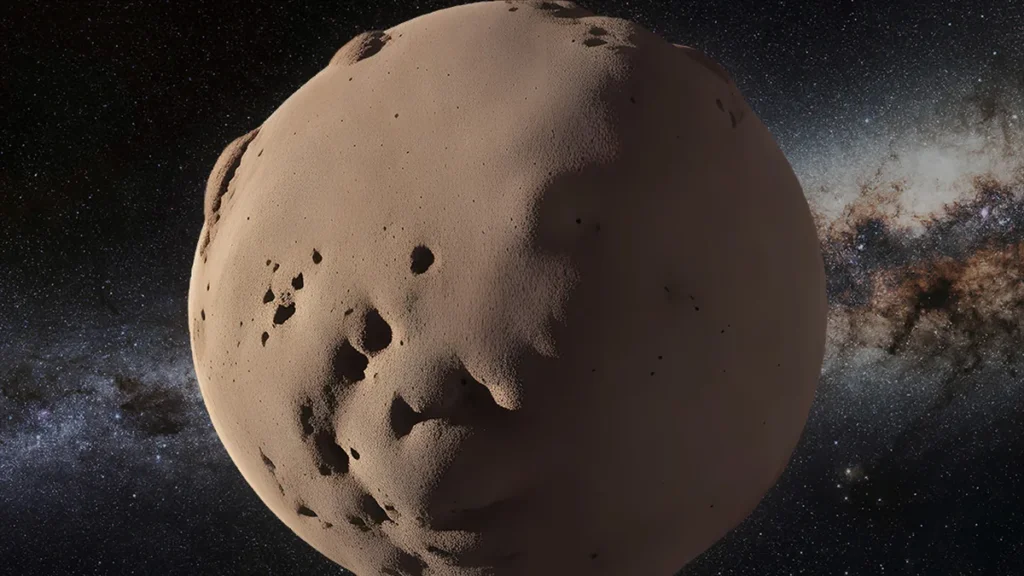
The team’s modeling points to grains below a few micrometers in size, with each grain combining water ice and refractory material, or dark rocky material. Dr. Silvia Protopapa of the Southwest Research Institute said the grains match the size of grains in our own comets but differ because the ice contains more dust. She explained that warming gas carries ice and dust grains from the comet’s interior into the coma, the surrounding cloud, where they preserve clues about its birth conditions.
The spectra of these grains do not match ice grains from Solar System comets, though they look like spectra from certain icy worlds past Neptune. The spectra display strong water-ice absorption and gas emission involving water, carbon dioxide and carbon monoxide. Water-ice signatures weaker than those typically found in icy comets appeared faint or absent in the 3I/ATLAS data, which the team attributes to sub-micrometer grains that mix water ice with refractory material.
Data from April 2026 point to a second group of larger ice-rich grains measuring microns across. Dr. Michael Kelley of the University of Maryland said the team cannot yet determine if temporal changes result from solar heating varying between observations or from fresh material uncovered as erosion wore the surface near the Sun. Both possible explanations remain open, and distinguishing between them is one of the questions the team plans to address.
The researchers suggest that icy planetesimals formed around other stars may share ice grain properties spanning pure ice to ice mixed with refractory material, placing 3I/ATLAS at the refractory-rich extreme. Protopapa said the icy materials used to build planets in our system and elsewhere may exist as tiny grains running from nearly pure ice to ice mixed with dust, with 3I/ATLAS on the dusty side. She added that the comet initially appears unlike known icy comets but fits alongside distant icy worlds in our own Solar System when compared directly.
Confirmation of this shared grain range would show that water ice takes its physical form early inside planet-forming disks and keeps that form in icy bodies that later form, the team said. The result would imply that the physical structure of water ice forms during planet formation and survives in the icy bodies produced in those disks.
The paper appeared in Astrophysical Journal Letters as ApJL 1011, L11, under DOI 10.3847/2041-8213/aea60d, authored by Silvia Protopapa et al. The citation identifies the journal, volume, article number and digital object identifier for the grain property study.
3I/ATLAS is the third confirmed interstellar object detected, following ‘Oumuamua in 2017 and Comet 2I/Borisov in 2019. The comet was first spotted by the Asteroid Terrestrial-impact Last Alert System, and its name reflects that status and the NASA-funded survey that found it.
A separate Nature study published June 22, 2026, led by Martin Cordiner of NASA’s Goddard Space Flight Center, estimated the comet formed 10 to 12 billion years ago, in the era known as cosmic noon when star formation reached its height. Measurements from that study show the comet carries roughly 30 times the deuterium level found in comets from our own solar system, and the NIRSpec instrument found only traces of carbon-13 relative to lighter-weight carbon-12. “This was a unique opportunity to study an ancient object from the distant galaxy, probably pre-dating our Sun and solar system,” Cordiner said.
Stefanie Milam of NASA Goddard said studying interstellar objects is a major step toward learning how common or uncommon conditions for the evolution of life are in the universe. She noted that Earth is the only known place where chemical ingredients led to life, making interstellar object analysis relevant to assessing how widespread life-friendly conditions may be.
A European Southern Observatory Very Large Telescope study led by Cyrielle Opitom of the University of Edinburgh complements Webb results by examining carbon and nitrogen forms in cyanide from 3I/ATLAS. The VLT cyanide analysis supplements the Webb isotope results with more information about the comet’s carbon and nitrogen chemistry.
Webb’s MIRI instrument made the first direct detection of methane gas on an interstellar visitor during observations of 3I/ATLAS. The first set of MIRI observations took place on December 15 and 16, when 3I/ATLAS was about 205 million miles from the Sun, and a second round followed on December 27, with the comet about 236 million miles away. The amount of methane relative to water surprised researchers because it far exceeds levels normally found in comets from our solar system, with only a few similar cases known, and the comet emits very large quantities of carbon dioxide compared with water, well beyond amounts usually measured in comets from our solar system.
Methane ice readily changes into gas, and detection only after the comet’s close pass by the Sun led researchers to suggest the ice lay beneath the surface. The team said surface material likely shielded the ice until the Sun’s heat reached deeper layers.
Scientists observed a sharp decline in production of gases, with water showing the steepest decrease, as the comet received less solar energy and temperatures fell. Water is less volatile than methane or carbon dioxide, so its gas production shuts down more quickly as the comet cools.
The team used the Medium Resolution Spectrometer for the MIRI observations, which separates infrared light into individual wavelengths and functions as an integral field unit to record a spectrum at every location across a small region of sky. The MIRI volatile inventory paper is by Matthew Belyakov et al., published in The Astrophysical Journal Letters, 2026; 1001 (1): L11, DOI 10.3847/2041-8213/ae5700.
The dust research combined data from the Hubble Space Telescope, the ground-based VLT, the space telescope SPHEREx, and the James Webb Space Telescope. When the Sun-comet-observer angle is small, polarization parallel to the scattering plane is stronger in 3I/ATLAS dust than in typical solar system comets.
An amorphous carbon model gave a visible-light effective reflectivity of 0.041 plus or minus 0.001 for the comet’s dust, averaged across 0.4 to 0.6 micrometers. The authors note the amorphous carbon label is a modeling choice and does not identify the actual dust material, while the low reflectivity matches dark dust in Solar System comets.
The team used the Pirka Telescope in Hokkaido to observe in January 2026 when the Sun-comet-observer angle was small, and under model conditions a structure where small grains cluster together while leaving many gaps is conceivable. The dust model includes grains of different sizes, and the relationship between small and large grains falls within the range estimated for solar system comets, but the upper limit of grain size has not been sufficiently narrowed down.
A model using only amorphous carbon cannot reproduce the brightness around 10 micrometers, but adding a silicate component approaches the observed brightness; the difference from observations remains large compared to errors, so grain size and component proportions are not treated as precisely determined. The authors believe bright and dark grains may mix in the same coma, with the prominent component changing depending on the light measured.
Scientists cannot trace 3I/ATLAS to a specific star system because gravitational encounters over billions of years would scramble its trajectory beyond reconstruction.
Chemistry suggests the comet formed in an extremely cold, chemically primitive region of the early Milky Way and possibly preserving material from a planetary system that formed more than 7 billion years before the sun and Earth. The carbon isotope ratios fall beyond values seen in nearby gas clouds and in young planetary systems, and the carbon evidence indicates a birthplace in a Milky Way region that contained few heavy elements but received enrichment from earlier massive stars.
If the age estimate stands, 3I/ATLAS would be roughly 4 billion years older than early predictions and a remnant from the galaxy’s first era. The comet formed in temperatures below about -400 degrees Fahrenheit and has changed little since then.
The grains hold clues to the conditions where the comet formed, Dr. Protopapa said. The findings suggest icy building blocks of planets here and around other stars may share ice in micron-scale grains, with 3I/ATLAS toward the dusty end. If confirmed, the shared range of grain properties could show that the physical form of water ice forms early in planet-forming disks and survives in icy bodies, the team said.
Analysis of interstellar objects is a major step toward learning how common or uncommon conditions for the evolution of life are in the universe, Stefanie Milam of NASA Goddard said.


Join the discussion