Key facts
- The Sun’s 27-day rotation leaves half its surface hidden from Earth-based observers, allowing sunspots to form unseen and later emerge as threats to space weather.
- Helioseismology uses acoustic waves traveling through the Sun to detect magnetic active regions on the far side, as variations in wave travel time reveal hidden sunspots.
- Up to 10% of far-side active regions detected via helioseismology are false positives ('ghost' regions) with no corresponding ultraviolet observations.
- NASA’s STEREO spacecraft provided ultraviolet images of the Sun’s far side (2010–2014), enabling researchers to validate helioseismic detections against direct observations.
Researchers led by Bibhuti Kumar Jha at the Southwest Research Institute published a probabilistic method in The Astrophysical Journal Supplement Series to estimate sunspot activity on the Sun’s far side. The approach blends helioseismology with historical spacecraft data rather than requiring new hardware. It draws on far-side ultraviolet images that NASA’s STEREO spacecraft collected from May 2010 to August 2014. Because Earth-based observatories cannot see the far side, hidden sunspots can develop there and later rotate into view as space-weather threats.
The Sun’s 27-day rotation keeps half of its surface out of Earth’s view, so sunspots can form unseen and later emerge as threats to space weather. Coronal mass ejections from hidden sunspots can damage satellites or overload ground-based power grids, and forecasters receive warning only once the activity rotates around to the visible side. Helioseismology uses acoustic waves traveling through the Sun to detect magnetic active regions on the far side, because variations in wave travel time reveal hidden sunspots.
The technique adapts earthquake seismology to the Sun: geologists use earthquake shockwaves to map Earth’s unseen interior, and solar physicists apply the same idea to the star. Churning in the Sun’s convective zone creates acoustic waves that bounce inside the Sun and reflect off its surface. Active regions with concentrated magnetism slightly shift the waves’ travel time, and those shifts betray sunspots on the far side. The technique mimics Earth seismology but faces challenges from noisy data.
Noise is the problem. Up to 10% of far-side active regions detected through helioseismology are false positives known as ghost regions, meaning they have no corresponding ultraviolet observations. Those false detections make forecasts unreliable because models may wrongly predict sunspot emergence before the regions rotate into view. The new method filters the acoustic data to separate real sunspots from ghosts, pairing STEREO ultraviolet images with SDO magnetic readings to improve far-side mapping accuracy.
NASA’s STEREO mission placed two spacecraft around the Sun’s far side while keeping direct communication with Earth. From May 2010 to August 2014, the pair gathered extreme-ultraviolet images of nearly the whole far side. The STEREO images let researchers cross-correlate far-side observations with SDO magnetic readings for model calibration. Researchers validated helioseismic detections against those direct observations.
The Solar Dynamics Observatory carries the Helioseismic and Magnetic Imager, and the ground-based Global Oscillation Network Group measures near-side ripples to locate magnetic knots on the far side. After scaling the acoustic signals into magnetic units, the team fed the calibrated STEREO–SDO data into the Advective Flux Transport model, which simulates plasma flows and magnetic fields. That model supports heliophysical forecasts and lets researchers follow hidden sunspot growth.
Conventional models underestimate the Sun’s total unsigned magnetic flux by 10% to 20% because they exclude far-side contributions. The new method captures those hidden contributions, improving the magnetic-flux estimate. It also follows how a sunspot grows while hidden, such as a region in 2011, so forecasts do not reset when the region rotates back into view.
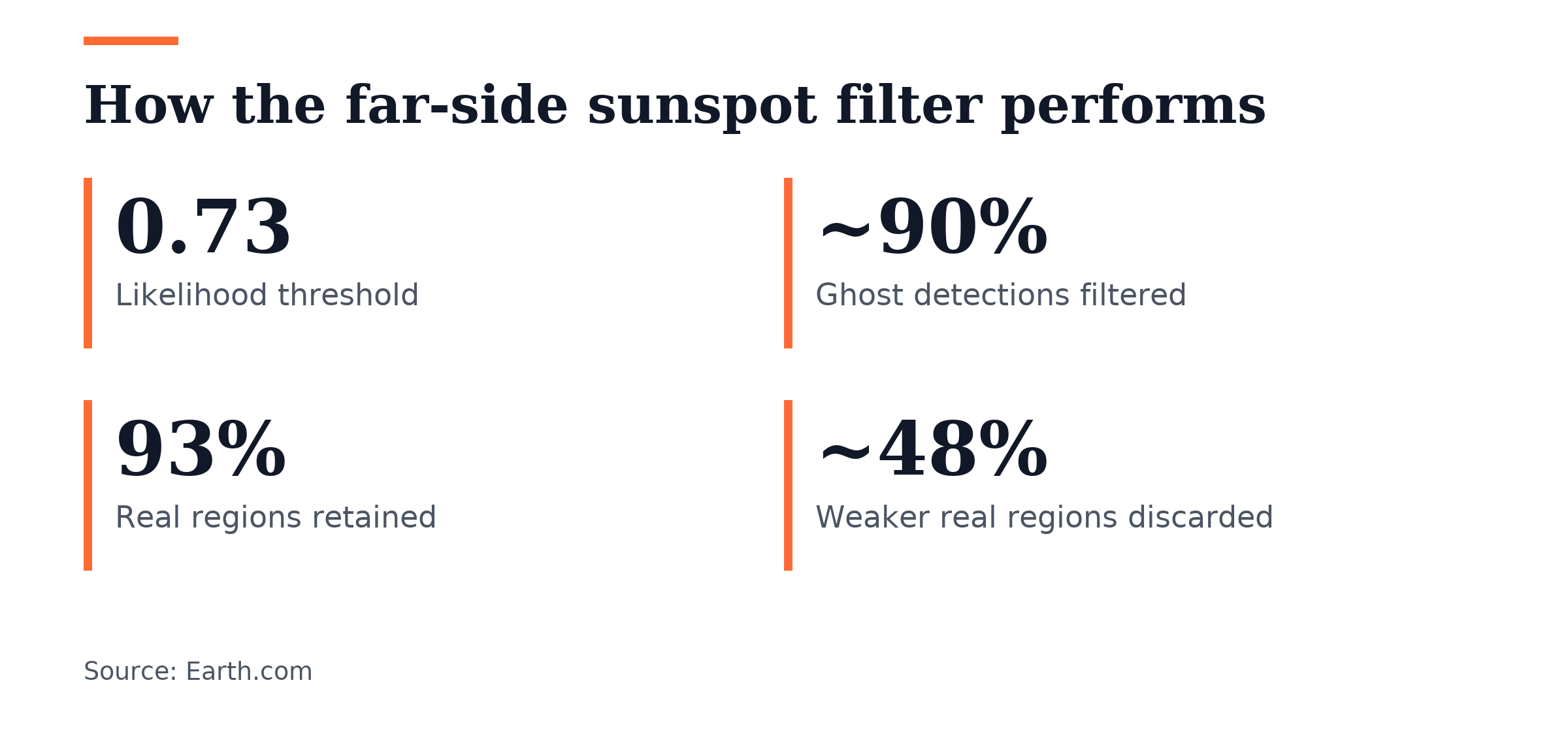
The team built a probabilistic model that assigns a likelihood score to each far-side active region, using a threshold of 0.73. Total magnetism receives about twice the weight of average strength, and the model also weighs distance from the Sun’s equator. Concentrated patches mark sound waves, so equatorial distance helps distinguish real sunspots from noise. At that threshold, the filter removes about 90% of ghost detections while retaining 93% of real regions.
Stanford co-authors converted Solar Dynamics Observatory sound-wave readings into far-side magnetism estimates every 12 hours. For each far-side patch, the researchers checked ultraviolet images for a bright spot in the same place, counting a match as a real active region and no match as a ghost. They sorted more than 10,000 detections, using most to train the statistical model and holding back 2,046 to test it.
The filter has limits. It discards about 48% of real but weaker far-side active regions, so the team says the model needs added criteria such as patch compactness to improve detection. Weaker regions often fall below the 0.73 probability threshold, which restricts how much far-side magnetism the model can capture.
Bibhuti Jha is a research scientist in the Solar System Science and Exploration Division of the Southwest Research Institute in Boulder, Colorado. Jha’s co-author Lisa Upton works as a lead scientist at the Southwest Research Institute office in Boulder, Colorado, and the two developed the probability model together. The researchers tested the method on more than four years of existing spacecraft data and needed no new telescope.
Jha described the ghost problem in his own words. “Acoustic data can sometimes indicate an active region on the far side, but when the area comes into view, we don’t see anything.” He called such indicators ghost active regions, and the team checked each patch against ultraviolet images for a matching bright spot.
A sunspot began to emerge near the Sun’s western edge on May 30, 2011, just before rotating out of view, and the standard model could not follow its growth while hidden. The region came back around on June 15, 2011, and the new model tracked it continuously without an abrupt jump when switching back to direct measurements. Older models reset their forecasts upon reappearance, producing jagged jumps that the new method smooths away.
Forecasting models begin with visible magnetism and carry it forward as the Sun turns, so an unexpected sunspot rotating into view can force scientists to update their forecasts. When a hidden region rotated into view, far-side estimates sometimes ran higher than telescope measurements, so direct observations must still correct the totals. The new method reduces those surprises by following hidden growth across the far side.
Accurate far-side mapping could improve long-term solar-cycle forecasts and aid predictions of space weather and solar wind behavior over years. Studies disagree about whether adding far-side regions improves solar-wind forecasts, and the authors say researchers need more precise far-side maps to settle the question. The method is a step toward a fully integrated early-warning system for solar-radiation events, though operational readiness depends on further validation.
Far-side sunspots may influence the Sun’s polar magnetism over time, but confirming that link requires a longer observational record, so the team left it to a follow-up study. Verified far-side magnetic maps also advance an integrated model of how sunspots form, although a fully functional early-warning system remains distant.
The benefit is better space-weather protection. Accurate far-side tracking could reduce false alarms and improve warnings for solar storms, shielding satellites and power grids. Forecasters currently rely on limited warnings before dangerous solar storms arrive. Improved far-side monitoring closes that warning gap.
The team tested the approach on archival data rather than new hardware, and turning sound waves into verified far-side magnetic maps advances an integrated model of how sunspots form. Researchers need more precise far-side maps to resolve whether far-side data improve solar-wind forecasts.

Join the discussion