The agency’s Science Mission Directorate is overhauling how it picks science missions under Competition Model 2.0, NASA said in a letter to the science community on Oct. 22, 2026. The change aims to deliver science faster.
NASA Administrator Jared Isaacman has told the Science Mission Directorate to speed up science delivery, cut the time and resources spent on lengthy competitive processes, and concentrate funding on the top-priority missions across NASA’s science divisions at the fastest pace and lowest cost possible. The letter says this direction makes mission selection smoother and more predictable.
The letter says the burden of bringing ideas forward is too heavy. It also says mission concepts need years to get through a two-step process marked by contract management problems, unpredictability, and too little funding.
NASA will hold a virtual town hall based at NASA Headquarters, set for Oct. 26, 2026, to explain Competition Model 2.0 and take community questions. Associate Administrator Nicky Fox announced the town hall on Oct. 21, 2026, and said she would discuss the new competition model and how NASA will compete science missions in the future. Neither the meeting time nor a participation link had been provided.
Under Competition Model 2.0, proposals will focus on science and skip detailed engineering plans, cost estimates, and implementation work until a decision truly calls for them. NASA says this lets people proposing missions spend more time on science and less time writing about how to carry it out.
For Astro-Probes, New Frontiers, and Discovery missions, the first step will ask for a strong science case, a plan for carrying out the science, and a preliminary mission design, removing about half of the paperwork currently needed to answer an Announcement of Opportunity, NASA’s formal call for proposals. NASA says the first round will judge the science, so a promising idea can succeed even if the team behind it is small or lacks major support.
Scientists who do not have major university or industry support will be judged fairly, and investigators working at any NASA Center can still apply. NASA says evaluating proposals on their merits instead of their backers makes the process open to more people.
Under Competition Model 2.0, reviewers decide whether a science case is strong enough to justify more work before any detailed planning for carrying out the mission starts. If Step 1 selects a proposal, it moves into study, and a later down-selection picks the single mission that keeps going into Phase A, an early design phase.
For Astro-Probes, New Frontiers, and Discovery, NASA expects the process to take about 19.5 months instead of 35 from an Announcement of Opportunity to the second selection step, a shortening of as much as 45 percent. NASA says a quicker path should leave a more developed mission ready at the point of selection.
Step 2 takes the form of a Mission Implementation Study run together with Goddard Space Flight Center or the Jet Propulsion Laboratory. Depending on the science chosen, NASA’s Science Mission Directorate could give a New Frontiers or Discovery study to Johns Hopkins University Applied Physics Laboratory, with Goddard Space Flight Center managing it.
The choice among missions happens partway through Phase A; the winner finishes Phase A and reaches Key Decision Point B with a developed design, while the losing teams stop work on their concepts for the rest of Phase A. Teams that lose the down-selection would not need to keep developing their concepts through the rest of Phase A without being chosen.
SMEX, Missions of Opportunity, Earth Venture, Hosted Payloads, and Ride Shares will move to a one-step competition handled by a smaller review team using virtual site visits, cutting the time to final selection from roughly 32 months to about 19 months, or by as much as 40 percent. NASA says the smallest missions gain from a growing commercial space industry, which should allow more flights, more often, with more science for less money.
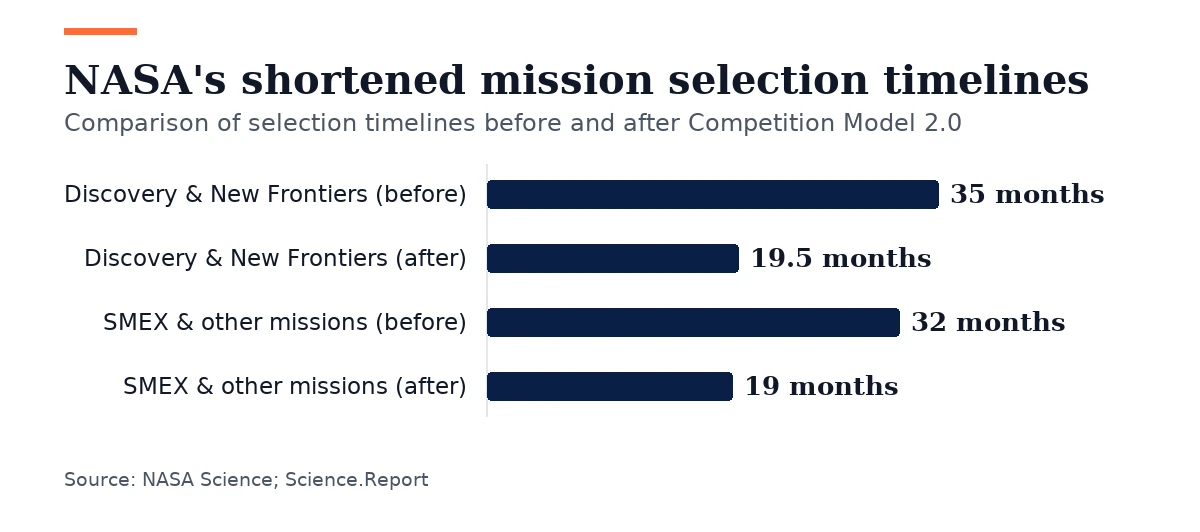
MIDEX and Earth Explorer will move to a comparable two-step model open to a wider set of implementing organizations, including universities and industry partners. They will be judged on how well they have done on past projects of similar size and cost before selection, with a goal of cutting the selection timeline by as much as 45 percent.
Flagship missions will keep their current management process under Competition Model 2.0. Following the James Webb Space Telescope, NASA’s Large Mission Study turned lessons from Webb into a written method for constructing large missions efficiently. Going forward, NASA will direct each flagship mission to a lead NASA Center and then compete science teams and instruments through focused solicitations, and NASA says the flagship process was already overhauled after Webb, so Competition Model 2.0 leaves the largest missions as they are.
NASA expects teams to rely on industry best practices and new commercial abilities such as commercial buses, subsystems, and multi-mission operations whenever they offer a technical or cost advantage. NASA also keeps reviewing the commercial marketplace using its Science as a Service Request for Information.
Cost and schedule control stays mandatory for every mission class, with Phase A estimates guiding decisions about complexity and scope and threshold breaches leading to consequences as severe as ending the mission. NASA describes this discipline as the way to keep the mission pipeline moving for everyone proposing missions.
NASA plans to assign work appropriately across Goddard and JPL to reduce taxpayer costs, stop unnecessary competition between centers, encourage collaboration, and keep essential agency capabilities. NASA says this cuts out needless rivalry among centers and helps maintain vital agency expertise.
NASA will roll the changes out slowly, with careful implementation and adjustments shaped by community feedback. NASA says it will need time to put certain changes in place, but streamlining proposal review and selection can produce meaningful change right away.
NASA’s Science Mission Directorate plans to put out Research Opportunities in Space and Earth Sciences 2027 by January 2027 at the latest, covering about 50 program areas in astrophysics, biological and physical sciences, Earth science, heliophysics, and lunar and planetary research. Science.Report says ROSES-27 is not part of Competition Model 2.0, but is part of the agency’s science opportunity planning discussed around the time of the town hall announcement.
Once a decade, the National Academies of Sciences, Engineering, and Medicine gathers expert input and reaches consensus on decadal surveys that set strategic priorities and recommendations for the coming ten years across Science Mission Directorate divisions such as Astrophysics, Biological and Physical Sciences, Earth Science, Heliophysics, and Planetary Science. Congress, the National Academies, and NASA value decadal surveys, but an inspector general’s report found that the review process and NASA’s limited role restrict communication, involvement, and feedback channels.
The National Academies often spends two years finishing a survey, yet it gives NASA fewer than ten days to look over the long prepublication reports. Division officials have raised unresolved concerns about the National Academies’ rigid processes and timelines, which the inspector general said limit chances for more customized and useful surveys.
The most recent Biological and Physical Sciences decadal survey called for two research campaigns costing $100 million to $400 million each year for ten years, which is more than the division’s fiscal year 2023 budget of $85 million. Officials also pointed to unrealistic budget expectations and recommendations that cannot be acted on as problems with the survey process.
One Science Mission Directorate division got four recommendations in its 2010s survey but 26 recommendations for its 2020s survey. Those newer recommendations were more complicated and difficult to carry out with today’s staff and budget.
Apart from the National Academies’ five-year midterm assessments, NASA does not track how Science Mission Directorate divisions carry out decadal survey recommendations. It also does not fully count the costs of running the survey process, such as mission concept studies and the staff time spent on decadal survey work.
The Science Mission Directorate does not have formal guidance or routine lessons learned. It also does not have enough resources to make common procedures uniform and to share effective methods across the directorate.



Join the discussion