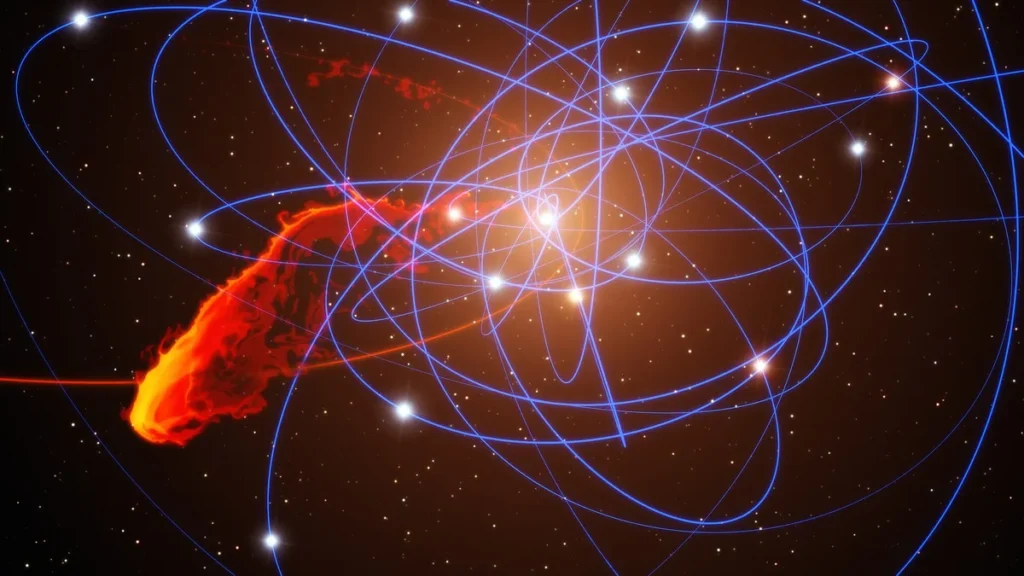
Researchers using the James Webb Space Telescope have observed gas orbiting Sagittarius A*, the supermassive black hole at the Milky Way’s center, enriched with metals, according to a study published in The Astronomical Journal in Oct. 2026. The study, led by McGill University Ph.D. student Nicole Ford at the university’s Trottier Space Institute, used the telescope’s mid-infrared spectrograph to measure the metal composition of gas clouds near the black hole.
The telescope’s high spectral and spatial resolution allowed researchers to distinguish the heat signatures of gas clouds, enabling precise measurements of their metal content. In astronomy, metals are elements heavier than hydrogen and helium, including carbon, oxygen, iron, and gold, which stellar processes such as supernovae produce.
Around Prague reports that the gas surrounding the black hole has a heavy-element concentration 1.8 times that of the Sun. This metal-rich composition is that of the stars orbiting the black hole, suggesting they may have formed together from the same material. The finding allows astronomers to examine the composition and temperature of the gas near the black hole, which is closer to Earth than any other supermassive black hole.
Researchers say the metal enrichment probably came from generations of exploding stars or past supernova explosions that released material into the black hole’s surroundings over time. The similarity in composition between the gas and the nearby stars supports the idea that they share a common origin, likely influenced by past stellar activity and supernovae.
Nicole Ford, a Ph.D. student at McGill University, notes that the central black hole consumes far less material than other supermassive black holes and does so more slowly, “eating a lot less material than other supermassive black holes, and more slowly.” Overlapping with Sagittarius A* in the sky, the supernova remnant Sgr A East has served as a major energy source, keeping the surrounding gas hot and turbulent. This turbulence may explain why the black hole consumes material at a slower rate, as the heated gas resists cooling and compressing enough to be drawn in.
In a companion study also published in The Astrophysical Journal in Oct. 2026, McGill University astronomer Mayura Balakrishnan found that local conditions strongly shape gas emissions near Sagittarius A*, making it difficult to isolate the black hole’s direct influence. The study isolated the supernova remnant Sgr A East from the black hole’s activity, concluding that past energy bursts from the remnant have kept the surrounding gas hot and turbulent. This makes it difficult to use gas emissions as a record of the black hole’s historical activity, as the remnant’s influence dominates the local environment.
To understand how Sagittarius A* attracts material, Nicole Ford notes that astronomers must compare the telescope’s observations with simulations of how gas evolves over longer timescales, as current observations provide only a snapshot. Because Sagittarius A* is closer to Earth than any other supermassive black hole, it offers a unique opportunity to study the fuel supply of a galactic center in detail. This proximity may help explain why the black hole is less active than others, offering broader insights into how metals spread around supermassive black holes in more distant galaxies.


Join the discussion