Key facts
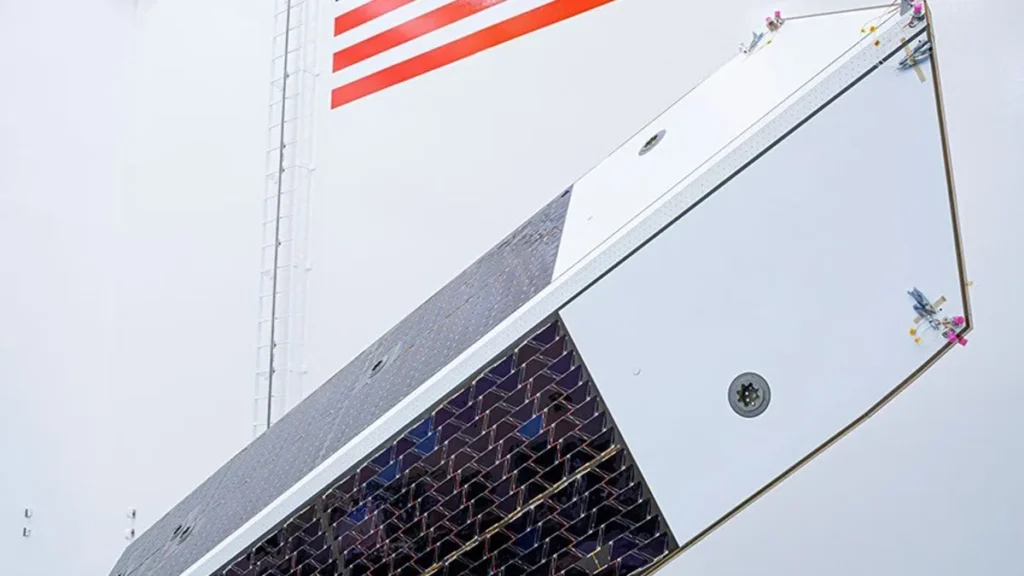
- The sunshade is 20 feet (6 meters) tall, its base is 8 feet (2.4 meters) wide, and its two flat panels meet at a 23.5-degree angle.
- In space, NEO Surveyor will detect hard-to-find asteroids and comets, including some in the Sun's direction, a region that ground-based optical telescopes find harder to search.
- The sunshade design blocks sunlight glare from entering the telescope's 20-inch (50-centimeter) aperture as it searches for infrared emissions from surfaces of asteroids and comets heated by sunlight.
- By tracking where objects are and how they move, mission data will help NASA gauge how many potentially hazardous near-Earth objects exist and what they are like.
NASA says teams recently completed integrating solar arrays onto the NEO Surveyor spacecraft’s sunshade, its largest component, at the Boulder, Colorado site of BAE Systems Space & Mission Systems. The sunshade blocks solar glare to keep the infrared telescope cool while the spacecraft searches for near-Earth asteroids and comets and supplies spacecraft power. NASA says the milestone brings the sunshade closer to its launch appearance as mission development continues. Sources: NASA Science
The sunshade stands 20 feet (6 meters) tall, its base is 8 feet (2.4 meters) wide, and its two flat panels meet at a 23.5-degree angle. NASA provides these dimensions for the structure that supports the solar cells and shade function. Workers covered the panels with 864 interconnected solar cells earlier this year, and NASA says the specialized array can supply up to 2 kilowatts of power. It will provide all electricity needed to charge the spacecraft’s onboard batteries and meet the spacecraft’s full electricity demand through battery charging.
Sources: NASA Science
In space, NEO Surveyor will detect hard-to-find asteroids and comets, including some in the Sun’s direction. NASA explains that this solar-direction region is difficult for ground-based optical observatories, making the space-based infrared mission valuable. The telescope operates in infrared, a form of light that senses heat rather than visible brightness. This wavelength range reveals heat given off by objects warmed by the Sun.
Sources: NASA Science
The sunshade design blocks sunlight glare from entering the telescope’s 20-inch (50-centimeter) aperture, its light-gathering opening, as it searches for infrared emissions from asteroid and comet surfaces heated by sunlight. Blocking glare is essential because the telescope relies on infrared emissions rather than visible light to find objects. Sources: NASA Science
By tracking where objects are and how they move, mission data will help NASA gauge how many potentially hazardous near-Earth objects exist and what they are like. NASA says determining location and motion through space supports better understanding of potentially hazardous near-Earth object populations. Sources: NASA Science
The telescope carries two infrared detector arrays tuned to two infrared bands, and each array creates a 16-megapixel sky mosaic. Imaging the same sky area in both bands lets the science team determine temperature and estimate object size. Comparing images in both bands enables the team to estimate an object’s temperature and size, crucial information for assessing near-Earth objects. NASA states that size estimates derived from temperature are important for near-Earth object assessment.
Sources: NASA Science
Applied Aerospace of Stockton, California built the sunshade structure. SolAero Technologies of Albuquerque, New Mexico installed its solar cells in January. NASA identifies the contractors and locations involved in building and outfitting the sunshade hardware. Sources: NASA Science
Tests on the sunshade and solar array ended in March at a commercial thermal vacuum facility in El Segundo, California. A thermal vacuum facility simulates space conditions by removing air and controlling temperature. The testing occurred before the hardware moved to its next integration site. Sources: NASA Science
The hardware arrived at BAE Systems in Boulder, Colorado before the planned date in May, so delivery came earlier than planned. After the May delivery, workers integrated coarse Sun sensors for attitude determination and temperature sensors onto the sunshade and finished functional and performance checks on the solar array. Coarse Sun sensors help determine the spacecraft’s orientation. Temperature sensors monitor the hardware’s heat levels.
NASA says these integration and testing steps occurred after delivery to BAE Systems. Sources: NASA Science


Join the discussion