This is a new development in a story we reported earlier: Portal Space Systems' Starburst-1 reached orbit Tuesday after Bothell plant opened.
Key facts
- Portal Space Systems' Starburst-1 reached orbit on October 20, 2026, aboard SpaceX's Falcon 9 Bandwagon-5 rideshare mission.
- The Almighty Magnet is Zenno's largest Supertorquer to date and launched on October 20, 2026.
- Faraday Factory and Zenno have partnered since 2024.
- Portal introduced Starburst to the world in November 2025 and reached orbit with Starburst-1 less than one year later.
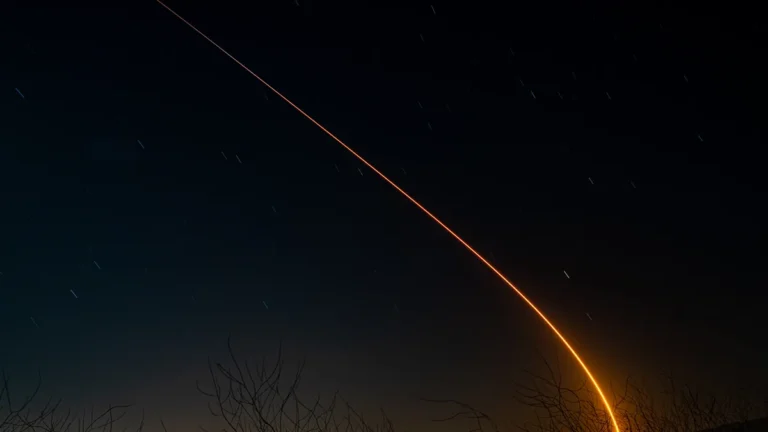
Portal Space Systems’ Starburst-1 reached orbit October 20, 2026, aboard a SpaceX Falcon 9 on the Bandwagon-5 rideshare mission from Cape Canaveral, carrying Zenno Astronautics’ Almighty Magnet superconducting magnetic actuator.
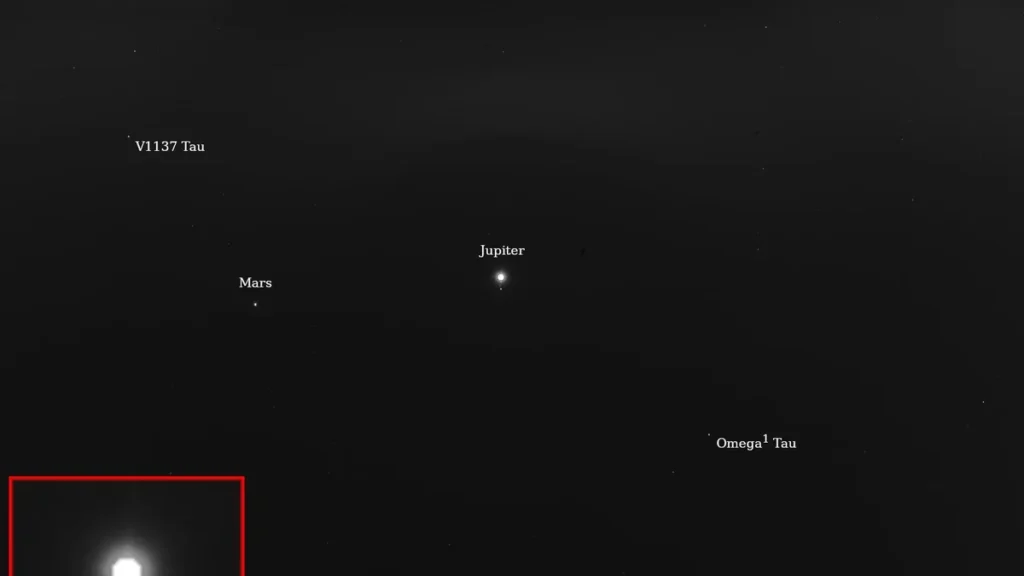
In the first hours after deployment, Portal established contact with Starburst-1, stabilized the craft, and unfolded its solar array. CEO Jeff Thornburg later posted on LinkedIn that the craft was in orbit, communicating with the ground, stable, and power positive with its solar array deployed, calling the first 24 hours remarkable for the team. “Starburst-1 is in orbit, communicating with the ground, stable, and power positive with its solar array deployed,” he posted.
The Almighty Magnet is the largest Supertorquer Zenno has built so far, and Zenno and Faraday Factory call it the strongest magnetic actuator ever launched into orbit. It launched aboard Starburst-1 on October 20, 2026, and Faraday Factory Japan issued a statement celebrating the successful launch on October 21, 2026.
A Supertorquer is a superconducting magnetic attitude-control system that orients a spacecraft using Earth’s magnetic field, conserving onboard propellant for maneuvering. Zenno developed and engineered the system, while Faraday Factory provided custom high temperature superconducting tape made for the actuator. The magnets produce exceptionally strong fields while using little energy, according to Faraday Factory.
Thornburg said the magnet could let the craft point itself differently than normal propulsion, shield sensitive electronics from radiation, and perhaps push or pull objects in orbit, which he compared to Star Trek shields or a tractor beam. Max Arshavsky, founder and CEO of Zenno, said the technology could enable mass drivers, magnetic radiation shields, and advanced satellite mobility. Sergey Lee, founder and CEO of Faraday Factory Japan, called the launch an important milestone and said it demonstrates the potential of high temperature superconductors for demanding applications.
Thornburg said the main goal is to validate the spacecraft’s engineering design for a year or longer, with the camera and magnet as secondary objectives. An onboard TRL11 Fovea M1 camera provides live video of the spacecraft and its surroundings, including confirmation that the solar array deployed. The craft also flies Atomic-6’s Space Armor tiles, made to guard against fast-moving orbital debris without adding new debris from the shield itself.
Engineers will test whether the magnetic field produced by the magnet can shield onboard electronics from radiation. Thornburg said everything after a year becomes residual capability, and Portal may later practice rendezvous proximity operations and refueling with other Portal spacecraft.
Portal unveiled Starburst in November 2025 and reached orbit with Starburst-1 less than a year afterward. Starburst has a five-year design life and carries a year of mission objectives, operating within one orbit once in space.
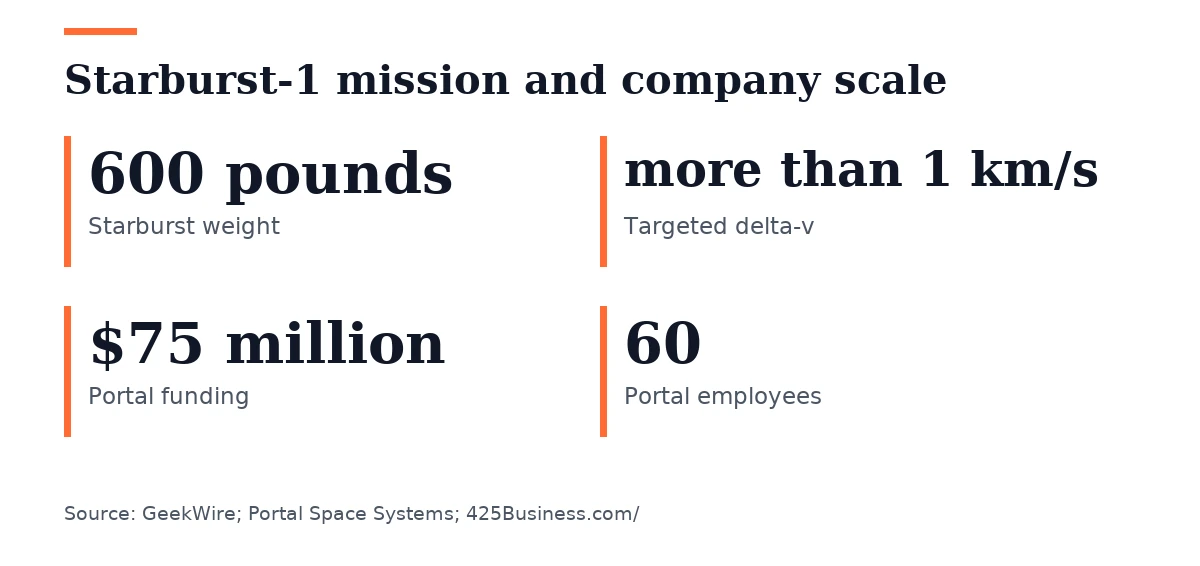
Portal came out of stealth in 2024 and has raised $75 million with SBIR and STRATFI backing. Portal now works out of a 65,000-square-foot Bothell manufacturing site it moved into in 2026 after leaving a 6,000-square-foot facility, and it plans to build about 30 spacecraft a year there. As of September 1, 2026, Portal had 60 employees and was working toward a planned 100-person staff. Portal paid for Starburst-1 itself to speed up flight experience and show what its team can deliver.
Governor’s Space Council appointed Thornburg, and Space Northwest gave Portal its Rising Star award. Space Northwest, a nonprofit industry association among space-sector companies in Washington and on the Eastside, also gave Portal the Emerging Space Company of the Year title. Preliminary research commissioned by Space Northwest puts Washington’s space sector at about 12,340 direct jobs, $8.1 billion in economic output, and $2.3 billion in labor income. Portal says Starburst’s rapid maneuverability lets defense and commercial operators move where and when they choose.
Portal’s Mini-Nova flew March 30 on a Momentus Vigoride vehicle to test critical spacecraft systems in orbit. Starburst and Supernova use the same core systems and manufacturing methods, with Supernova the larger of the two at 1,100 pounds compared with Starburst’s 600 pounds.
Starburst-1 is meant to give future Starburst spacecraft flight experience and help Supernova development before its planned 2028 debut. Portal announced in August 2026 that it had bought a dedicated Falcon 9 flight called Motus Via Sol, set for 2028, to carry several Starburst spacecraft and the first Supernova. Starburst uses heated ammonia in an electrothermal thruster, while Supernova uses FLARE solar thermal propulsion that heats ammonia in a heat exchanger and retains heat for up to an hour with a thermal battery.
Zenno, a New Zealand startup, is moving its headquarters to Los Angeles. Zenno believes stable, scalable space infrastructure will depend on resources already in space.
Faraday Factory operates the world’s largest high temperature superconductor tape plant and has shipped more than 10,000 kilometers of tape to hundreds of customers in recent years. It has partnered with Zenno since 2024. Faraday Factory says superconducting space technologies are a major opportunity to change how spacecraft operate and interact in orbit. Faraday Factory says demand for its HTS tape comes from fusion energy, power grid, aerospace, railway, healthcare, and other high-tech markets.

Join the discussion