Key facts
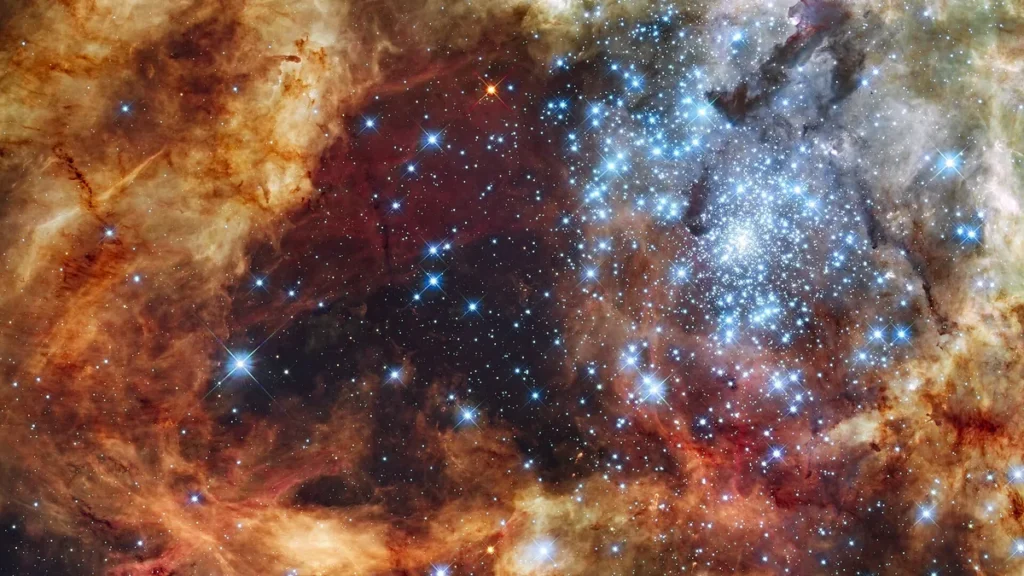
- Dark red filaments of cool molecular hydrogen cross the image center and form the nebula's densest part, shielding newborn stars from harsh radiation and stellar winds before the structures melt away.
- N159 is less than 3 million years old, ranks among the youngest star-forming regions in the Large Magellanic Cloud, and contains thousands of stars in their earliest formation stages.
- The brightly glowing Papillon Nebula on the image's left side is an exceptionally compact blob of ionized hydrogen thought to connect to massive star formation, and Hubble first resolved it in 1999.
- H II regions mark active star formation, and their ionized gas radiates light, making them appear as brilliant emission nebulae.
The James Webb Space Telescope’s October Picture of the Month shows star-forming region LHA 120-N 159, also called N159, located 161,000 light-years away in the Large Magellanic Cloud, and the frame covers roughly 230 light-years across, Phys.org reported Oct. 22, 2026.
Astronomers classify N159 as an H II region because it contains ionized hydrogen gas. In such stellar nurseries gravity makes cold molecular clouds collapse to form new stars, many of which are massive and hot enough to ionize their surroundings with ultraviolet light. H II regions mark active star formation, and their ionized gas radiates light, making them appear as brilliant emission nebulae.
Fierce stellar winds from the young massive stars sculpt dense ridges and carve open cavities in the gas. Webb’s Near-Infrared Camera captures these wind-sculpted features in fine detail.
Thick orange clouds billow across the image center and glow because of polycyclic aromatic hydrocarbons, important carbon-based molecules. Pale blue pools are H II gas ionized by intense ultraviolet light from massive stars.
Dark red filaments of cool molecular hydrogen cross the image center and form the nebula’s densest part. These filaments shield newborn stars from harsh radiation and stellar winds before the structures melt away. The Webb image shows stars as points of light embedded in the dark red filaments and in small pillars of orange gas reaching into the blue bubbles.
N159 is less than 3 million years old, ranks among the youngest star-forming regions in the Large Magellanic Cloud, and contains thousands of stars in their earliest formation stages. Astronomers have closely examined the stellar populations in N159 since the advent of space telescopes. The western region of N159 contains more young stellar objects in a more concentrated area, indicating an earlier stage of molecular cloud collapse.
Because the full star-formation sequence occurs at once there, N159 offers a close-up view of collapsing cloud evolution. The brightly glowing Papillon Nebula on the image’s left side is an exceptionally compact blob of ionized hydrogen thought to connect to massive star formation. Hubble first resolved it in 1999.
Hubble previously imaged sections of the sweeping gas clouds in a pair of 2025 pictures covering the east and west sides of the cloud.
The new Webb image uses data from observing program #5114, which aims to study and compare stars across evolutionary stages in the giant nebula. The findings appear in an arXiv paper by Nolan Habel et al., DOI 10.48550/arxiv.2609.27126. The arXiv paper describing the Webb data is titled Sequential Star-Formation and the Near-Infrared Stellar Populations within N159 by Nolan Habel et al.
Astronomers using the Webb data detected extremely dim stars less than one-tenth as massive as the sun. They separated larger, hotter, fully evolved stars from young stellar objects still wrapped in their natal thick clouds.
The Large Magellanic Cloud contains other H II regions such as N79 and the Tarantula Nebula. Its metallicity, the proportion of elements heavier than hydrogen and helium, is significantly lower than the Milky Way’s, offering early-universe-like conditions for studying star formation. The Large Magellanic Cloud is one of the satellite galaxies orbiting the Milky Way galaxy.


Join the discussion