Key facts
- The team assembled 244 galaxies with [OIII] 4363 detections and derived direct Te-based abundances.
- Direct measurements reveal S/O and Ar/O decreasing with increasing metallicity.
- The study required signal-to-noise above 5 in Hα and Hβ, above 3 on C III], [O II], [Ne III], [O III] 5007, [N II], [S II], and [Ar III], and above 3 on [O III] 4363 for the Te method.
- Earlier high-redshift studies of neon, sulphur, and argon abundances were based on samples of only about a dozen galaxies, leaving the evolution of these ratios poorly constrained.
On Oct. 20, 2026, a team led by Elisa Cataldi used the James Webb Space Telescope’s NIRSpec instrument to measure carbon, nitrogen, neon, sulfur, and argon abundances in star-forming galaxies spanning redshift z=1 to z=7. The observations combine deep spectroscopy from the MARTA survey, using NIRSpec’s medium-resolution gratings G140M and G235M. The team has submitted the results to Astronomy & Astrophysics and posted them on arXiv as 2610.28717.
The researchers assembled a sample of 244 galaxies with detections of the temperature-sensitive auroral line [O III] 4363, enabling direct, temperature-based (Te) abundance determinations. To extend the analysis beyond this “direct-method” parent sample, the team built empirical strong-line calibrations for the nitrogen-to-oxygen (N/O), neon-to-oxygen (Ne/O), sulfur-to-oxygen (S/O), and argon-to-oxygen (Ar/O) ratios. Because the faint auroral line requires deep integrations, only a subset of distant galaxies have the necessary signal for a direct measurement; strong-line methods provide a way to estimate abundances for larger samples. These calibrations allowed them to include an additional 514 galaxies that lack a measurable [O III] 4363 line.
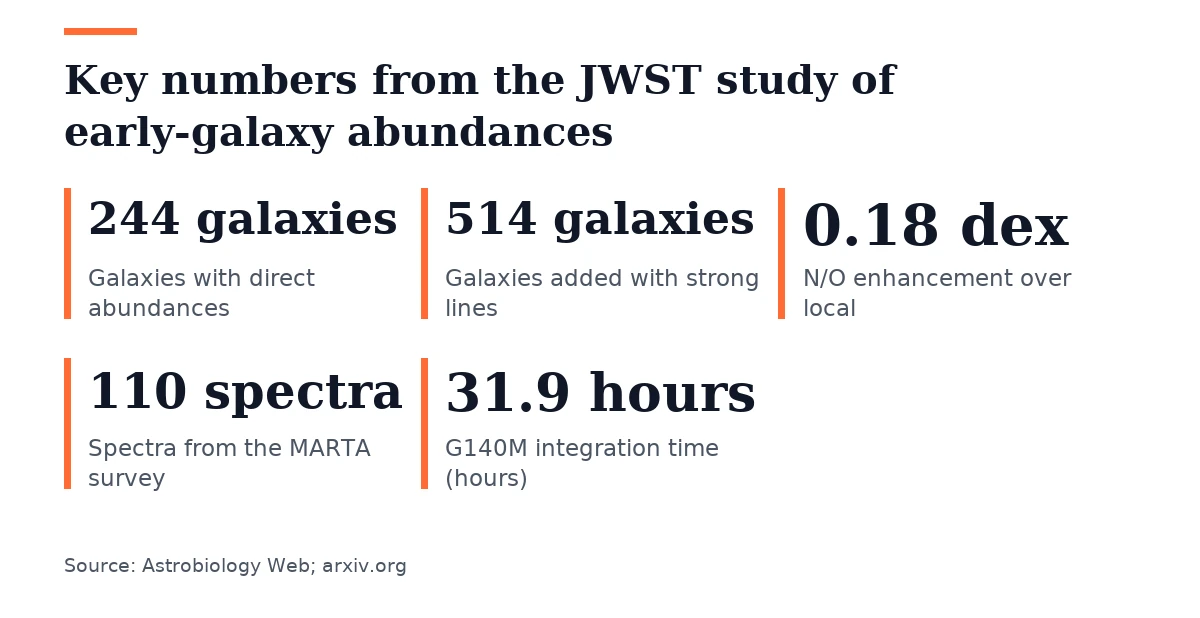
The team found N/O to be elevated by approximately 0.18 dex, with the enhancement growing stronger at low metallicity. Nitrogen is produced by both a primary channel that operates independently of initial metallicity and a secondary channel that depends on pre-existing carbon and oxygen, making the N/O ratio a sensitive tracer of chemical enrichment timescales. The primary nitrogen channel operates on timescales of tens of millions of years, while the secondary channel, which depends on pre-existing carbon and oxygen, takes hundreds of millions to several billion years to contribute.
Direct measurements reveal that sulphur-to-oxygen and argon-to-oxygen ratios decrease with increasing metallicity. Sulphur and argon are alpha-elements, but unlike oxygen, they also receive contributions from Type Ia supernovae, which can produce metallicity-dependent trends. However, when the team applied their strong-line calibrations to the larger sample, the S/O and Ar/O trends flattened at higher metallicities, especially for S/O, illustrating how the choice of abundance method can shape the apparent pattern. The difference between direct and strong-line results at high metallicity shows how observational methods can shape the apparent abundance patterns.
In the O/Ar versus Ar/H plane, lower-mass galaxies exhibit lower O/Ar at fixed argon abundance, a trend consistent with differences in star-formation efficiency and the delayed enrichment from Type Ia supernovae. Because core-collapse supernovae produce almost all oxygen on short timescales while argon also comes from the later Type Ia population, the O/Ar ratio behaves like an alpha-to-iron diagnostic, encoding the star-formation timescale of the host galaxy. This trend resembles the alpha-to-iron relation in galactic archaeology, where the ratio of alpha-elements to iron traces the star-formation history of a stellar system.
Neon-to-oxygen, by contrast, remains approximately constant up to a metallicity of 12+log(O/H) = 8.2, with only a mild increase at higher abundances and no significant redshift evolution. Neon is an alpha-element synthesized alongside oxygen in massive stars, so its ratio to oxygen is expected to stay steady unless other enrichment channels become important. Both neon and oxygen are produced on timescales up to a few tens of millions of years, primarily through alpha-capture processes in massive stars.
The carbon-to-oxygen ratio tentatively increases with metallicity and broadly follows the relation observed in local galaxies. The triple-alpha process during helium burning produces carbon, and low- and intermediate-mass stars release it over long delay times as well as massive stars through core-collapse supernovae and Wolf-Rayet winds on a few-million-year timescale. The carbon yield peaks for stellar masses around 2 to 4 solar masses and declines at higher masses because hot-bottom burning converts carbon into nitrogen.
The authors caution that observational selection can distort these abundance trends. A forward model of the selection effects shows that the cuts mainly restrict the accessible metallicity range for Ne/O and Ar/O, preferentially select galaxies with enhanced N/O at low metallicity, and have a weaker effect for S/O. These biases must be accounted for when interpreting abundance-metallicity relations.
The heart of the study is the MARTA survey (Measuring Abundances at high Redshift with the Te Approach), a deep JWST/NIRSpec multi-object spectroscopy campaign led by Curti. Designed to target star-forming galaxies at Cosmic Noon around redshift z=2–3, the survey used the G140M grating for 31.9 hours and the G235M grating for 7.4 hours, obtaining roughly 110 spectra. To ensure robust measurements, the team required signal-to-noise ratios above 5 in the hydrogen Balmer lines Hα and Hβ, and above 3 in a suite of emission lines including C III], [O II], [Ne III], [O III] 5007, [N II], [S II], and [Ar III], with a signal-to-noise above 3 on the faint [O III] 4363 auroral line for the direct method. Its goal is to detect the temperature-sensitive [O III] 4363 auroral line for direct metallicity determinations.
The abundance patterns reflect the different nucleosynthetic origins of the elements. Neon, sulfur, and argon are alpha-elements; alpha-capture in massive stars produces them on timescales up to a few tens of millions of years. If only core-collapse supernovae contributed, their ratios to oxygen would remain constant with metallicity; the observed trends indicate a non-negligible input from Type Ia supernovae, which release sulfur and argon on much longer timescales. Nitrogen’s primary and secondary production channels operate on similarly diverse timescales, which makes the N/O ratio a particularly sensitive clock of when a galaxy’s star formation was most active.
Carbon, by contrast, is built by the triple-alpha process and delivered by stars spanning a wide range of masses and delay times, from low- and intermediate-mass stars to massive stars on a few-million-year timescale. Type Ia supernovae contribute non-negligibly to sulphur and argon.
Earlier high-redshift studies of neon, sulfur, and argon abundances used samples of only about a dozen galaxies, leaving the evolution of these ratios poorly constrained. The new work, with its much larger sample, provides the first robust look at how these alpha-element ratios change with cosmic time. In local studies of low-redshift galaxies and H II regions spanning metallicities from 12+log(O/H) = 7 to 9, neon-to-oxygen, sulfur-to-oxygen, and argon-to-oxygen are broadly constant with metallicity, while carbon-to-oxygen rises with oxygen abundance. The high-redshift results generally echo these local trends, but with notable departures such as the enhanced N/O and the metallicity-dependent behavior of S/O and Ar/O. The new study’s sample is more than an order of magnitude larger than previous high-redshift work, allowing the authors to identify trends that were previously only hinted at.
The new study’s sample is more than an order of magnitude larger than previous high-redshift work, allowing the authors to identify trends that were previously only hinted at.
Together, the measurements map out how galaxies built up heavy elements during the epoch of peak star formation. The constant Ne/O suggests that massive stars produce neon and oxygen together, while the declining S/O and Ar/O point to a delayed contribution from Type Ia supernovae. The O/Ar ratio emerges as a particularly useful diagnostic of star-formation timescales, and the enhanced N/O at low metallicity indicates that nitrogen enrichment ran ahead of what nearby galaxies show. By anchoring these observations in a large, well-characterized sample, the study sets a new baseline for understanding chemical evolution in the early universe.




Join the discussion