Key facts
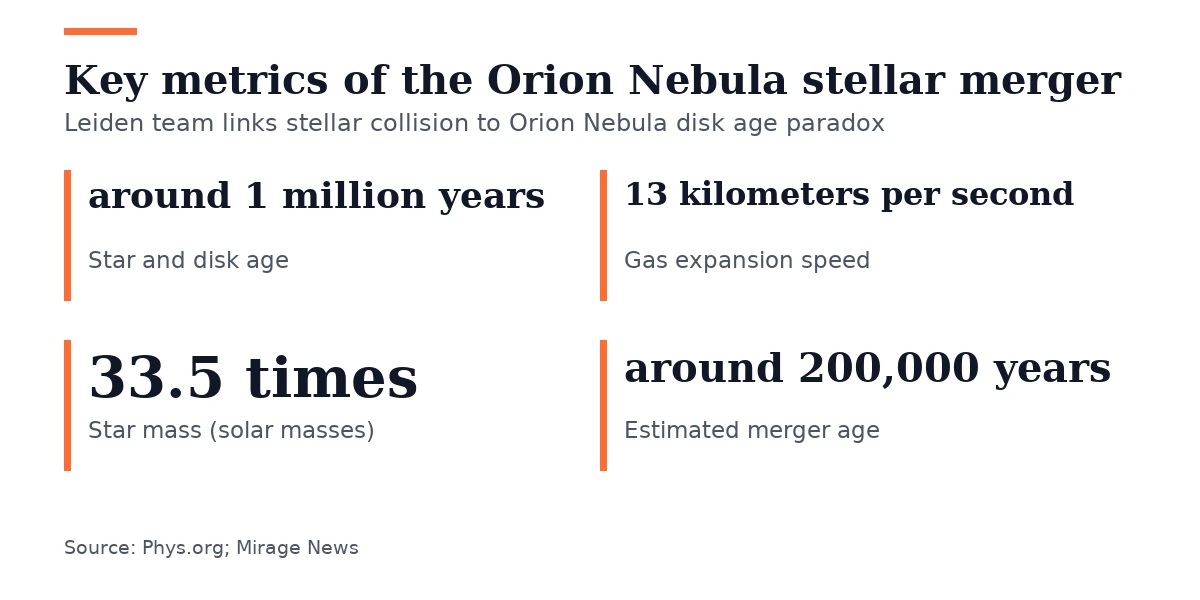
- Because the disks lose mass so quickly, they should already be gone given that the stars are around 1 million years old.
- 1 Ori C1 sets the surrounding gas in motion, expanding a large gas shell around the star at around 13 kilometers per second, or 8 miles per second.
- The merger alone is estimated to supply 30 times more driving force, yet a factor of 100 is required to explain the gas shell's observed expansion.
- Maite Wilhelm and her colleagues used computer simulations to test whether the merger scenario explains the observations.
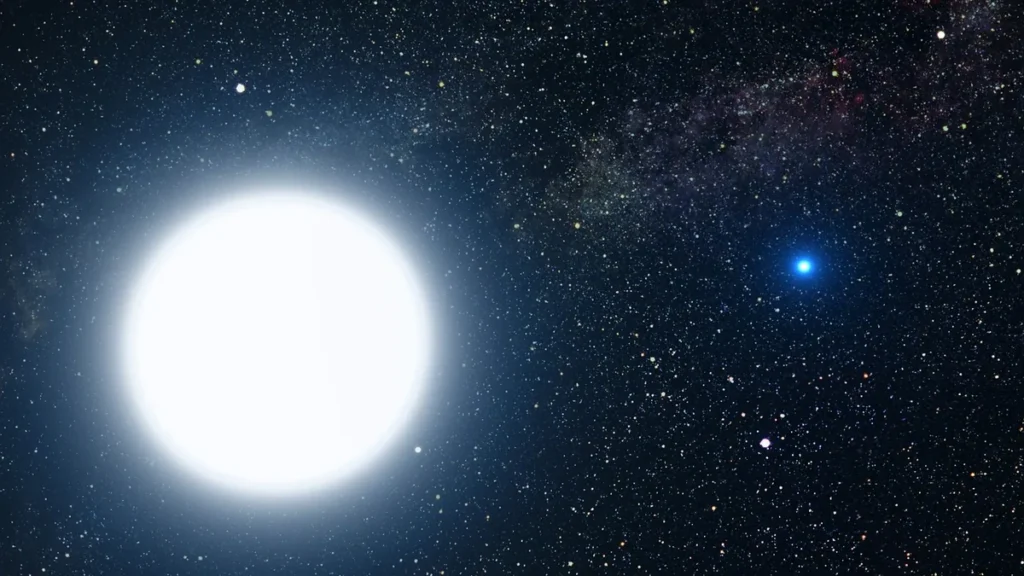
Research reported Oct. 23, 2026 by Leiden University astronomer Maite Wilhelm and international colleagues proposes that a collision between two stars formed the bright star at the center of the Orion Nebula and explains why surrounding planet-forming disks look far younger than the stars they orbit. The star, known as 1 Ori C1 or Theta-1 Orionis C1, is roughly 33.5 times as massive as the sun. The researchers frame this merger as the event that could reset the apparent ages of both the disks and the surrounding gas shell.
The naked-eye Orion Nebula is a star-forming region where gas-and-dust disks surround some young stars, and planets assemble in those disks. Radiation from the massive central star strips material from those disks, producing tadpole-like shapes through steady mass loss. That continuous stripping causes fast mass loss and helps explain why the disks appear much younger than the stars around them. Because the stars are around 1 million years old, the disks should already have disappeared given how quickly they erode.
That gap between rapid disk destruction and stellar age forms one side of the Orion Nebula age paradox.
The second side of the puzzle involves the gas shell around the central star. The star drives motion in the surrounding gas, expanding a large shell at around 13 kilometers per second, or 8 miles per second. Using that expansion speed, researchers can estimate when the shell formed, and working backward from the speed indicates the shell formed only a few hundred thousand years ago. Given that the stars are roughly 1 million years old, both the shell and the dust disks look far younger than the star they surround.
The stars are much older than both the gas shell and the dust disks appear to be, a gap the sources describe as the age paradox of the Orion Nebula.
Wilhelm and her colleagues say a third star disrupted a binary system — two stars bound by mutual gravity as they move around a shared center — shoving one star out of its stable orbit until the two stars collided. Should the merger have occurred a few hundred thousand years ago, the combined star’s brightness would have increased sharply from that moment forward. The team ran computer models to test the merger scenario against the observations, checking whether a sharp post-merger rise in radiation fits the fast disk mass loss seen in the nebula. The models back the idea: before the collision the pair gave off less radiation, allowing dust disks to endure most of their lives, and only after the merger did radiation spike and set off rapid disk evaporation.

The models connect the merger’s timing to the disks’ apparent youth. On its own, the merger provides an estimated 30 times more driving force, but explaining the shell’s observed expansion calls for a factor of 100. Since the merger falls short by that margin, the team seeks another contributor. They suspect that cool gas from evaporating dust disks contributes as well, blending with hot gas within the expanding bubble to add the missing force, a proposed mixture intended to close the gap between the merger’s driving force and the force required for the observed expansion.
The model might also account for two additional traits of 1 Ori C1: a tilted magnetic field and a slight nitrogen excess in the star. Those extra signatures provide the merger model with more observational targets beyond the disks and the gas shell, offering further ways to test the idea. Wilhelm said subtle effects in triple-star systems can strongly affect star-forming environments and potentially shape planets still taking shape.
Co-author Simon Portegies Zwart described it as the first time researchers have seen the consequences of a major stellar collision in our own cosmic neighborhood. Portegies Zwart put it this way: “stellar collisions may be much more common than we previously thought, and that they can have far-reaching consequences.”
The paper’s title is ‘A triple-induced merger in θ1 solves the proplyd lifetime problem and the curiously young shell of M42’. Phys.org provides the complete publication information, covering the article title, journal and DOI. Mirage News reports that the press release appeared originally on astronomie.nl, and Mirage News credits its header image, Tadpoles in the Orion Nebula, to ESA/Hubble.



Join the discussion