
Key facts
- The evening terminator of WASP-121 b absorbs more infrared light than the morning terminator.
- Powerful winds carry heat from the permanent dayside to the nightside, heating the evening terminator more strongly.
- As the evening atmosphere warms, it expands, presenting a larger cross-section to stellar light and increasing absorption.
- NIRSpec data show a stronger carbon monoxide signal toward the end of transit.
Researchers using the James Webb Space Telescope’s NIRSpec instrument (the Near Infrared Spectrograph) reported that the evening terminator of the ultra-hot exoplanet WASP-121 b absorbs more infrared light than the morning terminator.
WASP-121 b is tidally locked, meaning one hemisphere constantly faces its star while the other side stays in perpetual night. This permanent dayside‑nightside split creates distinct morning (dawn) and evening (dusk) terminators that researchers can study separately.
The dayside averages about 2770 kelvin (≈2500 °C) while the nightside averages near 1000 kelvin (≈725 °C). This strong temperature contrast drives the atmospheric asymmetry observed at the two terminators.
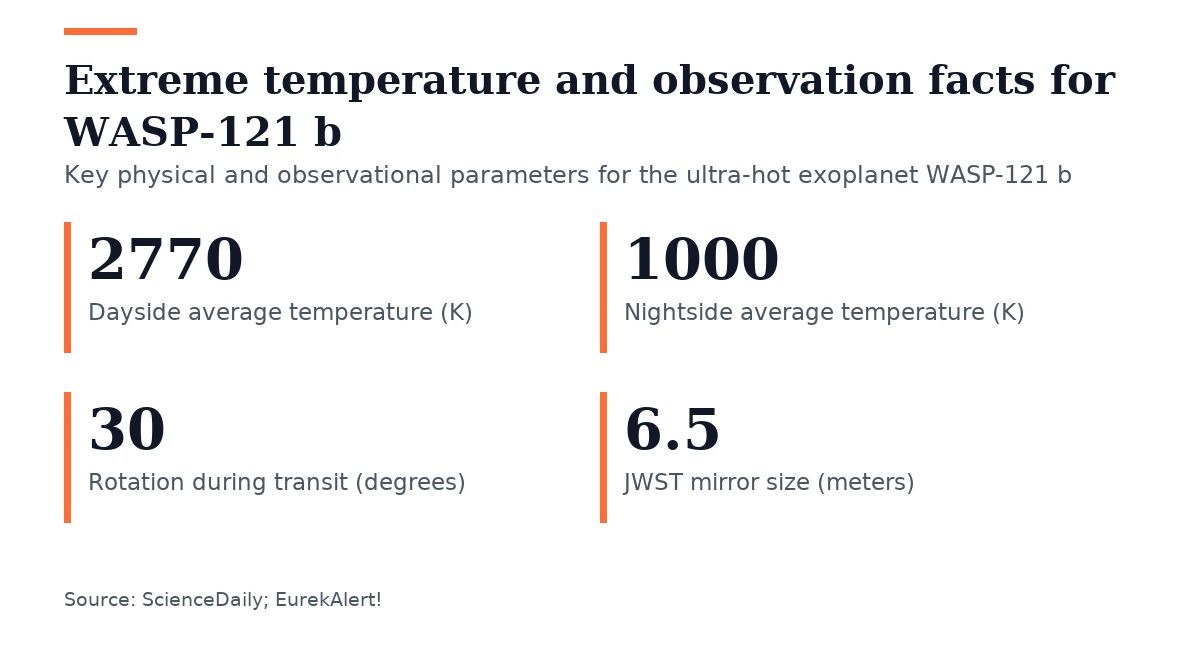
During each transit the planet rotates roughly 30 degrees, providing enough longitudinal resolution to separate the signals from the morning and evening limbs. This rotation lets JWST probe the atmosphere longitude by longitude.
Powerful winds transport heat from the permanent dayside toward the nightside, raising the temperature of the evening terminator. As the evening atmosphere warms it expands, presenting a larger cross‑section to stellar light and increasing its infrared absorption.
The NIRSpec instrument covers wavelengths from 0.5 to 5.0 micrometers, delivering the spectral resolution needed to identify molecules such as carbon monoxide and water vapor. The JWST (the James Webb Space Telescope) 6.5‑meter mirror gathers enough photons during the short transit windows to yield statistically decisive detections.
NIRSpec data show a stronger carbon monoxide signal toward the end of transit, which researchers attribute to temperature‑dependent changes in the molecule’s spectral strength rather than an actual rise in CO amount. In the hotter evening regions water vapor is markedly depleted, interpreted as genuine dissociation of H2O into hydrogen and oxygen atoms by extreme temperatures.
Climate‑model simulations that include heat transport from the dayside to the nightside reproduce the day‑night temperature asymmetry. But these models systematically underestimate the observed infrared excess.
The discrepancy suggests that processes, such as mineral‑rich clouds, may be influencing the atmosphere. Previous work indicates that in ultra‑hot worlds cloud particles could condense from silicates rather than water droplets.
Such silicate clouds would block infrared radiation from deeper, hotter layers. When we adjust models to approximate the shielding effect of silicate clouds, the simulated signal aligns more closely with the JWST observations.
Confirming whether silicate clouds truly exist in WASP-121 b’s atmosphere will require more sophisticated treatments of cloud physics. These models must capture particle nucleation, growth, and sedimentation under the extreme pressures and temperatures characteristic of ultra‑hot exoplanets.
JWST’s high sensitivity allowed the detection of these atmospheric differences as WASP‑121 b rotates. As WASP‑121 b turns, variations in the starlight it absorbs reveal how its atmosphere changes with longitude.




Join the discussion