Key facts
- Penn engineers assembled hundreds of everyday Mylar sheets into hybrid layered insulating film stacks, or HyLIFS, for possible use as insulation in lunar habitats.
- Insulation design faces a trade-off because added mechanical strength can reduce thermal performance, while aerogels are fragile and conventional multilayer insulation tears easily and cannot bear significant loads.
- Current samples are about one square centimeter in area and take hours of manual cutting and stacking, so scaling to meter-sized sheets for practical insulation will require a different manufacturing approach.
- If small-scale properties hold at larger scales, the material could serve as flexible insulation for lunar habitats, rovers, electronic systems and spacesuits operating for long periods in the vacuum of space.
Penn engineers assembled hundreds of everyday Mylar sheets into hybrid layered insulating film stacks, or HyLIFS, for possible use as insulation in lunar habitats.
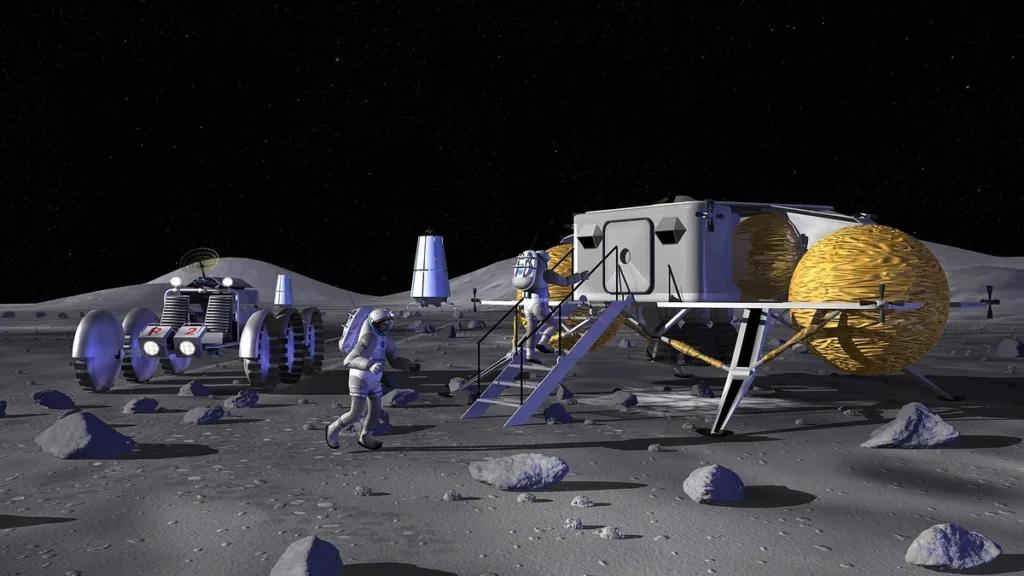
The researchers call the material hybrid layered insulating film stacks, and say it joins strong thermal insulation with mechanical durability, two properties that rarely co-occur. The work addresses lunar temperatures that swing from hundreds of degrees below zero to boiling. Establishing a long-term lunar presence requires solving challenges overlooked on Earth, including insulation that can survive the bumps, compression and repeated handling of construction and maintenance.
Insulation design faces a trade-off because added mechanical strength can reduce thermal performance. Aerogels are insulators used on NASA’s Mars rovers but are vulnerable to mechanical damage. Conventional multilayer insulation limits radiative heat transfer but is not built to bear significant loads and tears when touched.
Mylar, formally biaxially oriented polyethylene terephthalate, is the lightweight plastic in household food wrap and aluminum-coated emergency blankets given to marathon runners to conserve body heat. The polymer is already used in aerospace. When combined with a metal like aluminum, Mylar blocks infrared radiation and traps heat, giving reflective films their insulating function.
Blocking infrared radiation is how reflective films limit radiative heat transfer, the same principle behind conventional multilayer insulation. HyLIFS pairs that radiative blocking with mechanical durability by stacking the films. The Penn team chose this familiar polymer as the starting material because it is already used in consumer products and aerospace applications.
Researchers studied Mylar films in thicknesses. They applied an ultra-thin alumina coating, also called aluminum oxide, to stiffen select films before piling them sheet by sheet. The coating made the delicate films stiff enough to handle and stack. Researchers evaluated how the coated films behaved under load and in vacuum conditions.
Microscopic antiblocking particles added to commercial Mylar to keep sheets from sticking together play a central role in how heat moves across the stacked films. Models compared with experimental data indicate that in a vacuum, heat mainly crosses between sheets at the microscopic contact points where antiblocking particles touch neighboring films. Conventional multilayer insulation focuses on limiting radiative heat transfer, so there has been less reason to study whether these particles constrain conductive heat transfer pathways between sheets.
The thinnest successfully characterized films and medium-thickness films performed similarly when coated with alumina, contrary to the expectation that thinner films would insulate best by adding more interfaces. Levin explained that as layers compress, the contact landscape changes, so engineers must account for how contacts change and films deform as pressure increases rather than only minimizing thickness. Film thickness, stiffness and the distribution of embedded particles all influence thermal performance because compression changes the contact landscape.
Pressing samples inside vacuum chambers to mimic conditions in a pressurized lunar habitat, the strongest stacks kept flexibility while matching the thermal conductivity of other leading vacuum insulation materials. The compressed setup represents how the material would perform indoors in a lunar habitat containing air at atmospheric pressure, and flexibility is important because anything sent to the moon must be transported there. The researchers compressed samples to approximately 20 megapascals, equivalent to 200 pounds or 91 kilograms on a fingertip, and the stacks survived ten consecutive high-stress cycles without losing insulating properties.
Coated stacks kept their thermal performance under the highest compressive stresses the laboratory equipment could achieve, so the researchers did not have to choose between insulation quality and durability. Levin said the team worried about failure under high compressive stress, but the stacks endured repeated cycling, which matters for lunar infrastructure that must survive transport and accidents during construction. ‘These stacks of Mylar can bend, withstand compression and maintain their insulating performance,’ said Igor Bargatin, an associate professor in mechanical engineering and applied mechanics.
The paper’s first author is Danielle R. Levin, a recent Penn doctoral graduate in chemistry with a master’s in mechanical engineering and applied mechanics. Igor Bargatin, an associate professor in that department, is senior author. The paper lists co-authors Matthew F. Campbell, Gulzhan Aldan, and Orevaoghene H. Omodior, and the research took place at the University of Pennsylvania School of Engineering and Applied Science.
The research appeared in ACS Applied Materials & Interfaces under DOI 10.1021/acsami.6c09126 and the National Science Foundation Division of Chemical, Bioengineering, Environmental and Transport Systems supported the work under grant number 1845933. The journal article is an experimental study that appeared on Sept. 16, 2026, and the authors declare no competing financial interest. Penn Engineering also supported the work.
The current assembly process is manual and time-consuming, using two pairs of tweezers and small weights to handle delicate films, and even breathing near the stack can send the layers flying. Levin described the process as time-consuming. ‘The simplest configuration ended up being the best one,’ said Danielle R. Levin. Current samples are about one square centimeter in area and take hours of manual cutting and stacking, so scaling to meter-sized sheets for practical insulation will require a different manufacturing approach.
To scale past hand-stacked centimeter samples, the researchers point to continuously coating large rolls of Mylar and eventually tuning film thickness, coating and particle distribution before winding the material into large stacks. A roll-to-roll coating route is the envisioned path to practical, meter-sized insulation.
If small-scale properties hold at larger scales, the material could serve as flexible insulation for lunar habitats, rovers, electronic systems and spacesuits operating for long periods in the vacuum of space. Because astronauts will inevitably bump into insulation during long-term lunar habitation, tough materials that survive packing, transport and rough treatment over many years are important.
Unanswered questions include whether the films can survive bending cycles and bumps and scuffs of real-life applications when made at larger scales. The authors say that if the small-scale properties hold, the material could insulate lunar habitats, rovers, electronic systems and more, but large-scale behavior such as bending cycles remains unproven.
The researchers say future Mylar-based films could be engineered by choosing the antiblocking particles’ size, number and distribution specifically to control heat transfer. Antiblocking particles are a routine additive that keeps adjacent Mylar films from sticking together, but the study treats their size, count and placement as a lever for controlling heat flow. Because conventional multilayer insulation mainly limits radiative heat transfer, the conductive paths created by embedded particles between sheets had received little attention before the Penn study.
HyLIFS is a passive, vacuum-tested insulation, meaning it works without active power, intended for long-term use in lunar habitats, rovers, electronic systems and spacesuits if the small-scale properties hold at meter scale. The material operates in the vacuum of space, where temperature extremes and mechanical handling pose constant risks.
For long-term surface stays, thermal control is a gating constraint because lunar temperatures swing from hundreds of degrees below zero to boiling. Existing space insulation such as aerogels and multilayer insulation is fragile or cannot bear loads, creating a durability-versus-performance trade-off that HyLIFS aims to resolve. Long-term habitats need insulation that keeps conditions stable through hundreds of degrees of temperature variation.


Join the discussion