Key facts
- SpaceX is negotiating access to more than 80,000 US cell sites to become a national mobile carrier, according to Bloomberg reporting dated October 22, 2026.
- SpaceX is in discussions with Crown Castle Inc., American Tower, and Vertical Bridge for access to cell tower infrastructure.
- Elon Musk said during SpaceX's earnings call that the company will build out terrestrial networks so there is broad-based connectivity anywhere SpaceX and Starlink are allowed to operate.
- Crown Castle CEO Chris Hillabrant said on an October 21, 2026 earnings call that Crown Castle is talking with all relevant parties about lease agreements but declined to comment on SpaceX specifically.
SpaceX is negotiating access to more than 80,000 US cell sites to become a national mobile carrier, according to Bloomberg reporting dated Oct. 22, 2026.
The discussions include Crown Castle Inc., American Tower, and Vertical Bridge, companies Bloomberg described as among the largest owners of cellular towers in the United States. LatestLY reported on Oct. 23, 2026 that the move complements Starlink Direct to Cell and would build a hybrid satellite-terrestrial network challenging Verizon, T-Mobile, and AT&T. Bloomberg cited people familiar with the matter for the talks, which Bloomberg reported after SpaceX executive comments on Oct. 21, 2026.
SpaceX President Gwynne Shotwell stated on Oct. 21, 2026 that the company definitely intends to build out terrestrial components including antennas on towers and rooftops. The statement addressed SpaceX’s plans for ground-based infrastructure as part of its mobile carrier ambitions.
Elon Musk said during a SpaceX earnings call that the company will build out terrestrial networks so there is broad-based connectivity anywhere SpaceX and Starlink operate. Musk made the comment as part of SpaceX’s strategy to combine satellite and ground infrastructure for mobile service, aiming to provide connectivity anywhere the company operates.
Musk added that the effort “will pave the way for Starlink Mobile to become a major mobile carrier in the US.” Musk also stated that Starlink Mobile service relies on satellite launches and spectrum acquisitions to become a major U.S. mobile carrier.
Crown Castle chief executive Chris Hillabrant said on an Oct. 21, 2026 earnings call that Crown Castle is talking with all relevant parties about lease agreements but declined to comment on SpaceX specifically. Hillabrant’s comments came as SpaceX reportedly negotiated for access to Crown Castle’s tower assets as part of its carrier push. He did not confirm any specific deal with SpaceX.
Starlink Direct to Cell began commercial service in the United States with T-Mobile under the brand T-Satellite in July 2025. The service aims to bridge connectivity gaps where traditional cellular networks fail, particularly in rural or underserved areas. It initially provides text messaging, voice calls, and modest data speeds of 2–4 Mbps.
The service also launched commercially in New Zealand with One NZ in late 2024. It offers text messaging, voice calls, and data speeds of 2–4 Mbps, initially targeting cellular dead zones with basic connectivity before scaling up.
SpaceX aims for 150 Mbps user speeds in its next-generation Starlink Direct to Cell service, targeting late 2027 testing and 2028 mass adoption. The upgrade requires a new 15,000-satellite Very Low Earth Orbit constellation, meaning satellites flying much closer to Earth than traditional orbits. The plan also depends on significant spectrum acquisitions, including agreements with EchoStar.
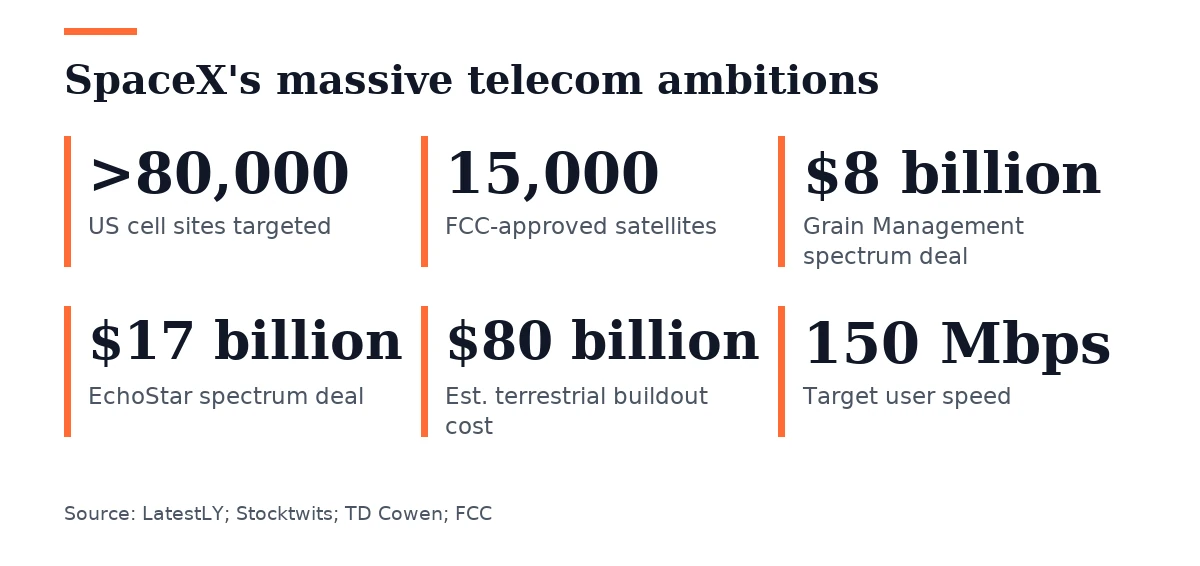
SpaceX’s $17 billion acquisition of AWS-4 and H-Block spectrum licenses from EchoStar in late 2025 supports its next-generation Starlink Direct to Cell ambitions. That deal covers airwaves deemed critical for achieving the high speeds and coverage required for a competitive mobile service. The licenses are part of a broader spectrum strategy that includes recent FCC approvals.
On Oct. 7, 2026, the FCC approved SpaceX’s deployment of 15,000 direct-to-device satellites, waiving a rule requiring spectrum leases from terrestrial partners. Direct-to-device means satellites connect directly to standard mobile phones. The authorization lets SpaceX use its own spectrum, reducing dependence on third-party infrastructure and positioning it as a direct competitor to traditional carriers without relying on terrestrial infrastructure leases.

On Oct. 8, 2026, SpaceX agreed to acquire low-band 800 MHz spectrum licenses from Grain Management for approximately $8 billion, pending FCC approval. Low-band spectrum is critical for building penetration and long-range connectivity, addressing a key limitation of satellite-only networks.
The FCC approved SpaceX’s acquisition of three spectrum licenses in the 1695–1710 MHz band from Tristar on Oct. 21, 2026, with waivers for satellite communications. This approval supports SpaceX’s hybrid satellite-terrestrial strategy by enabling spectrum flexibility for direct-to-device services. The waivers allow the company to use the airwaves for satellite-to-phone connections.
Traditional carriers Verizon, T-Mobile, and AT&T face potential disruption from SpaceX’s push, as evidenced by stock movements and market reactions following the carrier reports. TD Cowen analysts estimate that building a nationwide terrestrial network for SpaceX could cost over $80 billion. The figure underscores the financial scale of SpaceX’s ambition to compete with traditional carriers like Verizon, T-Mobile, and AT&T.
Network and security architect Ram Chandra Sachan views the FCC’s approval of SpaceX’s 15,000-satellite direct-to-device network as a pivotal move for SpaceX to become a nationwide full-service telecom provider. Sachan highlights the scale and regulatory flexibility as key enablers for SpaceX’s competitive positioning in the telecom industry.
Crown Castle Inc. shares rose 9% after reports of SpaceX’s cell site negotiations, while American Tower added 5% and Vertical Bridge also saw gains. The trading occurred on Oct. 22, 2026. The market reaction reflects investor anticipation of potential lease agreements benefiting tower infrastructure companies. The gains came on the same day that Bloomberg reported the carrier negotiations.
Bloomberg reported that the value of potential cell site lease deals could reach into the billions. The financial scale of these agreements highlights the strategic importance of terrestrial infrastructure to SpaceX’s mobile ambitions.
Shares of AT&T, Verizon, and T-Mobile dropped 4–5% in after-hours trading on Oct. 22, 2026, due to competitive implications of SpaceX’s mobile carrier push. The decline signals market concerns about SpaceX’s potential to disrupt traditional carrier dominance in the U.S. wireless market. The movement followed reports of SpaceX’s efforts to secure cell tower access.
SpaceX’s stock (SPCX) rose 1.4% after hours on Oct. 22, 2026, following reports of its cell site negotiations. The stock movement reflects investor optimism about SpaceX’s potential to enter the wireless carrier market and compete with established providers.
Retail sentiment on Stocktwits for SpaceX (SPCX) stock was “extremely bullish” on Oct. 22, 2026, with message volume rising from “high” to “extremely high.” The surge in retail activity indicates strong speculative interest in SpaceX’s potential as a wireless carrier.


Join the discussion