Key facts
- JWST spectroscopy helped astronomers identify a possible black hole in MARTA 3887, a clumpy, metal-poor galaxy observed as it appeared about 12 billion years ago at redshift z~3.8.
- The candidate black hole in MARTA 3887 has a mass of about 3.3 million solar masses, while its host galaxy contains roughly 145 million solar masses of stars.
- The black hole-to-stellar-mass ratio in MARTA 3887 is approximately 100 times higher than the relationship seen in nearby galaxies.
- Mirko Curti of the INAF – Astrophysics and Space Science Observatory of Bologna led the study, which combined JWST spectroscopy with Hubble imaging and archival Very Large Telescope MUSE data.
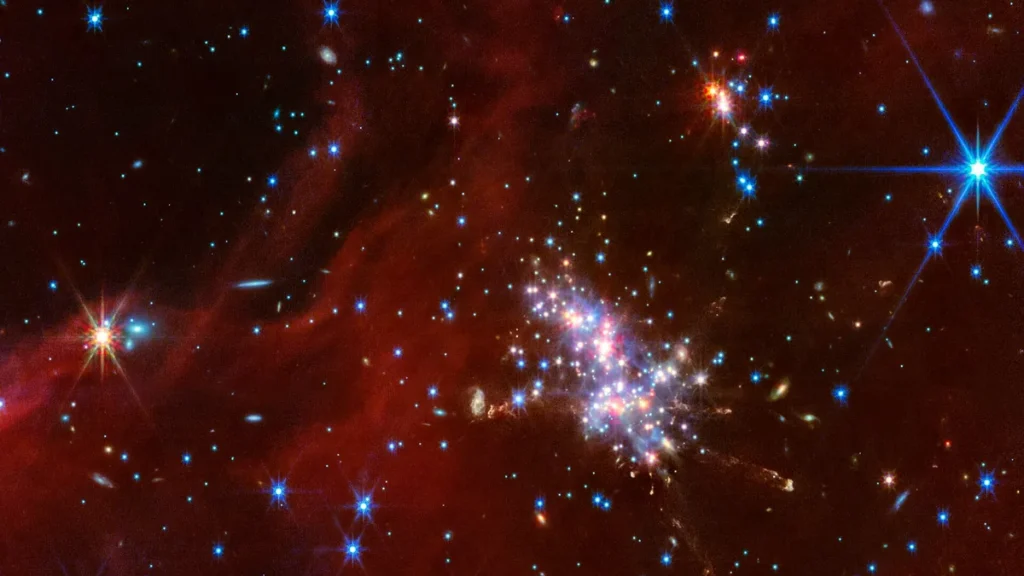
Astronomers using James Webb Space Telescope spectroscopy have identified a possible black hole in MARTA 3887, a clumpy, metal-poor galaxy observed as it appeared about 12 billion years ago at redshift z~3.8, a measure of how much the universe has stretched light since it was emitted. The finding comes from a multiwavelength study combining JWST spectroscopy with Hubble imaging and archival Very Large Telescope MUSE data, reported in a paper posted to the arXiv preprint server.
The work was led by Mirko Curti of the INAF – Astrophysics and Space Science Observatory of Bologna. The discovery paper carries the title MARTA: A little black hole hidden in a clumpy, metal-poor galaxy at z~3.8 with DOI 10.48550/arxiv.2611.00199. The Phys.org article reports the preprint and its authors, Mirko Curti et al., published in 2026.
The candidate black hole has a mass of about 3.3 million solar masses, while the galaxy contains roughly 145 million solar masses of stars. Curti and colleagues derived the mass from JWST spectroscopy, placing the black hole at roughly 2.3% of the galaxy’s stellar mass. That produces a black hole-to-stellar-mass ratio approximately 100 times higher than the relationship seen in nearby galaxies.
The spectroscopic evidence took the form of a wide hydrogen-alpha line, a specific wavelength of light emitted by hydrogen, indicating gas moving at about 1,270 kilometers per second, or 790 miles per second. The signal appeared only in hydrogen, not in oxygen lines from calmer gas. The width of the line indicated the gas velocity.
MARTA 3887 itself is compact and clumpy, with heavy elements at about 10% of the sun’s level. It forms stars at roughly five to nine solar masses per year, mostly in a recent burst. These traits mark it as a young, metal-poor galaxy typical of the early universe environment where the black hole candidate was found.
The research team cautions that MARTA 3887 only possibly hosts a black hole because an interacting supernova or a compact, thick outflow could mimic the signal, and a single observation cannot rule those out. This uncertainty means the overmassive black hole interpretation remains a candidate rather than a confirmed detection. The team’s caution means the detection is not yet firm.
Signals from supernovae, shocks, and outflows can mimic faint black holes more broadly, and in young metal-poor galaxies the spectral line ratios used to distinguish black hole-powered gas from star-powered gas may overlap. Extreme stars can also mimic an active galactic nucleus, complicating identification of faint black holes.
Simple growth models built by the researchers assume steady growth from a single seed with no mergers and a constant feeding rate, ending at the observed mass. The model assigns 100 solar masses a 34% feed rate, 10,000 solar masses a 19% rate, and 100,000 solar masses an 11% rate when growth starts at roughly 0.1 billion years after the Big Bang. If the recent star-formation burst marks the start, the researchers’ model says a 100-solar-mass seed would need to feed at an extreme rate requiring growth faster than the normal black-hole feeding limit.
MARTA 3887 may be leaking ultraviolet light, with about 44% of its Lyman-alpha light escaping, making it an indirect leaker candidate for helping clear the neutral hydrogen fog during cosmic reionization. Lyman-alpha is a specific ultraviolet wavelength associated with hydrogen. Cosmic reionization is the era when the neutral hydrogen fog of the early universe was cleared. The team cannot yet measure the escape fraction of ultraviolet photons directly, so the leaker status remains indirect.
Surveys can currently detect only black holes that are bright or fast-moving enough, so samples skew toward the heaviest black holes for a given galaxy mass and may miss smaller, more typical ones. This detection bias affects the sample of overmassive black holes studied in the early universe.
Many recent studies have found early black holes that are too heavy compared with their host galaxies’ stellar masses, suggesting black holes in the early universe may grow faster than stars. This pattern motivates the search for smaller, more typical black holes beyond the brightest detections.
Little Red Dots are tiny, intensely red objects that seemingly disappear before the universe is two billion years old, and a new model suggests they may be an early stage of extremely rapid black hole growth. If correct, this could explain why Little Red Dots appear common in JWST observations.
Supercomputer simulations suggest JWST’s Little Red Dots are rapidly growing black holes that formed under early-universe conditions no longer present today. The research was led by Sunmyon Chon of the Max Planck Institute for Astrophysics and used the ATERUI III supercomputer at the National Astronomical Observatory of Japan.
Intense far-ultraviolet radiation from nearby galaxies can prevent ordinary star formation in some gas clouds, causing the gas to collapse into a single supermassive star that then forms a black hole seed. This direct-collapse pathway is part of the simulation results explaining how massive seeds could arise naturally.
Thick disks of dense gas around these early black hole seeds trap radiation and allow the black holes to consume material dozens of times faster than black holes can in the modern Universe. This extreme growth rate helps explain how the simulated objects resemble the Little Red Dots observed by JWST.
Some supermassive black holes containing millions or billions of solar masses already existed less than 600 million years after the Big Bang, a longstanding mystery JWST was expected to help solve. JWST can peer farther back than earlier observatories because light from distant objects takes billions of years to reach Earth.
Little Red Dots may be connected to primordial black holes born from density fluctuations just after the Big Bang, which would predate stars, galactic dust, and elements heavier than hydrogen and helium. Researchers led by Valerio De Luca of Johns Hopkins University tested whether one Little Red Dot, QS01, could host such a black hole. They would have existed before stars formed.
QS01 lies around 13.1 billion light-years from Earth and is seen as it was just 700 million years after the Big Bang, and it is almost entirely composed of hydrogen and helium. Its pristine composition makes it a candidate for a more unspoiled, primordial object than other Little Red Dots. Its lack of heavier elements sets it apart.
Cosmological observations constrain primordial black holes so that there can only be so many in the universe and not too many in a given cluster, according to Loris Del Grosso of Johns Hopkins University. The team considered three scenarios and found the most likely is a smaller primordial black hole consuming gas and energy until it grew to the size of QSO1. Those constraints limit how many primordial black holes could exist in any one cluster.
The Johns Hopkins team plans to examine the other roughly 100 Little Red Dots seen by JWST to determine how many could have begun as primordial black holes, work that could provide evidence for whether primordial black holes actually existed. The primordial black hole findings were published in June in the journal Physical Review Letters, and the research was conducted by Valerio De Luca, Loris Del Grosso, and colleagues at JHU.


Join the discussion