Key facts
- Researchers using the ALMA telescope found three dense cores at differing evolutionary stages inside the massive gas clump G40.282−0.219, located roughly 3.4 kiloparsecs from Earth.
- Earlier low-resolution observations could capture only the combined properties of massive dense clumps and could not resolve individual dense cores or measure their physical and chemical traits and evolutionary states.
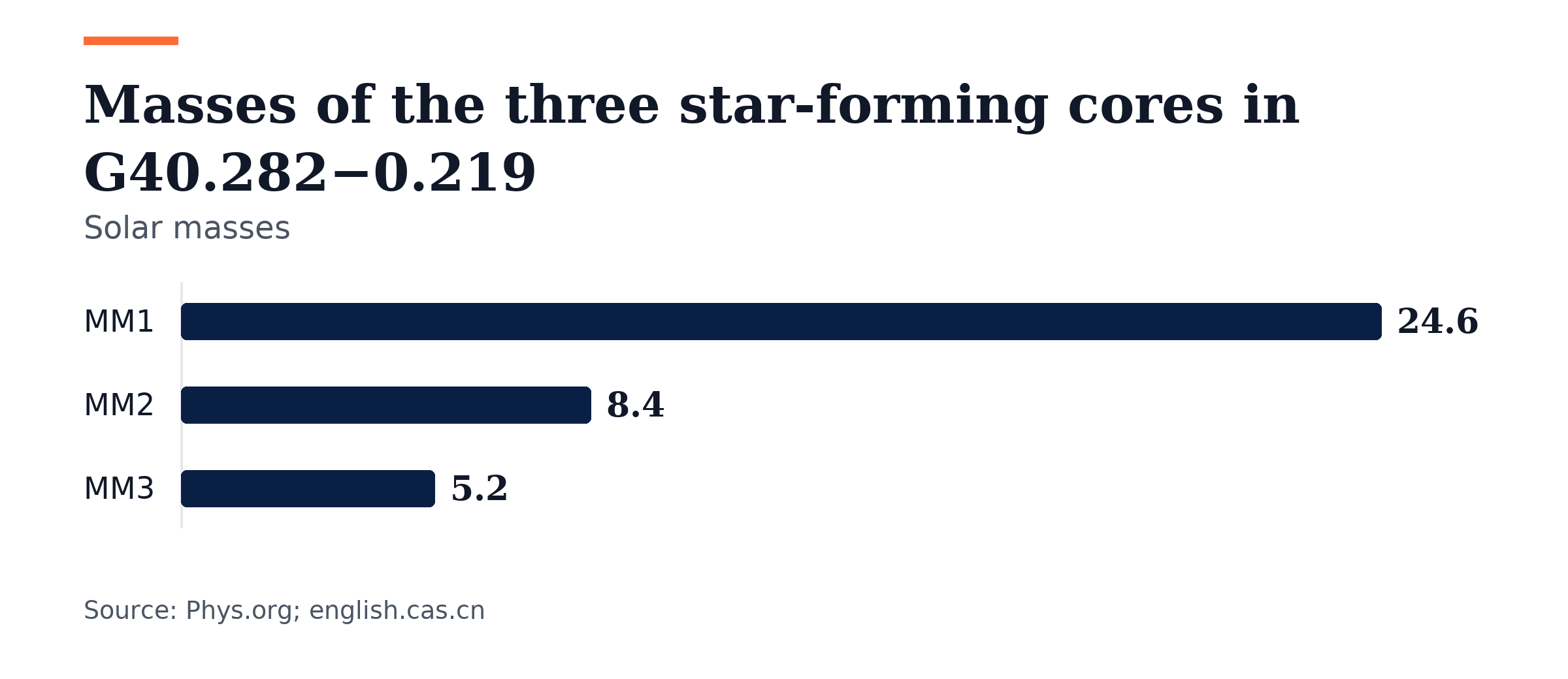
- MM2 contains about 8.4 solar masses, drives a powerful outflow, and its silicon monoxide jet moves at roughly 25 kilometers per second.
- MM3 has the smallest mass, roughly 5.2 solar masses, but shows the highest dust temperature, the broadest molecular variety, and a 6.7 gigahertz Class II methanol maser.
Researchers using the Atacama Large Millimeter/submillimeter Array, or ALMA, found three dense cores at differing evolutionary stages inside the massive gas clump G40.282−0.219 in findings that appeared in The Astrophysical Journal in 2026._The work examines sibling cores born from the same natal material to see how they diverge physically and chemically. The three dense cores inside G40.282−0.219 lie close together but show differences in mass, how evolved they are, and their physical and chemical traits. The goal was to learn how sibling cores can differ even when they share the same origin._ALMA has shown in recent years that massive dense clumps are frequently made up of many lower-mass dense cores located close together while differing in mass, evolutionary stage, and physicochemical properties. This pattern means one clump can hold several cores at different points in their development. These clumps are common sites of star formation._Earlier low-resolution observations could capture only the combined properties of massive dense clumps and could not resolve individual dense cores or measure their physical and chemical traits and evolutionary states. The limitation meant previous studies missed the internal differences among cores inside a single clump. Astronomers saw the clump as one object rather than a group of separate cores. The combined view hid any internal structure._Those earlier observations classified G40.282−0.219 as a massive young stellar object. ALMA’s higher resolution allowed the team to separate G40.282−0.219 into its constituent cores. The region’s distance and prior classification framed the target before ALMA resolved its internal structure. The clump lies roughly 3.4 kiloparsecs from Earth._Using ALMA data observed in the 1.3 millimeter band, the team resolved G40.282−0.219 into three dense cores named MM1, MM2, and MM3 inside the same parental clump. Millimeter waves are radio wavelengths. The 1.3 millimeter observations provided the detail needed to distinguish individual cores that earlier surveys had seen only as one object. Earlier surveys lacked the resolution to see the cores separately._MM1 holds the largest mass, roughly 24.6 solar masses, yet shows the fewest detected molecular spectral lines and no outflows or masers. Molecular spectral lines are signatures of specific molecules. These traits mark it as the least evolved of the three cores._The combination of high mass and sparse molecular signatures led the researchers to place MM1 at the earliest point of the sequence. This core marks the starting point of the observed progression inside the clump. It has not yet developed the energetic outflows or maser emission seen elsewhere._MM2 contains about 8.4 solar masses, drives a powerful outflow, and its silicon monoxide, or SiO, jet moves at roughly 25 kilometers per second. SiO is a molecule made of silicon and oxygen. An outflow is a flow of gas and dust driven away from a young stellar object. The fast jet shows gas moving away from the core at high speed._The outflow and jet indicate energetic activity that distinguishes MM2 from the quiescent MM1 and marks an intermediate evolutionary step. This core sits between the earliest and most evolved objects in the sequence. MM1 remains quiet while MM2 already launches material into space._MM3 has the smallest mass, roughly 5.2 solar masses, but shows the highest dust temperature, the broadest molecular variety, and a 6.7 gigahertz Class II methanol maser. Methanol is an alcohol molecule. A maser is an intense source of microwave radiation. Its warm dust and rich chemical inventory point to a later stage of evolution._Warm dust, rich chemistry, and maser activity led the researchers to classify MM3 as the most evolved of the three cores. This core forms the end point of the sequence inside the clump. MM3 packs the most activity into the least massive core._The researchers therefore place MM1 first and MM3 last in an evolutionary sequence inside G40.282−0.219. The ordering rests on the progression from no outflow or maser in MM1, to an outflow in MM2, to maser emission and the richest molecular inventory in MM3. The sequence tracks how the cores change over time._Molecular-line richness refers to the count of different molecular spectral lines detected. The team said accurate staging requires weighing mass, density, temperature, outflows, jets, molecular-line richness, and maser types together rather than relying on one property. No single measurement is enough to assign an evolutionary stage._A. G. Tegegne, a doctoral student at the Xinjiang Astronomical Observatory of the Chinese Academy of Sciences who works in its star formation and evolution group, conducted the study under professor Jarken Esimbek and Andrey M. Sobolev. The work was carried out at the Chinese Academy of Sciences facility as part of its star formation and evolution research group. Esimbek and Sobolev served as professors supervising the doctoral research._The National Key R&D Program, the National Natural Science Foundation of China, and other projects supported the research. These Chinese national research programs funded the work behind the ALMA analysis. The support enabled observations and analysis of the massive clump._The study is titled “Distinguishing between the Strongest Millimeter Compact Emission and Maser and Outflow Activities in the G40.282–0.219 Massive Young Stellar Object Cluster” by A. G. Tegegne et al., with DOI 10.3847/1538-4357/aea6ad. Millimeter compact emission refers to bright radio emission from a small region. The paper provides the formal publication record for the core identification and evolutionary analysis. The title reflects the paper’s focus on separating different kinds of activity in the cluster._An image from the Xinjiang Astronomical Observatory shows the Spitzer view of the region, the ALMA-resolved cores, and methanol masers concentrated around MM3. The image illustrates how ALMA resolved cores that were previously unresolved and where masers appear. Spitzer is a space telescope that observes infrared light. The Spitzer view shows infrared emission from the region._Another image traces molecular gas using SiO, SO, H2CO, and CH3OH, marks MM2’s bipolar SiO outflow with blue and red contours, and places yellow markers on the three cores. The figure connects specific molecular tracers to the outflow driven by MM2 and locates the cores within the clump. SiO, SO, H2CO, and CH3OH are molecules used as tracers. Bipolar means having two lobes pointing in opposite directions.





Join the discussion