Key facts
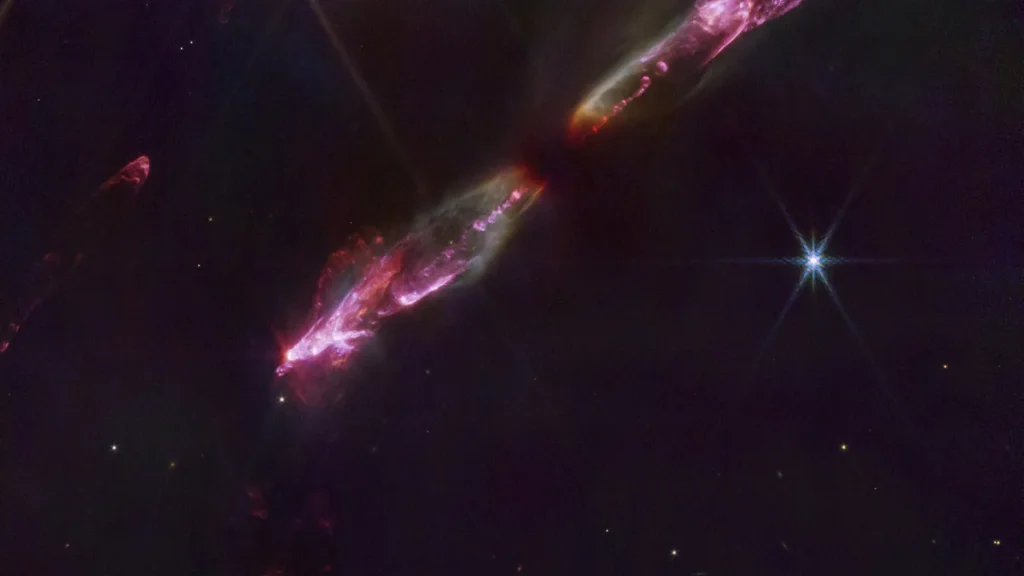
- NASA featured a James Webb Space Telescope image of NGC 7129 as its Astronomy Picture of the Day on November 16, 2026, showing the star-forming region in infrared light.
- NGC 7129 is a stellar nursery and young open star cluster about 3,300 light-years from Earth in the constellation Cepheus, first documented by William Herschel in 1794.
- The Webb image divides into two connected stages: a golden cavity on the left and a red-tinted plume of younger protostars on the right.
- Protostars eject high-speed jets along their rotational axes that slam into surrounding gas at supersonic speeds, generating glowing shock fronts known as Herbig-Haro objects.
NASA featured a James Webb Space Telescope infrared image of NGC 7129 in Cepheus as its Astronomy Picture of the Day on Nov. 16, 2026. NGC 7129 is a molecular cloud and young open star cluster in Cepheus, about 3,300 light-years from Earth; William Herschel first documented it in 1794. Webb’s NIRCam pierced the molecular dust cloud hiding hundreds of young stars and protostars from earlier telescopes.
The Webb image divides into two connected stages. On the left, a golden cavity about 3.5 light-years across is dominated by LkHα 234, a pre-main-sequence star estimated at five to eight times the Sun’s mass. On the right, a clumpy flame-shaped red-tinted plume is packed with protostars still accumulating mass, an earlier stage than pre-main-sequence contraction. A blue-tinted nebula higher in the frame shows protostellar outflows from a protostar with a toroidal disk casting a shadow, a geometry Hubble previously called the Bat Shadow elsewhere.
Protostars eject high-speed jets along their rotational axes that slam into surrounding gas at supersonic speeds, generating glowing shock fronts known as Herbig-Haro objects. Webb resolves overlapping Herbig-Haro outflows from different protostars simultaneously, creating the chaotic layered red texture in the image. Bow shocks, curved arcs of compressed gas where stellar winds plow into the surrounding medium, appear as individual resolvable features near pre-main-sequence stars in the cavity.
Webb’s 6.5-meter primary mirror has about 58 times the light-collecting area of Spitzer’s 0.85-meter mirror, letting Webb separate stars, resolve filaments, trace jets, and reveal dozens of background galaxies. Webb’s NIRCam covers 0.6 to 5 microns, a near-infrared range where NGC 7129’s molecular dust becomes transparent because opaque dust in cool stellar atmospheres can obstruct visible-light images when dispersed, while visible-light telescopes see only the dust’s surface. The telescope’s 18-segment hexagonal mirror geometry produces eight-pronged diffraction spikes around bright sources such as LkHα 234.
LkHα 234’s earlier outflows carved into the surrounding hydrogen gas cloud, compressing some regions to form new stars and blowing others away. Webb’s NIRCam resolved a photodissociation region at the sharp ridge where the golden cavity meets the denser cloud, marking where far-ultraviolet photons split hydrogen molecules into individual atoms. Astronomy & Astrophysics research in July 2026 using SOFIA data found molecular clouds hosting their first massive young stars erode over two- to ten-million-year timescales once erosion begins. The youngest protostars in NGC 7129’s denser regions today may be among the last generation this cloud produces before it dissipates.
NGC 7129 is relatively compact compared with the Tarantula and Orion nebulae, hosts more than 130 young stars most under one million years old, and spans stages from protostars to near-main-sequence heavyweights. The James Webb Space Telescope is an international partnership between NASA, ESA, and CSA, with science operations managed by the Space Telescope Science Institute in Baltimore.
Stars on the left in gold-colored gas are typically more mature than those on the right in the red region, and jets and winds likely cause the filamentary red gas. Astronomers will keep analyzing Webb’s NGC 7129 dataset to learn how embedded stars and protostars shape gas and dust for models of systems like ours from 4.6 billion years ago.

Join the discussion