Key facts
- Astronomers conclude the 'Cat's Tail' feature in the Beta Pictoris system resulted from a collision between two large bodies, similar to Pluto.
- The 'Cat's Tail' structure spans approximately 1,000 astronomical units.
- Researchers found the 'Cat's Tail' likely extends sideways across the plane of the sky rather than behind the star.
- A warp in the Beta Pictoris dust halo is likely caused by interaction with the planet Beta Pic b.
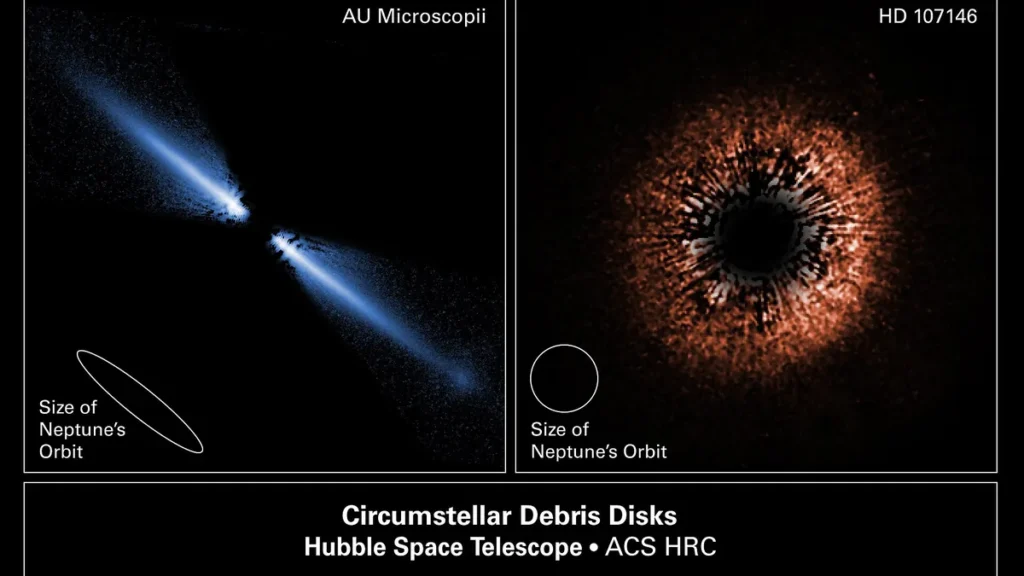
Astronomers announced that the ‘Cat’s Tail’ feature in the Beta Pictoris system, located 63 light-years away in the constellation Pictor, is the aftermath of a collision between two large bodies, similar to Pluto. The collision produced a massive, elongated dust structure within the system’s debris disk that spans approximately 1,000 astronomical units. Because the tail is composed primarily of carbon-based organic refractory material, the long chains of carbon atoms absorb visible wavelengths, making the structure appear black and rendering it previously only detectable by the James Webb Space Telescope’s infrared sensors. Researchers estimate that the colliding dwarf planets are estimated to have had radii between 600 km and 800 km, reaching this figure by assuming bulk densities similar to dwarf planets found in our Solar System’s Kuiper Belt, such as Charon and Makemake.
The dust particles making up the ‘Cat’s Tail’ are micron-sized and highly porous, though the exact mechanism that created these fluffy grains remains unknown. Kevin Wagner, a NASA Sagan postdoctoral fellow, suggested that high-velocity collisions might have vaporized carbon grains, which then recondensed into porous forms as they cooled. To understand the three-dimensional layout of this structure, researchers combined Hubble Space Telescope data with James Webb Space Telescope infrared observations. By applying computer models to this combined dataset, the team determined that the tail stretches sideways across the plane of the sky instead of extending behind the star, resolving a key uncertainty about its orientation.
The dust halo of Beta Pictoris shows a distinct warp, which researchers attribute to gravitational interaction with the planet Beta Pic b.
Arin Avsar, a University of Arizona scientist, noted that the feature was previously only visible via infrared light, saying, “The Cat’s Tail is thought to be the aftermath of a collision between large bodies – think something like Pluto,”. This young system, located 63 light-years away in the constellation Pictor, is about 23 million years old and is considered to be in the final stages of planet formation.


Join the discussion