Key facts
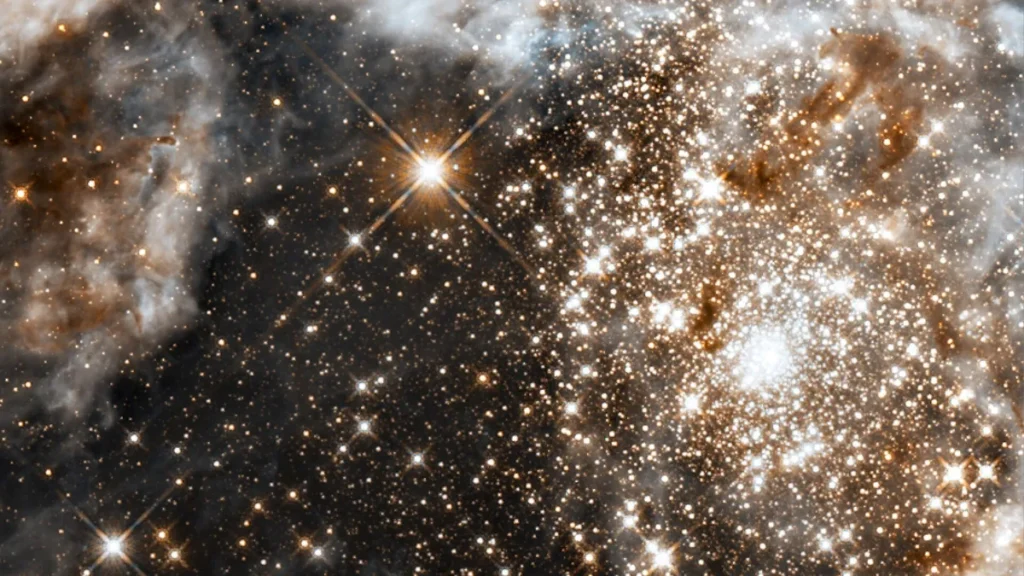
- NASA, ESA, and CSA's James Webb Space Telescope and NASA and ESA's Hubble Space Telescope imaged the Cat's Head Nebula within the Carina Nebula.
- Webb's infrared observations reveal numerous stars and star formation details that appear as a dark dust pillar in Hubble's visible-light view.
- Hubble's view shows a glowing red eye in the nebula which might indicate a young star partially embedded in the dust.
- In mid-infrared light, Webb detected emissions from carbon-based molecules known as polycyclic aromatic hydrocarbons (PAHs) and warm dust.
NASA, ESA, and CSA’s James Webb Space Telescope and NASA and ESA’s Hubble Space Telescope imaged the Cat’s Head Nebula in the Carina Nebula, the agencies said Oct. 29, 2026.
The visible-light view from Hubble renders the nebula as a dark brown pillar that blocks light. Hubble’s filters capture oxygen, hydrogen, and sulfur emission along with starlight scattered by dust. Above the pillar, diffuse material glows blue and cyan, while lower down it shifts to yellow, orange, and red. The nebula’s glowing red eye might indicate a young star partly buried in the dust.
In near-infrared light, Webb keeps the pillar’s shape but lets the filament appear more transparent and reveals detailed surface structure. These wavelengths pierce the dust and expose ghostly wisps to radiation from nearby massive stars on the cat’s left. Webb’s near-infrared view presents many blue and yellow stars and picks out faint background galaxies, allowing a partial view through the Milky Way and into deeper space. Webb keeps the cat’s eye conspicuous as a clearer embedded-star example, while Hubble’s bright optical nebulosity is less prominent in the near-infrared image.
Mid-infrared light reveals emission from warm dust and carbon-based molecules called polycyclic aromatic hydrocarbons, or PAHs, outlining intricate structures in the nebula. Globules and strands along the pillar’s left edge stand out particularly in mid-infrared light. On the pillar’s right side, a bright yellow mid-infrared light source appears against reddish emission from nearby material and is likely an infant star embedded in dust. A narrow filament appears to cross the source, yet the image alone cannot show whether the two are physically connected.
Shifts in color and brightness may follow PAH emission, dust continuum, and local irradiation more than temperature alone. Gas at the bright rim is lit and ionized by ultraviolet light from nearby massive stars, potentially driving photoevaporation, a process in which radiation heats gas and drives it away. ESA says energetic ultraviolet light impinges on the gas, heats it, and essentially evaporates it, forming a wispy outline. While radiation and stellar winds wear away nearby gas and dust, denser sections of the pillar withstand that erosion.
Near the cat’s belly, a faint jet-like feature may point to an outflow from a nearby young star. Certain stars stay concealed within dust to different extents even at infrared wavelengths. The Cat’s Head Nebula is a short-lived scene that will eventually disperse as stars form and evolve over time.
The Carina Nebula, containing the Cat’s Head Nebula, lies approximately 7,500 light-years from Earth. ESA describes the Carina Nebula as a cloud of gas and dust, while NASA calls it a diffuse star-forming region. The name reflects a feline shape, with the creature seated with its back to the viewer and its head turned rightward to show a glowing eye.
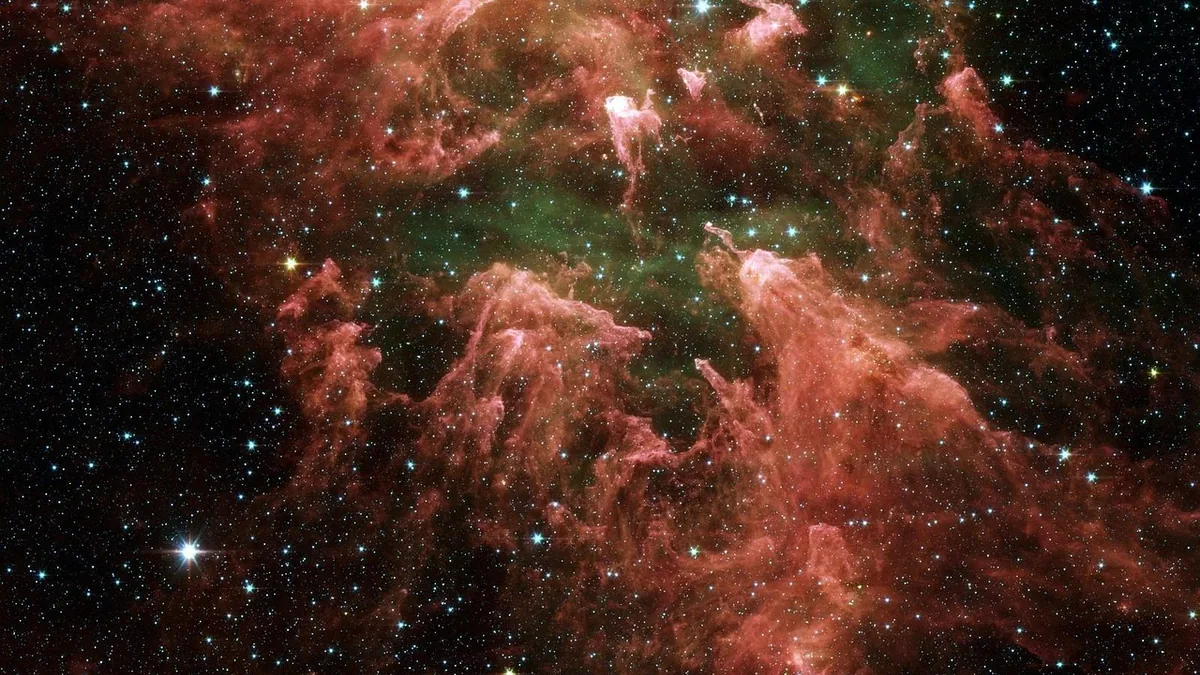
Combined Hubble and Webb views help astronomers learn more about the elusive, chaotic, and complex process called star formation. ESA and NASA say the region holds abundant information, while the paired telescopes give complementary views that aid understanding of chaotic star formation. ESA said, “The two telescopes offer complementary views of the shadowy form, nicknamed the Cat’s Head Nebula, which reflects the ‘magical” process of star formation.”
Goddard Space Flight Center in Greenbelt, Maryland, oversees Hubble and mission operations, while Lockheed Martin Space provides operational support there. The Space Telescope Science Institute in Baltimore, run by AURA, handles science operations for NASA. Hubble, an international project between ESA and NASA, has been operating for more than three decades and continues to return new astronomical images.
Webb ranks as the largest, most powerful telescope ever launched into space, and it serves as the world’s premier space science observatory. The observatory is an international partnership involving NASA, ESA, and CSA. NASA describes Webb as an international program led by NASA with ESA and CSA partners.
Pursuant to an international collaboration agreement, ESA provided the launch service for Webb aboard an Ariane 5 vehicle. ESA contributed the NIRSpec spectrograph and half of the mid-infrared instrument MIRI, built by the MIRI European Consortium with JPL and the University of Arizona.

Join the discussion