Key facts
- Researchers report the discovery of WD J132800.85–145019.95, a white dwarf with a new gas-disc system showing quadruple-peaked line profiles instead of double-peaked ones, published in Nature Astronomy in 2026.
- Two small planets or planet-like bodies are probably responsible for shaping the disk's structure, each on its own orbit.
- The inner planet-like body needs very high density or strong internal strength, or tidal forces would tear it apart at such close range to the white dwarf.
- Dust is common in debris disks around white dwarfs, but gas is less common and has been found in only 21 such disks.
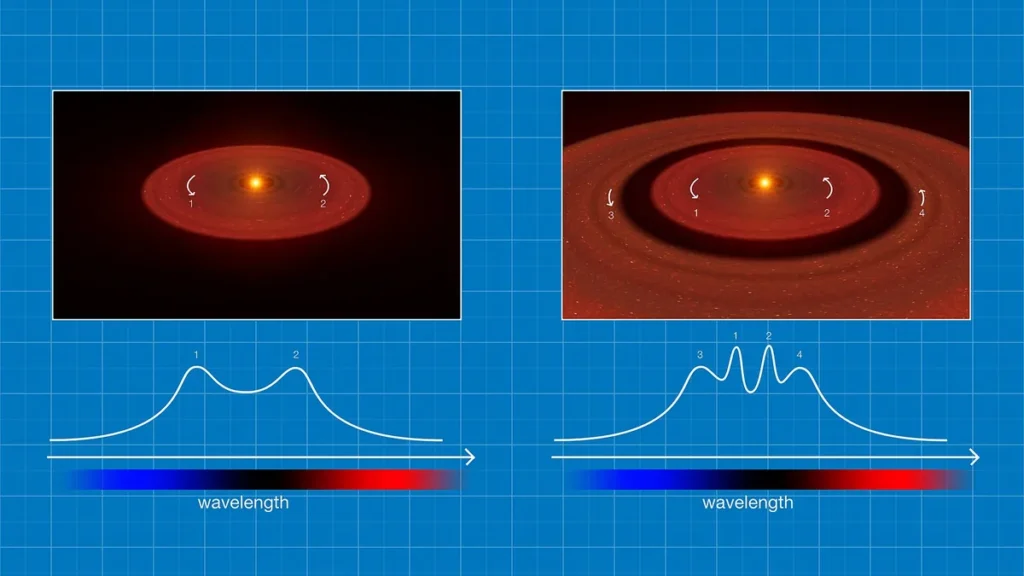
Researchers have found a white dwarf with a double debris disc and two planet-like bodies orbiting inside it, according to a study published in Nature Astronomy in 2026. Universe Today reported the discovery on Oct. 27, 2026. The star, WD J132800.85–145019.95, shows quadruple-peaked emission lines rather than the double-peaked profile seen in other gas-disc systems.
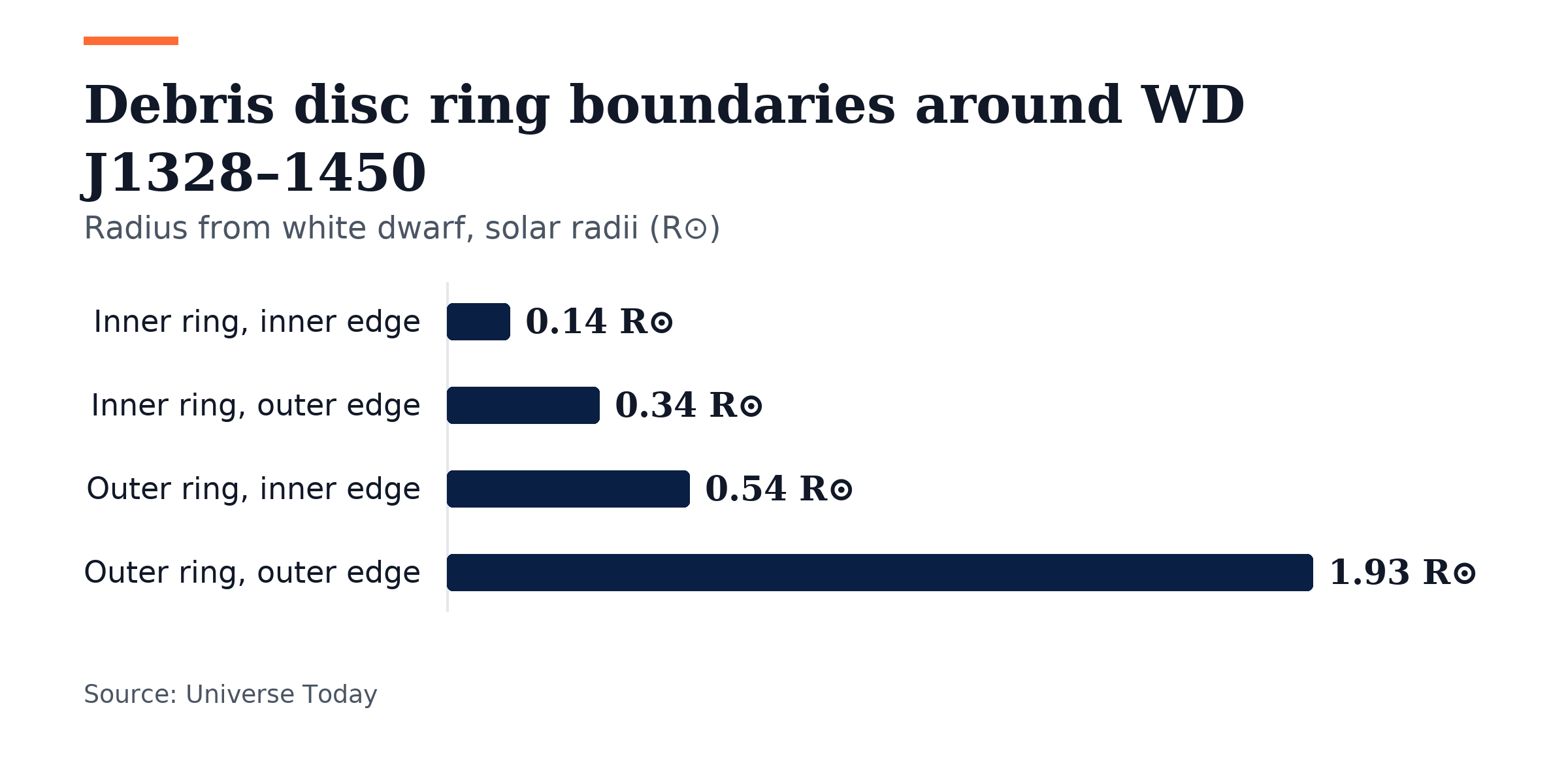
The emission lines come from two separate gaseous rings. One ring extends from 0.14 R⊙ (solar radii) to 0.34 R⊙, and the other runs from 0.54 R⊙ to 1.93 R⊙. The different spin rates of the two disks create four peaks in the spectrum. The quadruple-peaked morphology indicates two concentric discs, unlike the prototypical gas-disc system SDSS J1228+1040, which shows double-peaked profiles.
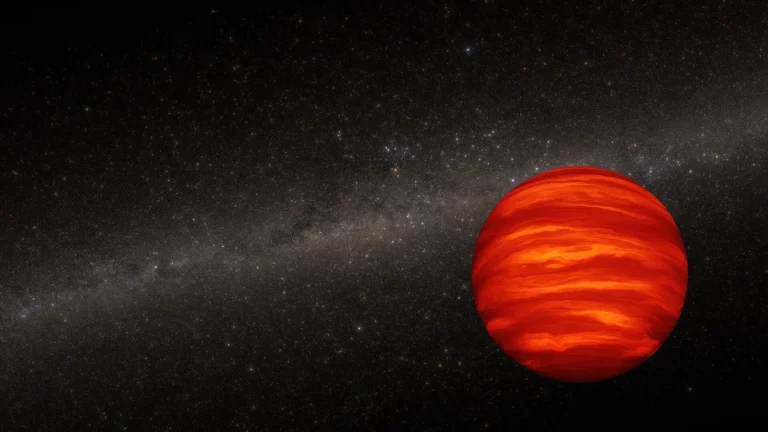
Two small planets or planet-like bodies are probably responsible for shaping the disk’s structure, each on its own orbit. The inner body is only a few kilometers across, little more than an asteroid, while the other is about the size of Pluto or possibly as large as the Moon. The rings remain stable and separated by a gap.
The inner planet-like body needs high density or strong internal strength, or tidal forces would tear it apart at such close range to the white dwarf.
The stable, gap-separated rings challenge current models of debris disc formation and evolution. Felipe Lagos-Vilches, a study co-author and astronomer at the University of Warwick in the UK, said the structure is intriguing because of this stability.
Dust is common in debris disks around white dwarfs, but gas is less common and astronomers have found it in only 21 such disks. Astronomers think planetesimals in these disks generate gas from dust through collisions, and fast-moving planetesimals can vaporize dust into gas when they collide with it.
The inner gaseous ring around WD J1328–1450 appears enriched in magnesium while the outer ring lacks magnesium. Astronomers detect gaseous disks around white dwarfs using red-shift and blue-shift of light measured by a spectrograph, an instrument that splits light into its component wavelengths.

The system offers a glimpse into the Solar System‘s future, where the Sun expands and vaporizes Earth and the other inner planets. When a star like the Sun expands toward becoming a white dwarf, it engulfs and destroys its inner planets; the Sun will definitely destroy Mercury and Venus and almost certainly destroy Earth.
The Sun will lose its gravitational hold on outer layers, expel them into space creating a planetary nebula lasting tens of thousands of years, and leave behind a cinder-like white dwarf radiating only remnant heat. White dwarfs eventually cool to black dwarfs, but the Universe is not old enough for any to have formed yet.
Astronomers have known about gaseous debris disks around white dwarfs for two decades, but how they form, take shape, and evolve over time is not well understood. Many planetary systems survive their host star’s metamorphosis into a white dwarf, as indicated by dusty discs around the remnants and chemical traces of planetary debris in the stars’ atmospheres.
Nicola Gentile Fusillo leads the research and works as an astronomer at the Università degli Studi di Trieste in Italy, with an additional affiliation at the INAF-Astronomical Observatory of Trieste. The research titled “A double debris disc around a white dwarf sculpted by two planetary bodies” was published in Nature Astronomy in 2026. Gentile Fusillo described the system as a rare glimpse of a planetary system’s violent end. “The system is a rare glimpse of the violent, chaotic process by which a planetary system meets its end,” Nicola Gentille Fusillo said.
Felipe Lagos-Vilches is a study co-author and astronomer at the University of Warwick, UK, who commented in a press release. He said the two gaseous rings are stable and separated by a gap, and that the system offers a remarkable glimpse of the future of planetary systems including our own.

Join the discussion