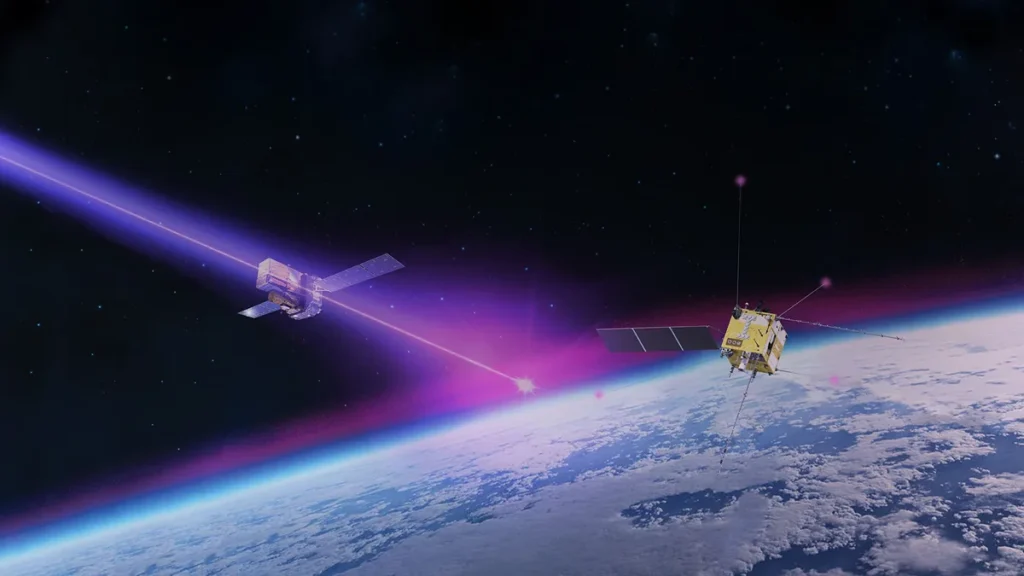
Key facts
- While the satellite passed Svalbard, Norway, the ground station received a downlinked poem describing a blue marble below, silent data streams, and starlight feeding the spacecraft's core.
- The prototype launched October 1, 2026, on SpaceX's Transporter-18 rideshare mission and was built with Planet.
- Google will test laser interconnects in 2027 with two satellites in orbit.
- The satellite holds four Google TPUs and produces up to 1 kW of electricity, though only one TPU can operate at a time.
Google announced on Oct. 30, 2026, that its Project Suncatcher prototype satellite downlinked the first AI-generated response from orbit to a ground station at Svalbard, Norway: a haiku written by an onboard Gemma 4 model running on a data-center-class Tensor Processing Unit, a chip for AI workloads.
Engineers sent the first prompt to the satellite’s onboard Gemma 4 model during a ground-station pass, requesting a haiku about being in space, and the team uplinked the prompt as the satellite passed over Svalbard. The downlinked poem described a blue marble below, silent data streams, and starlight feeding the spacecraft’s core. The team then tried space-themed limericks and telemetry prompts relaying payload system status after the initial haiku success.
The prototype launched Oct. 1, 2026, on SpaceX‘s Transporter-18 rideshare mission and was built with Planet, and Google confirmed contact with the spacecraft after it reached orbit, saying it was operating normally. The refrigerator-sized satellite rode the rideshare into low Earth orbit. During the weeks following launch, the team completed a commissioning list that included powering up the host and TPU trays and running early machine learning tests, and subsystem tests took about three weeks after launch before the spacecraft was ready for work.
The satellite holds four Google TPUs, each capable of producing up to 1 kW of electricity, though only one TPU can operate at a time; it runs on one Google TPU, drawing about 1 kW of solar power. Heat limits restrict operations to 15 to 20 minutes per session, and power limits let the team run just one TPU for roughly 20 minutes at a time, making ground contact more difficult. Google’s plan calls for the TPUs to compute for 15 minutes, run Google’s Gemini AI on short questions, then turn off to cool.
Because TPUs produce intense heat in a small area and space has no airflow, heat can only spread through radiators, and fans cannot cool chips in space because shipping large amounts of water is impractical. The team is developing heat pipes and radiators for chip cooling and has tested the setup in a thermal vacuum chamber that mimics space temperatures and vacuum, since more computing power in a satellite means more heat dumped into its small interior.
Radiation tests exposed TPUs to a proton beam at UC Davis’s Crocker Nuclear Laboratory while AI workloads ran, tracking effects such as bit flips, and early results indicated Trillium TPUs can endure a total ionizing radiation dose exceeding what they would receive over a five-year space mission.
Google already ran TPU tests in particle accelerators on Earth but must now observe actual radiation effects on processors in space. Radiation can cause bit flips that change a stored memory value and corrupt data without setting off normal monitors. Inference means a trained model answers a prompt, unlike the heavier work of learning from data. Ground trials suggested radiation would barely affect inference tasks but pose more trouble for model training, so upcoming tests will measure TPU performance under orbital heat and radiation.
A Sept. 24, 2026, engineering post said low Earth orbit offers near-constant sunlight, providing up to eight times more solar power than Earth. Data centers used about 1.5 percent of global electricity in 2024, and usage could double by 2030 per the International Energy Agency, which motivates interest in space-based alternatives powered by solar energy.
Travis Beals, Google’s senior director of paradigms of intelligence, revealed the achievement in a Google Research post, calling it the mission’s “Hello World” milestone and the first AI response from a data-center-class TPU in orbit. The mission aims to collect orbital data showing how Google’s TPUs withstand launch stress, radiation, and temperature extremes in space. An engineering post described a low Earth orbit trip as lasting about 10 minutes with acceleration up to 10 g, while TPU chips may face 50 to 100 g, and vibration testing shook the satellite along all three axes to copy launch frequencies.
Google will test laser interconnects in 2027 with two satellites in orbit, and if the onboard chips work well, Google plans to launch two more advanced-chip satellites in 2027. Proving TPUs can run workloads reliably in space clears the path for twin linked satellites in 2027, and the 2027 satellites will generate more power and test optical links between spacecraft.
The original roadmap envisioned a Planet partnership to launch two prototype satellites by early 2027 for orbital hardware testing, and Google eventually wants satellite fleets with a dozen TPUs each, linked by lasers to one another and Earth. Later satellites would carry dozens of TPUs each, fly in clusters, and talk to each other with lasers requiring very high bandwidth across tiny distances, and Google plans two more satellites next year and has proposed groups of over 80 satellites.
Several satellite constellations could eventually link together to handle larger AI workloads while in orbit, and Suncatcher is unusual among space data center ideas because it plans fast satellite-to-satellite links for shared computing work. Starcloud and Cowboy Space intend to run inference jobs on single satellites, while SpaceX data centers may use lasers but will fly too far apart to process data together effectively.
Google calls Suncatcher a moonshot aimed at building affordable infrastructure by the 2030s, and success may hinge on how Google’s wider business handles near-term AI pressures and chances. Alphabet shares fell this week after the company said AI features in search are slowing ad revenue growth. Alphabet owns a large stake in SpaceX, and both firms need Starship to become fully and quickly reusable before launching their orbital data centers. Suncatcher researchers estimated in a peer-reviewed study that SpaceX must fly Starship 1,800 times to match earlier cost gains.
A peer-reviewed paper describing the mission research appears in the journal Joule, and the preprint released with the announcement covered satellite constellation design, control, communications, and early radiation test results for Google TPUs. Google published the paper as part of its research documentation for Project Suncatcher alongside the satellite launch and milestone announcements.

Join the discussion