Key facts
- NASA's Hubble Space Telescope observations challenge a leading theory about the early universe's emergence from a hydrogen fog roughly 13 billion years ago.
- Scientists once believed stellar explosion winds assisted radiation in leaving galaxies and clearing the fog.
- Observations linked faster galactic winds to a reduced amount of escaping ionizing radiation.
- Carr and colleagues found supernova winds can make it harder for radiation to leave a galaxy.
Hubble Space Telescope observations reported on Oct. 30, 2026 challenge a leading theory about how the universe emerged from a hydrogen fog roughly 13 billion years ago. University of Michigan researchers led the work, revising the assumed role of stellar and supernova winds in letting radiation escape from the first galaxies. ScienceDaily reported the discovery based on University of Michigan research, noting that the new findings indicate the opposite of what scientists once believed about exploding star winds.
Scientists once believed that winds from stellar explosions helped radiation leave galaxies and clear the fog. This long-standing assumption held that supernova-driven outflows created paths for ionizing radiation to escape into intergalactic space. Researchers relied on this picture when modeling how the first galaxies made the cosmos transparent. The new Hubble data indicate the opposite may be true, with powerful winds impeding rather than aiding escape.
The result challenges the established picture of how the first galaxies contributed to reionization.
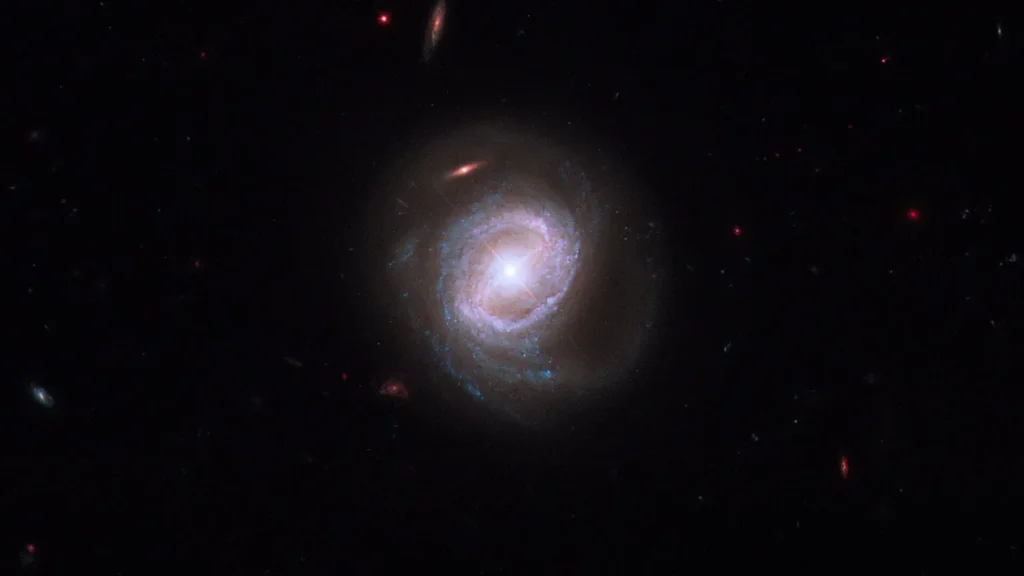
The research team examined spectra from nearby starburst galaxies to measure wind speeds and radiation escape fractions. These systems have exceptionally intense star formation and serve as modern examples of galaxies believed to have contributed to reionization. Galaxies with the most rapid winds permitted the smallest portion of ionizing radiation to leave. Faster galactic winds were thus linked to a reduced amount of radiation escaping into space, suggesting that the most violent outflows are not the most effective at letting light out.
Cody Carr and colleagues found that supernova winds can make it harder for radiation to leave a galaxy. The energy appears to block radiation by increasing gas and dust coverage around stars. “Basically, how these galaxies were leaking ionizing radiation isn’t what we thought,” Carr said. The finding reverses the earlier assumption that winds cleared paths for radiation to escape from star-forming regions.
Radiation from young, massive stars may leave galaxies before those stars detonate as supernovae and create powerful winds. Carr said the observations show photons escaping before galactic winds form. Smaller winds and other activity around young stars could still create openings in surrounding gas, allowing radiation to escape before large winds develop. This timing suggests an alternative route for ionizing radiation to reach intergalactic space during reionization.
Stephan McCandliss, a senior author of the study and director of the Center for Astrophysical Sciences at Johns Hopkins University, said supernova energy input stirred up galactic surroundings. His leadership role at Johns Hopkins and senior authorship on the paper frame his assessment of the physical mechanism. McCandliss said energy from supernovae stirred up the area around galaxies and left more neutral gas and dust behind, material that suppresses ionizing radiation escape. The result means supernovae may trap radiation rather than clear a path for it.
Renyue Cen, a senior author of the study and professor and director of the Center for Cosmology and Computational Astrophysics at Zhejiang University, said supernovae play a central role in cosmological hydrodynamic simulations explaining how ionizing radiation escapes from galaxies. His position at Zhejiang University and senior authorship inform his view on the implications for computer modeling. The findings highlight the need to examine radiation and winds from young stars before the first supernovae explode. Computer simulations of the early universe attempt to recreate how galaxies formed, how gas moved through them, and how radiation transformed intergalactic hydrogen.
The study appeared in Nature Astronomy on Oct. 15, 2026, under the title “Lyman continuum escape during the onset of galactic winds in compact starbursts.” Its digital object identifier is 10.1038/s41550-026-02999-z. Cody Carr, a postdoctoral researcher in the University of Michigan’s Department of Astronomy, conducted and led the research while working as a postdoctoral scholar at Zhejiang University in China before joining Michigan. The paper presents the observational evidence behind the revised understanding of radiation escape.
Nearly 30 scientists from more than a dozen institutions around the world took part in the research. Sally Oey, a professor of astronomy at the University of Michigan, also contributed to the study. The international collaboration brought together researchers from multiple academic organizations across different countries. Carr worked with colleagues across these institutions to produce the analysis.
Hubble is a NASA mission launched with contributions from the European Space Agency. The team used the telescope to examine nearby starburst galaxies with exceptionally intense star formation. These galaxies serve as useful modern examples of the primordial systems believed to have contributed to reionization. Scientists chose them because their active star formation resembles conditions in the early universe, making them practical laboratories for studying radiation escape.
The researchers analyzed galaxy spectra to measure galactic wind speeds. Spectra show how much light is present at different wavelengths. Gas absorbs particular wavelengths of light, creating dips whose locations and shapes reveal how quickly the gas is moving. This spectroscopic approach connected wind motion to the amount of radiation escaping each galaxy.
The team applied this method to compact starburst systems selected for their intense stellar activity.
Reionization began approximately 13 billion years ago when intense radiation from early galaxies stripped electrons from neutral hydrogen atoms. The early universe contained a fog of neutral hydrogen that blocked light. The process left positively charged protons and free electrons behind. As more hydrogen ionized, ultraviolet light could travel much farther through intergalactic space, gradually clearing the cosmic fog.
ScienceDaily describes reionization as the final major phase transition in the history of the universe.
Carr said scientists have not yet identified which objects provided the radiation behind reionization or how sufficient amounts of that radiation escaped from early galaxies. ScienceDaily says the study does not yet resolve what triggered the last major phase transition in cosmic history. It does provide an important new clue suggesting that radiation escaped galaxies before powerful stellar explosions began to alter their surroundings.
Carr and his colleagues are seeking additional observing time with Hubble to examine more galaxies. They want to investigate whether the same escape patterns appear elsewhere in the universe. They also hope to further test the role of smaller winds in other systems. The findings have implications for computer simulations of the early universe, which attempt to recreate how galaxies formed, how gas moved through them, and how radiation transformed intergalactic hydrogen.
Accounting more accurately for early interactions between stars, radiation, and gas could improve those models.
The project received financial support from Zhejiang University and the Zhejiang Provincial Top-Level Research Support Program. The National Natural Science Foundation of China also provided backing, along with the Ministry of Science, Innovation and Universities in Spain. Additional funders included the European Regional Development Fund and the European Union’s Horizon 2020 Research and Innovation Program. NASA, the U.S. National Science Foundation, and a Space Telescope Science Institute grant for Hubble observations also supported the work.
The funding mix spans Chinese, Spanish, European, and American institutions.


Join the discussion