
Key facts
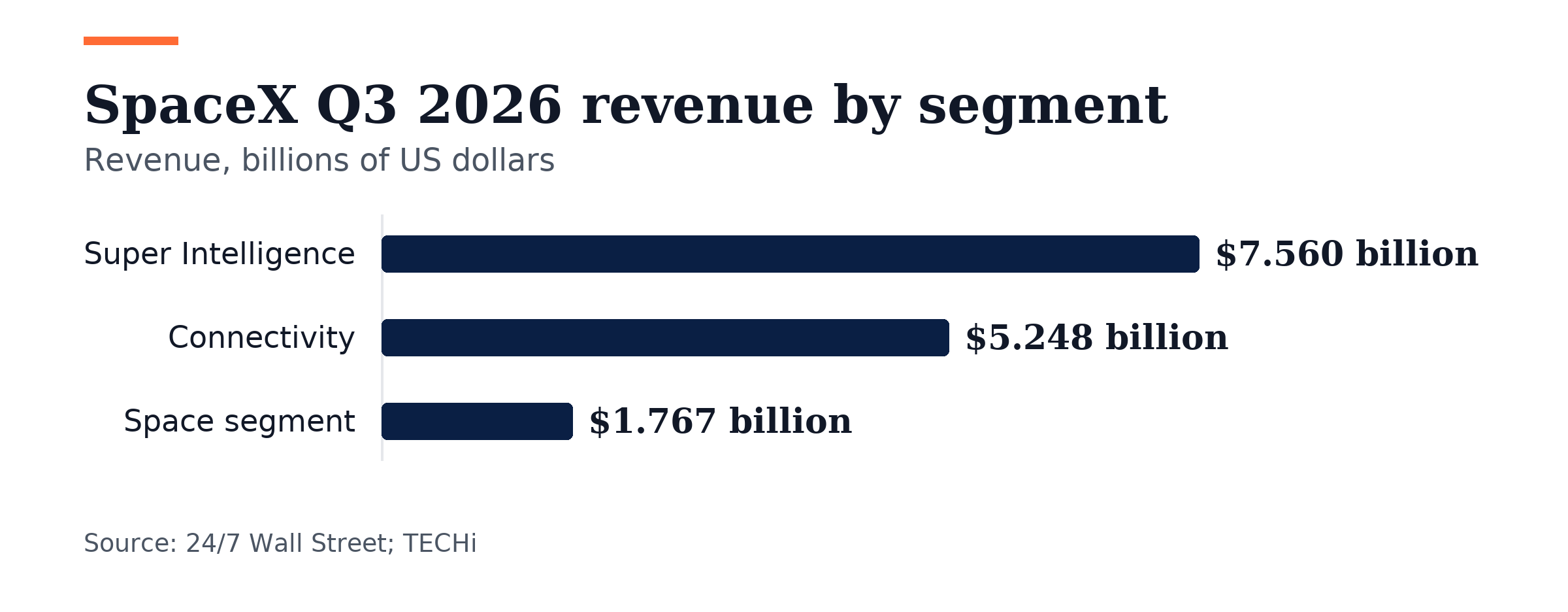
- Super Intelligence revenue of $7.560 billion exceeded Connectivity revenue of $5.248 billion in Q3, the first time the AI unit outpaced Starlink.
- Connectivity revenue increased 69 percent year over year to $5.2 billion in Q3.
- SI recorded its first operating profit of $431 million following $1.2 billion in Cursor-related stock compensation.
- Cursor, acquired Aug. 14, added $608 million to SI revenue.
SpaceX recorded a profit in Q3 2026, the first since the company went public, the company said on its Oct. 20 earnings call.
SpaceX reported Q3 2026 revenue of $14.6 billion, up 161 percent from a year earlier and 87 percent from the $7.814 billion in Q2 2026, topping the $12.7 billion analysts expected. Net income reached $4.4 billion, compared with a $1.054 billion loss in Q3 2025, though the company remained $413 million in the red for the nine months to Sept. 30.
Operating income swung to $2.791 billion from a $143 million loss in Q2, while adjusted EBITDA reached $8.8 billion, up 306 percent from a year earlier. Operations contributed $2.8 billion to the $4.4 billion profit, with $1.6 billion coming from outside the business, including $1 billion of other income, a $390 million tax benefit, and $198 million more in interest earned on cash than paid on debt.
The Super Intelligence segment produced $7.560 billion in revenue, exceeding Connectivity’s $5.248 billion for the first time and representing 51.9 percent of total company revenue, up from 15 percent a year earlier. SI revenue grew 195 percent from Q2, and the segment recorded its first operating profit of $431 million after $1.2 billion in Cursor-related stock compensation, for a 5.7 percent margin against 45.1 percent for Connectivity. Connectivity revenue increased 69 percent year over year to $5.2 billion, with enterprise and government revenue within the segment reaching $2.127 billion.
Starlink added 1.6 million consumer subscribers in Q3, reaching 13.6 million total, though the addition was fewer than the record 1.7 million in Q2. Consumer average revenue per user was $69 a month in Q3, up from $66 in Q2 but down from $83 a year earlier, a rise Johnsen attributed to a better mix of customers, though he warned expansion into new countries may pull ARPU down over time. Johnsen said kits sent to retail stores ahead of the holiday season should lift activations this quarter. Starlink Mobile passed 22 million monthly users, with Shotwell saying the service connects ordinary phones directly to satellites.
The unit holds contracts for about 12,000 aircraft, nearly a quarter of the total, and had equipped more than 3,800 aircraft by the end of September. Connectivity’s gross margin was 55 percent, including about 3 percentage points from one-time benefits mostly related to tariff refunds. Sales to businesses and governments rose 91 percent, driven by airlines and Starshield, the secure government and military version of Starlink. Musk said SpaceX sees a clear route to hundreds of billions of dollars annually in connectivity revenue.
The Cursor acquisition, which closed Aug. 14, added $608 million to SI revenue and was consolidated only from that date through Sept. 30, making Q3 a partial quarter for the unit. SpaceX reserved $23.4 billion of Cursor’s $60 billion value for stock awards to retain staff, to be expensed over about three years, and the awards affected SI’s Q3 operating profit.
Bret Johnsen now expects 2.5 to 3 gigawatts of nameplate compute by year-end, up from an August target of more than 2 gigawatts, and said at current pricing new compute deployments generate a payback of less than a year. Musk said he would be surprised if less than 13 gigawatts of compute comes online by the end of next year, revising an August view that end-2027 capacity lay closer to 10 gigawatts than 5. “I would be surprised if we brought on less than 13 gigawatts of compute by the end of next year.” — Elon Musk
CFO Bret Johnsen said at the Oct. 20 analyst call that capital spending will roughly double this quarter to $35 billion to $40 billion from $19.6 billion in Q3, reflecting extra data center capacity at company sites in Memphis, Tennessee, and Southaven, Mississippi.
Over the nine months to Sept. 30, SpaceX generated $13.1 billion from operations while spending $48.1 billion on property and equipment, a cash dynamic TECHi calculated as roughly negative $35.0 billion in free cash flow. Cash and short-term investments dropped 10 percent from the end of June to $89.9 billion by Sept. 30, while cash and equivalents stood at $51.294 billion at Sept. 30 after the company bought $46.8 billion of marketable securities during the nine months.
Johnsen guided first-quarter 2027 revenue to a range of $33 billion to $37 billion and kept the goal of a $100-billion annualized revenue run rate by December, calculated as December’s revenue multiplied by 12. To hit that target, SpaceX needs about $8.3 billion in revenue in December. The company disclosed a $63 billion backlog, with about $42 billion due within a year, and Johnsen repeated a $100 billion year-end annual recurring revenue goal. Musk projected $500 billion to $1 trillion in ARR by end of 2027.
SpaceX shares rose 7.8 percent on Oct. 21 before erasing the gain and closing Friday at $147.49. Diluted EPS was $0.35, beating expectations of about $0.14; Shacknews reported the result beat the $0.11 share estimate and the $0.18 whisper number.
SpaceX flew 35 launches in Q3, with 12 for customers and 23 internal, and completed its first revenue-generating Starship mission. The Space segment brought in $1.767 billion and nearly broke even with a $7 million operating loss, compared with a $542 million loss in Q2. Starship Flight 14 flew during the final week of September, reached orbit for the first time and deployed 26 Starlink V3 satellites. Flight 15, expected next month, will see an attempt to catch the booster and the ship, with Musk putting the odds of a double catch at better than even.
SpaceX reached a deal on Oct. 8 to buy 800 MHz licenses across the country from Grain Management, pending regulatory approval. Musk said SpaceX and Tesla formed special committees of independent directors to weigh a merger at shareholders’ request, with no agreement reached; Wedbush’s Dan Ives was reported estimating an 80 to 90 percent chance of a merger by the end of 2027.



Join the discussion