According to Assistant Professor Haiyang S. Wang and Professor Anders Johansen, on October 7, 2026, they published a study in Nature Astronomy concluding that Earth and Mars formed through different processes.
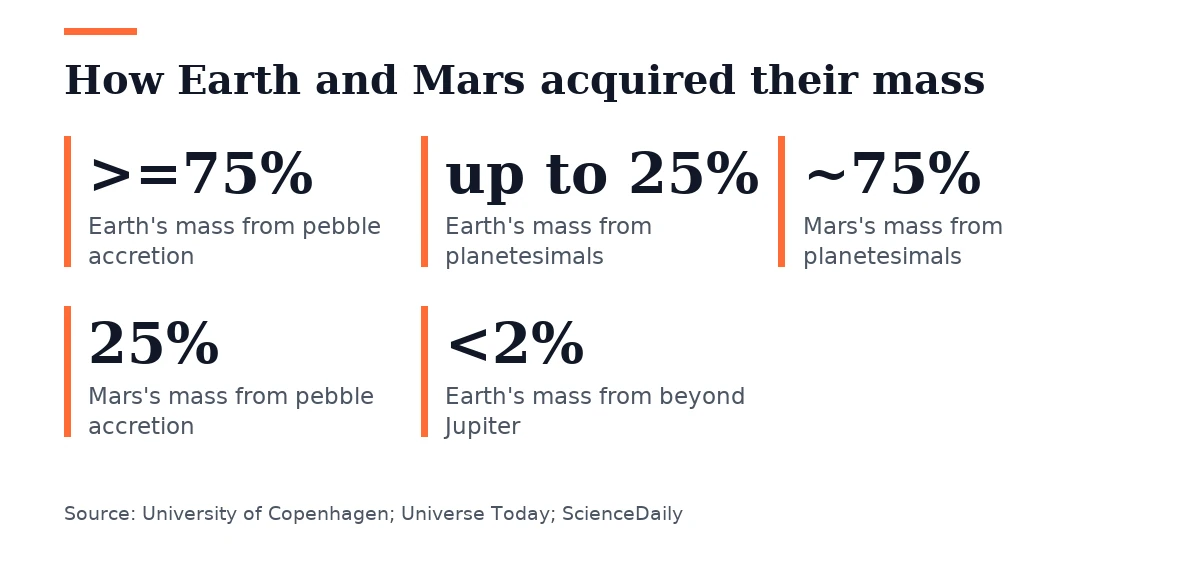
The team examined volatile elements such as sodium, zinc, and potassium in the crust and mantle of Earth and Mars to infer their formation histories. The authors stated that their chemical‑based method offers a more precise and direct view of planet formation than the traditional isotope‑based approach, which can yield interpretations. The researchers found that two protoplanets that grew by accreting pebbles account for at least 75% of Earth’s mass, while planetesimals contributed up to 25%. They found that approximately 75% of Mars’s mass derives from planetesimals, with the remaining 25% coming from pebble accretion.
On October 7, 2026, the results supported a hybrid formation model in which both pebble accretion and planetesimal collisions played roles, but the relative contributions differ between the two planets. On October 7, 2026, even after testing alternative assumptions about the early Solar System’s composition and the efficiency of volatile loss during pebble accretion, the core conclusion that Earth and Mars formed differently remained robust.
New research shows Earth and Mars built their masses in different ways, according to a study led by Assistant Professor Haiyang S. Wang and Professor Anders Johansen of the University of Copenhagen’s Globe Institute. On October 7, 2026, the researchers noted that upcoming facilities such as the Habitable Worlds Observatory, expected to go into operation in the 2040s, and ground‑based observatories with adaptive optics will enhance exoplanet studies.



Join the discussion