Key facts
- ETH Zurich researchers found that asteroid Bennu formed near the water-ice line, where inner and outer Solar System materials mixed, around 4.5 billion years ago.
- Bennu’s chemical composition closely resembles the Sun’s elemental mix, suggesting it preserves the original ingredients from which terrestrial planets, including Earth, were built.
- Bennu's iron and titanium isotopic fingerprint matches neither inner solar system rocky material nor icy material beyond Jupiter; it is a hybrid of both regions, according to the ETH Zurich team.
- NASA’s OSIRIS-REx mission collected ~120 grams of Bennu’s surface material in 2023 and delivered it to Earth on September 23, 2023, with half a gram allocated to ETH Zurich for analysis.
ETH Zurich researchers reported September 24, 2026, in Science Advances that asteroid Bennu formed near the water-ice line roughly 4.5 billion years ago, based on isotopes measured in material returned by NASA’s OSIRIS-REx mission.
The ETH Zurich team, led by Maria Schönbächler of the Institute of Geochemistry and Petrology, analyzed half a gram of Bennu’s sample using multi-collector inductively coupled plasma mass spectrometry (MC-ICPMS). The method measures isotope ratios with microgram-scale precision, and isotopes are different forms of the same element with varying neutron counts. Iron and titanium spread evenly through the material.
The isotopic fingerprint matches neither inner Solar System rocky material nor icy material beyond Jupiter, the ETH Zurich team found. “Bennu is a hybrid: the material does not clearly match either the inner or the outer Solar System,” says Schönbächler. Bennu’s iron, titanium, and chromium fingerprint matches Ryugu and CI meteorites, distinguishing it from other asteroids, meteorites, and planets.
ETH Zurich researchers say Jupiter’s rapid growth within one million years of the Sun’s birth opened a gap in the protoplanetary disc. The gap acted as a filter that blocked coarse material while allowing fine dust from both inner and outer regions to circulate and mix near the water-ice line. Fine dust crossed the gap while coarser, regionally differentiated material was screened out, leaving Bennu with a hybrid composition resembling the Sun’s elemental mix.
Tech Times reports that the gap created a pressure peak outside it, a ring of higher pressure that stalled pebbles and boulders while fine dust drifted freely across the zone. Water vapor drifting outward from the inner disk condensed onto dust grains near the water-ice line, providing extra glue that helped fine particles stick together, according to the ETH Zurich scenario.
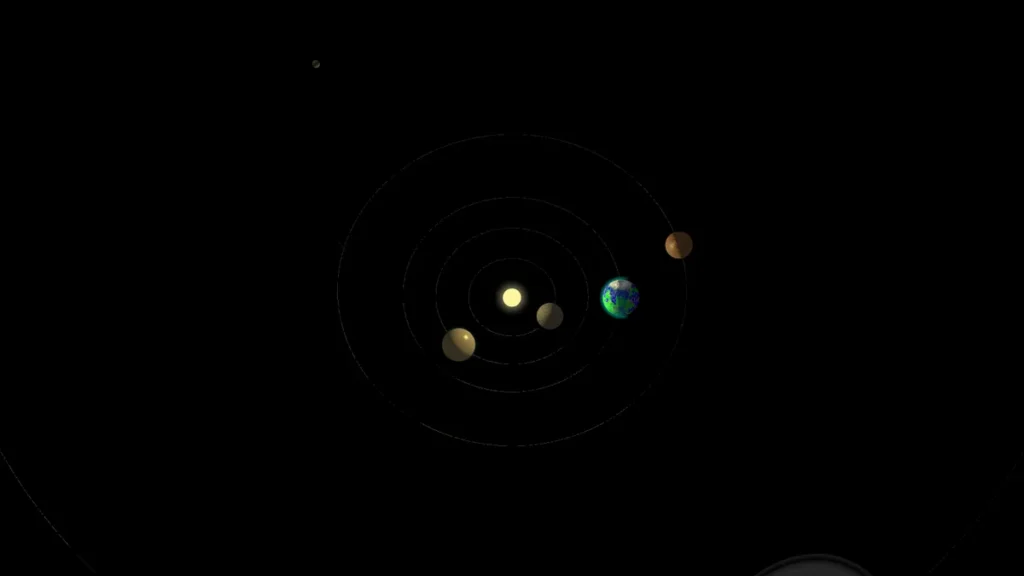
The water-ice line lies at about 150 to 170 Kelvin, or minus 190°F to minus 155°F, roughly two to three astronomical units from the Sun, placing it in the current asteroid belt. Ice evaporation and condensation enriched Bennu’s parent body with water and organics. The body experienced aqueous alteration, shown by water-bearing clay minerals, indicating liquid water was present during formation near the line.
The ETH Zurich team found that Bennu’s chemical composition closely resembles the Sun’s elemental mix, suggesting it preserves the original ingredients from which terrestrial planets, including Earth, formed. The asteroid’s water-bearing minerals and organic compounds point to formation in a zone where ice processes enriched the material. Bennu’s material also contains amino acids and organic compounds directly relevant to prebiotic chemistry.
The findings contradict earlier ideas that primitive asteroids like Bennu formed in the outer Solar System, where comets originated, and came together late. Researchers held both assumptions, and the new data challenges them. The even distribution of iron and titanium through Bennu’s material is part of the chemical fingerprint that led the team to classify the asteroid as a hybrid rather than a single-region body.
NASA’s OSIRIS-REx spacecraft briefly touched Bennu’s surface in Oct. 2020 and collected about 120 grams of surface material. The capsule delivered the sample to Earth on September 23, 2023, and ETH Zurich received half a gram. Tech Times reports the capsule landed in the Utah desert on September 24, 2023, carrying 121.6 grams, the largest asteroid sample returned to Earth since Apollo.
A Lawrence Livermore companion analysis confirmed the ETH Zurich isotope results using a separate subsample of the same Bennu material, according to Tech Times. Fewer than 10 CI chondrite specimens totaling roughly 37 pounds, or 17 kilograms, exist on Earth, and they serve as the standard reference for bulk Solar System composition.
Tech Times reports that an Aug. 2026 Nature Communications paper co-authored by Schönbächler and a University of Copenhagen team found that Bennu and Ryugu preserve isotopic heterogeneity in magnesium, silicon, and iron absent from CI chondrites.
JAXA’s Martian Moons eXploration mission is launching in late Oct. 2026, and Maria Schönbächler plans to apply for access to analyze Phobos samples. Tech Times reports the mission will launch from Tanegashima in Oct. 2026 and return at least 10 grams of Phobos material by Jul. 2031 as a joint project of JAXA, NASA, ESA, CNES, and DLR. If Phobos matches Bennu’s and Ryugu’s isotopic fingerprint, it likely is a captured carbonaceous asteroid; a mismatch would point to a giant-impact origin and alter understanding of Mars’s evolutionary history, according to the ETH Zurich team.
Bennu completes one orbit around the Sun every 1.2 years and approaches Earth about every six years, passing within roughly 300,000 kilometers, or 186,000 miles. Gizmodo says researchers believe Bennu originated from a larger carbon-rich asteroid roughly 700 million to 2 billion years ago, and the fragment moved closer to Earth over that time.
OSIRIS-REx principal investigator Dante Lauretta of the University of Arizona will lecture on Bennu’s ancient waters and asteroid sample chemistry at the Arizona Astrobiology Center on November 4, 2026.



Join the discussion