
Key facts
- The Martian Moons eXploration (MMX) spacecraft will launch on an H3 rocket from Tanegashima Space Center.
- The spacecraft consists of three modules: propulsion, exploration, and return, with only the return module bringing samples to Earth.
- The spacecraft carries 13 instruments, including a Franco‑German rover, a NASA sampling device, a gamma‑ray instrument, and an ESA deep‑space communication device.
- Landing on Phobos is challenging due to its gravity being about one two‑thousandth of Earth's gravity.
Japan plans to launch the world’s first mission to return samples from Phobos, Mars’s larger moon, with liftoff scheduled for Tuesday at 4:41am Japan time from the Tanegashima Space Centre.
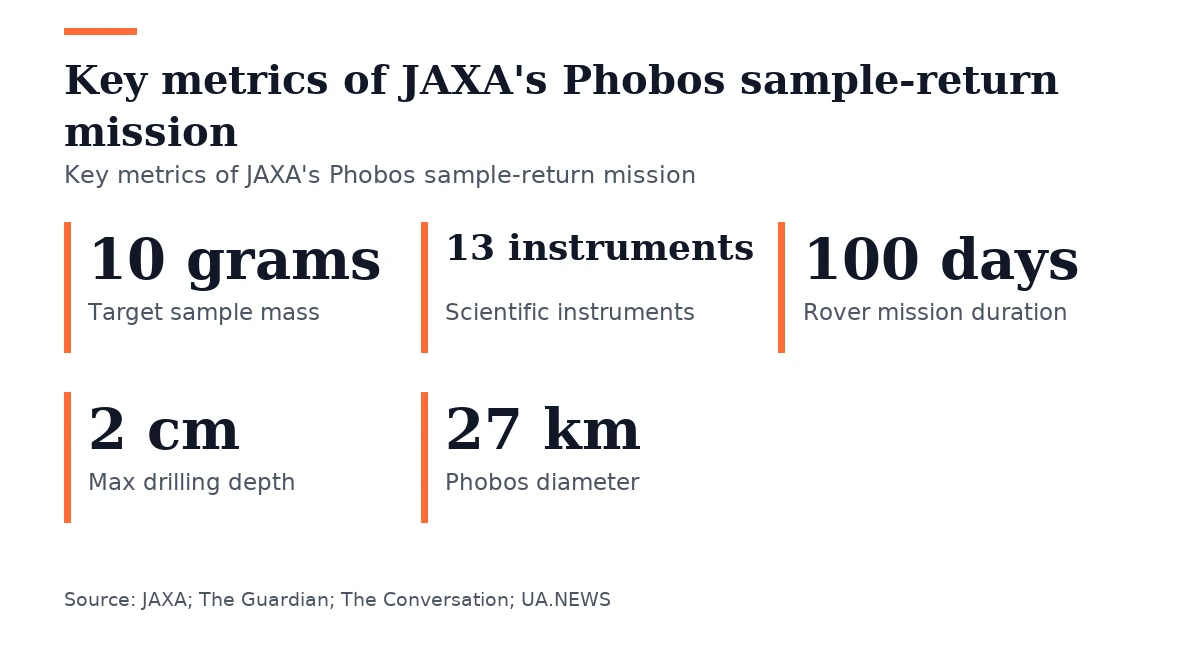
JAXA’s MMX spacecraft will launch on an H3 rocket from Tanegashima to collect at least 10 grams of Phobos soil and return it to Earth by 2031.
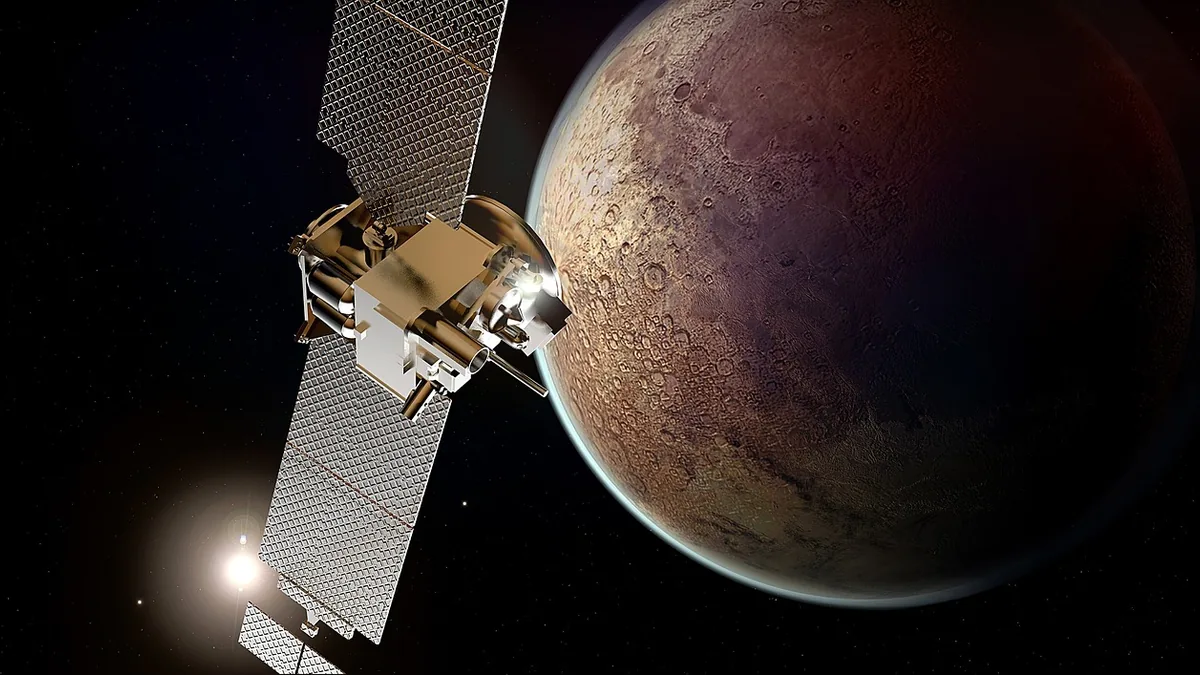
The MMX spacecraft consists of three modules—propulsion, exploration, and return—with only the return module designed to bring samples to Earth. It carries 13 instruments, including a Franco‑German rover, a NASA sampling device, a gamma‑ray instrument, and an ESA deep‑space communication device. The H3 rocket carrying the MMX spacecraft is scheduled to launch on Tuesday at 4:41, or at 19:41 GMT on Monday. According to The Conversation, instruments Tengoo and Orochi cameras, Lidar altimeter, MIRS infrared spectrograph, and Megane gamma‑ray detector will map Phobos’s surface and composition.
The Franco‑German rover Idefix will land on Phobos first, during a 100‑day mission around 2029, to explore the surface and aid later Japanese soil‑sampling. Its wheels provide traction in low gravity, allow it to self‑right if tipped, and move at a snail’s pace. In early 2029 the exploration module will deploy Idefix from 40‑100 m altitude to land on Phobos, and the rover will operate for about 100 days using sensors such as a Raman spectrometer and radiometer to select a landing site.
Landing on Phobos is challenging because its gravity is about one two‑thousandth of Earth’s gravity. According to The Guardian, to reduce bounce at touchdown, the exploration module has four‑legged landing gear with shock absorption. Phobos is about 27 km (17 mi) in diameter and orbits Mars at roughly 6,000 km (3,700 mi) three times per day.
JAXA scientists plan to collect samples using a NASA pressurised‑gas device and a Japanese coring method that reaches about 2 cm depth. According to The Conversation, the C‑sampler can drill a core up to 2 cm deep, providing material unaltered by solar radiation. According to The Conversation, the P‑sampler uses nitrogen gas to lift soil and loose pebbles into a collection chamber. According to The Conversation, the P‑sampler carries a small risk of toppling the spacecraft in Phobos’s low gravity.
Samples will be stored in a heat‑protected capsule designed to survive Earth reentry and are expected to land in Australia before transport to Japan. According to The Conversation, after sampling, the spacecraft will leave Phobos, discard landing gear, and return to Earth, arriving in 2031. Collecting samples from multiple locations increases chances of detecting any past microbial life from Mars.
The spacecraft is expected to reach the vicinity of Mars approximately one year after launch. According to The Conversation, the spacecraft will first circle Mars before slipping into orbit around Phobos about a month after arrival. After arrival, MMX will spend up to three years orbiting Phobos to collect data and samples before returning to Earth.
The mission’s key objective is to determine how Phobos and Deimos formed and what they are made of. “Despite their potential importance, Martian moons have never been fully investigated,” Kawakatsu said. Some scientists think Phobos and Deimos are remnants of debris from a large impact on Mars, while others think they are captured asteroids. Analysing Phobos soil samples should allow scientists to almost certainly conclude the moons’ origin.
According to The Guardian, samples from Phobos may also contain about 0.1 % Martian material, offering insight into Mars’s surface. According to The Guardian, while no landing is planned, MMX will observe Deimos to gather data on the smaller moon.
According to UA.NEWS, the mission is intended to be the first round‑trip to the Martian system. According to UA.NEWS, the mission involves collaboration with France’s CNES, Germany’s DLR, NASA, ESA, and about 20 universities and technology companies. According to JAXA, the mission hopes to help develop technologies needed for future human exploration of Mars and assess Phobos as a potential staging point.
According to The Conversation, Japan’s Hayabusa2 mission returned 5.4 grams of asteroid material in 2020, demonstrating the country’s sample‑return capability. According to The Conversation, JAXA’s earlier Hayabusa missions (2003‑2010 and 2018‑2020) proved it can return asteroid samples. According to The Conversation, Russia’s Phobos Grunt attempt in 2011 failed to leave Earth orbit after reaching low Earth orbit. According to Daily Minute Mirror, China plans to launch a sample-return mission around 2028, aiming for a possible return by 2031.
According to The Conversation, Phobos’s gravity is about 0.1 % of Earth’s, allowing a human to jump roughly 1.5 km horizontally. According to The Conversation, MMX will also test communication with a newly developed ground station after launch. According to The Conversation, the mission may provide a “lite‑version” of the Mars Sample Return, as Phobos could have collected Martian surface material ejected by impacts.
According to The Conversation, budgetary pressures led the US Congress to effectively cancel the Mars Sample Return program. According to The Conversation, if successful, MMX samples could offer a consolation prize for scientists seeking Martian material.




Join the discussion