Scientists reported Oct. 23, 2026 in the journal Science Advances that they tested whether high-pressure ice phases VI and VII can incorporate glycine and alanine, thick layers that separate subsurface oceans from rocky interiors on large icy moons and exoplanets.
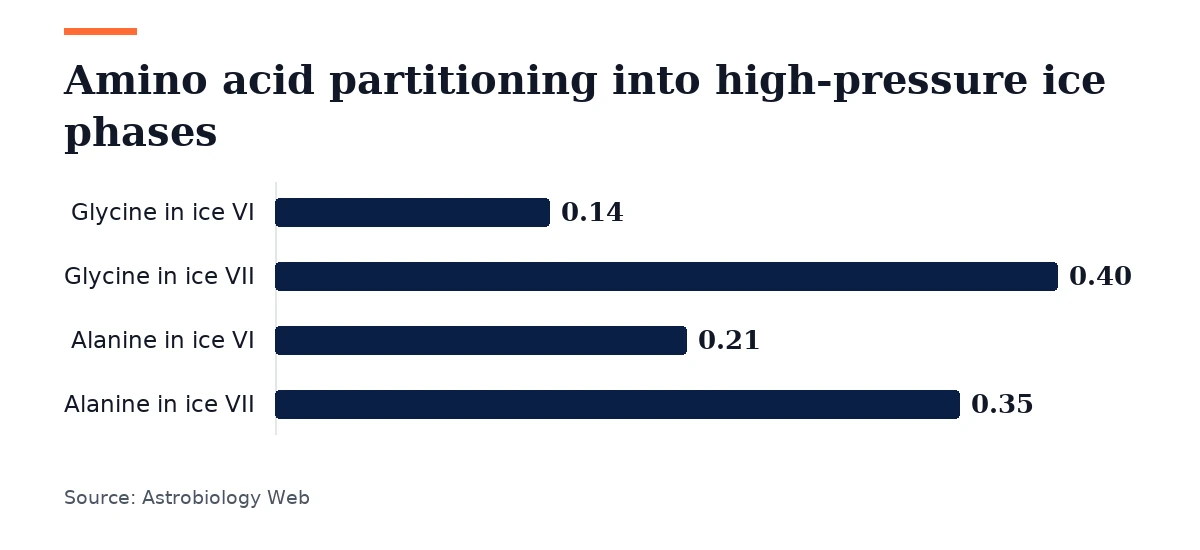
Astrobiology Web reports that scientists used a diamond-anvil cell under raised temperature and pressure to measure how glycine and alanine enter ice VI and ice VII. Glycine showed a partition coefficient of 0.14 in ice VI and 0.40 in ice VII; the coefficient measures how readily the amino acid enters the ice. Alanine showed a partition coefficient of 0.21 in ice VI and 0.35 in ice VII.
Astrobiology Web reports that first-principles calculations indicated that the lattice of high-pressure ice could incorporate amino acids through cogrowth, meaning the compounds become part of the growing crystal structure. The paper states that amino acid compatibility with high-pressure ices would favor transport of the compounds through large extraterrestrial oceans and open an avenue to habitability.
Astrobiology Web explains that thick layers of high-pressure ice separate water oceans from rocky interiors on large icy moons and exoplanets, blocking the direct release of nutrients and organics formed through water-rock interaction. The report frames the results as relevant to whether these ice shells hinder or allow chemistry that could support life. Science Advances published the paper “How high-pressure ices on large ocean worlds can support habitability: The compatibility of amino acids into ice VI and VII”.

Join the discussion