Key facts
- HRI will serve as HWO's main imaging camera while also providing grism spectroscopy, sub-microarcsecond astrometry, fine guidance, wavefront sensing, and pupil imaging of the observatory's segmented primary mirror.
- In orbit, operators can select readout modes that capture the full field using exposures of 10 seconds or longer, or smaller windows supporting observation rates up to 1 kilohertz.
- HWO will need astrometry to determine planet masses, and a precision of 10 percent is essential to avoid degeneracy that would prevent identification of the dominant background gas in a planet's atmosphere.
- For an Earth-like planet at a distance of 10 parsecs, the astrometric signal measures roughly 0.3 microarcseconds, equivalent to 0.3 millionths of a single arcsecond, within a sky of 1,296,000 arcseconds.
A UK-led consortium with a French partner has proposed a design concept for the High Resolution Imager aboard NASA’s Habitable Worlds Observatory, detailed in preprint arXiv:2610.29957 submitted on Oct. 21, 2026.
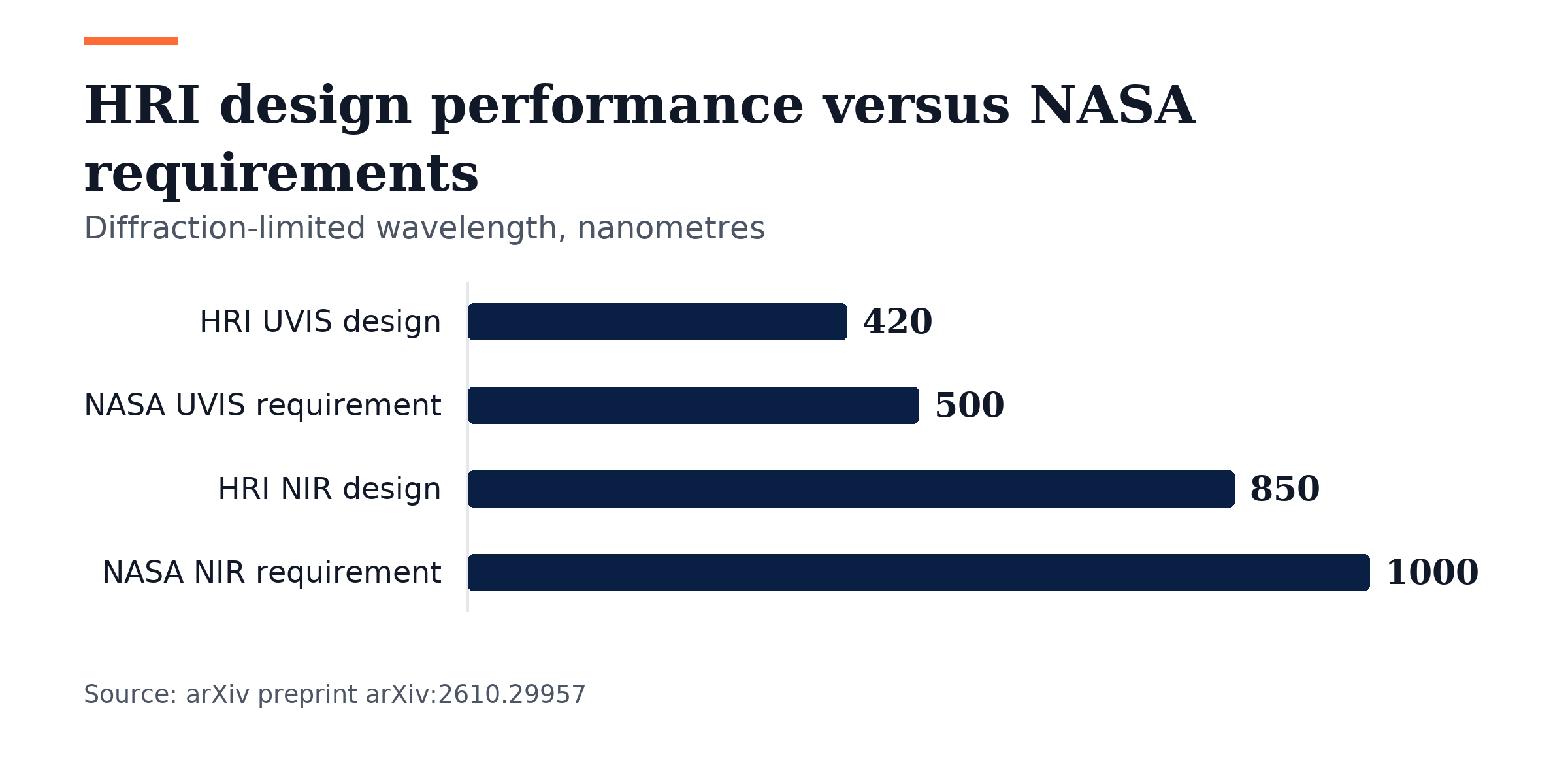
The UK Space Agency funded the study, carried out through two intensive sessions at a Concurrent Design Facility, while a French partner takes responsibility for the astrometric channel. The consortium maintained daily contact with NASA staff, so the design could track the evolving mission architecture. HRI will serve as HWO’s main imaging camera while also providing grism spectroscopy (a prism–grating that spreads light into a spectrum), sub-microarcsecond astrometry, or precise positional measurement, fine guidance, wavefront sensing (measuring and correcting distortions in light waves) and pupil imaging of the observatory’s segmented primary mirror.
Because the telescope cannot be pointed or aligned without it, HRI is observatory infrastructure rather than a deferrable instrument and cannot be pushed to a servicing mission. The astrometric channel has its own focal plane fed directly by the telescope with no foreoptics, minimising field distortion and adding stability, and it is the single largest consumer of HRI’s thermal and power budgets. It is required by 33 of the 76 science investigations in NASA’s 2023-25 START portfolio, more than any other instrument.
The optical design collimates light from a 3-arcminute by 2-arcminute field using two mirrors, then splits it with a dichroic, a wavelength-dividing filter, for simultaneous ultraviolet-to-visible observations from 200 to 900 nanometres and near-infrared observations from 0.9 to 2.2 micrometers. A forward interchange mechanism at the centre of the imager reconfigures both arms ahead of the split.
In orbit, operators can select readout modes that capture the full field using exposures of 10 seconds or longer, or smaller windows supporting observation rates up to 1 kilohertz. The beam is divided at 900 nanometres to suit the infrared detector’s short-wavelength limit and keep the silicon channel in its useful quantum efficiency range.
The UVIS front-end electronics sit immediately behind the UVIS focal plane assembly but outside the cold enclosure, keeping the imager’s largest dissipator out of the volume that must reach 178 kelvin. The design specifies HWO’s telescope environment as thermally stable at the millikelvin level, driving an isothermal optical bench and placement of dissipating elements outside the cold enclosure.
HWO is intended to launch around 2040 and, when operational, will be the most capable telescope ever flown, according to the design concept paper. The observatory is the large ultraviolet, optical and infrared telescope recommended by the 2021 US decadal survey from the National Academies of Sciences, Engineering, and Medicine. At least three instruments are expected aboard HWO at launch: a coronagraph, a multi-object spectrograph and the High Resolution Imager.
The HRI concept was baselined against EAC-1, a 6-metre off-axis segmented telescope with a room-temperature optical train and an L2 orbit. Candidate architectures EACs 2 through 6 remain under consideration, and the next study phase will adopt some of these designs.
The consortium groups HRI science cases as Living Worlds, Solar System in Context, Evolution of the Elements and Galaxy Growth. Field-of-view drivers include galaxy cluster cores at 3 by 2 to 3 by 3 arcminutes, Saturn and Jupiter rings at 2 by 2 arcminutes, protoplanetary discs at 2 by 2 arcminutes, and Venus at 1 by 1 arcminute. The instrument will support transmission and emission spectroscopy and phase curves of transiting planets, sub-Neptunes and candidate water worlds.
Short-wavelength drivers include hydrogen in Titan’s atmosphere at 120 nanometers and carbon monoxide on Mars at 180 nanometers, while the long-wavelength baseline is 2.2 micrometers for Mars hydrated minerals at 1.9 to 2.5 micrometers and the K atmospheric window. HRI will track moving targets for planetary defense and observe ocean worlds Europa, Enceladus and Ceres, plus Venus and giant planets with ring systems.
HRI will also count dark matter substructure through dwarf galaxies and gravitational lensing, resolve stars in nearby galaxies, and measure Cepheids and tip of the red giant branch for the distance ladder. HRI is on the critical path for HWO’s headline result because interpreting an exoplanet atmosphere spectrum requires knowing the planet’s mass.
HWO will need astrometry to determine planet masses, and 10 percent precision is essential to avoid degeneracy that would prevent identification of the dominant background gas in a planet’s atmosphere. Without that precision, atmospheric models cannot distinguish between nitrogen, as in Earth’s atmosphere, or carbon dioxide, as on Venus.
The standard radial velocity method measures a star’s spectral wobble, but an Earth-sized planet orbiting a sun-like star produces a signal of only 9 centimetres per second, easily drowned out by stellar surface activity. About 30 percent of HWO’s target list consists of hot rotating A and F-type stars for which radial velocity measurements are essentially impossible.
For an Earth-like planet at a distance of 10 parsecs, the astrometric signal measures roughly 0.3 microarcseconds, or 0.3 millionths of an arcsecond, within a sky of 1,296,000 arcseconds. The authors suggest using the Gaia G band for HWO astrometry because it balances diffraction limits and background star density.
They propose a dedicated 200-day astrometry survey spread throughout HWO’s 5-year primary mission, with roughly 100 observations of each target star, to measure the masses of about 40 habitable-zone Earth-like planets to 10 percent precision.
Separately, researchers at the University of Central Florida’s College of Optics and Photonics are developing PEEPSS, the Photonics-Enabled Exoplanet Spectroscopic System, a NASA-funded effort to help astronomers directly image planets concealed by the brilliant glare of their host stars. A host star with a planet in the habitable zone is typically 10 billion times brighter than the planet, according to principal investigator Stephen Eikenberry.
PEEPSS carries out wavefront sensing at the telescope’s focal plane to catch and fix non-common-path aberrations (optical errors introduced after the light path splits) appearing after starlight travels through a coronagraph. It uses photonic lanterns, fiber-optic devices that sort incoming light into separate optical channels, recovering brightness and phase information that conventional imaging systems typically discard.
The current three-year project, supported by NASA award No. 80NSSC26K0577, builds and tests prototype photonic lantern systems in laboratory and telescope environments. PEEPSS collaborators include the University of Central Florida, the University of California Santa Cruz, the University of Sydney and the Space Telescope Science Institute.
The team includes graduate student Genevieve Markees and researchers Rodrigo Amezcua Correa, Miguel Bandres and Jose-Enrique Antonio-Lopez working with Eikenberry. Researchers have tested prototype photonic lantern systems on telescopes in Hawaii with the Air Force Research Laboratory and international partners. The University of Central Florida supported initial concept development through its SPICE Academic Excellence Program.
Starlight leakage of one part in a million through a coronagraph remains 10,000 times brighter than an exoplanet, Eikenberry says. He offered an analogy: “Imagine you’re in a house and you want the entire house to be perfectly clean”. PEEPSS enables quantum-inspired imaging, which uses light behavior to improve resolution and filter out remaining starlight. UCF and the University of Sydney are the only two major centers doing cutting-edge work on photonic lanterns, according to Eikenberry.



Join the discussion