Key facts
- The Callisto Surface Composition Analyzer will be a Raman spectrometer that uses laser light to analyze rock composition.
- The plan for Tianwen-4 was first outlined in 2020 and will likely be changed, including possible changes to the orbiter's instrumentation, mapping camera, and resolution.
- JWST detected a 4.25-micrometer spectral band representative of dry ice, or frozen CO2, on Callisto's surface, though CO2 should not naturally remain stable without some form of entrapment or replenishment mechanism.
- JWST detected a very faint atmosphere on Callisto primarily made up of CO2, extremely patchy, with the highest concentration around the Valhalla basin.
On Nov. 13, 2026, the China National Space Administration said it had started asking for scientific instrument proposals for Tianwen 4, a robotic mission to study Jupiter and land on Callisto.
CNSA framed the announcement as work on scientific equipment, not a confirmed launch date or finalized mission architecture, making it a stated intention rather than an approved, funded mission. The Lunar Exploration and Space Engineering Center is asking for research and development proposals covering 12 scientific payloads split between the orbiter and lander. The agency is seeking proposals from domestic groups and international collaborators to improve performance and success.
Tianwen 4 aims to orbit Jupiter, explore Callisto from orbit and from the surface, and advance research on the Jovian system. The orbiter will carry 10 scientific instruments split between two research areas: studying Jupiter’s space environment and examining Callisto’s surface. The lander will carry two scientific payloads: the Callisto Surface Composition Analyzer and the Callisto Lander Magnetometer.
One instrument group on the orbiter will study Jupiter’s magnetosphere — the region of space dominated by its magnetic field — with detectors for magnetic fields and waves, particle analyzers, a soft X-ray spectrometer, and a far-ultraviolet imager. They would study auroras, interactions between the magnetosphere and solar wind, and energetic particles around the gas giant. A second group will focus on Callisto through remote sensing, using cameras, a laser altimeter, a visible-infrared imaging spectrometer, and a gamma-ray spectrometer to characterize terrain, identify surface materials, and look for signatures tied to radioactive elements.
Remote sensing data from the orbiter could give a fuller picture of Callisto’s geological history and point to areas worth exploring on the surface. One of its visible light imaging cameras, the wide-angle camera known as JWAC, maps Callisto’s surface and topography. From a 300 km mapping orbit, JWAC will operate at about 90 meters per pixel.
Galileo took the best existing surface images, seeing most of the moon at poor resolution and only some small areas at tens of meters per pixel. Galileo flew within 138 km of Callisto, but that encounter took place 25 years ago. Improved camera technology since Galileo’s era makes the planned 300 km orbit significant for modern mapping.
With an ancient, cratered, and stable surface, Callisto is a geologically quiet place compared to Io. The moon does not experience the tidal heating and constant volcanic upheaval that affect Io, and it has no mountains or volcanoes, only ancient craters stacked on ancient craters. Its surface is heterogeneous on a small scale, with bright patches that appear to be pure water ice, other patches that look like a mixture of rock and ice, and larger darker areas that are not ice. Because orbital images are unlikely to have changed by the time a lander arrives, hazard avoidance should be easier.
Callisto sits outside Jupiter’s powerful radiation belts, where radiation can degrade sensitive instruments after brief exposure. Surface radiation doses are weaker on Callisto and will not take such a heavy toll on sensitive electronics. The moon also has a shallower gravity well than the other Galilean moons, which are deeper inside Jupiter’s magnetic fields and radiation belts and are much more hazardous to visit.
Atmospheric braking cannot slow a landing on Callisto because the moon has no atmosphere. Signals take about 35 to 50 minutes to reach Callisto, so a round trip doubles that wait and the lander must touch down autonomously. These factors combine to make the descent a demanding, self-guided operation.
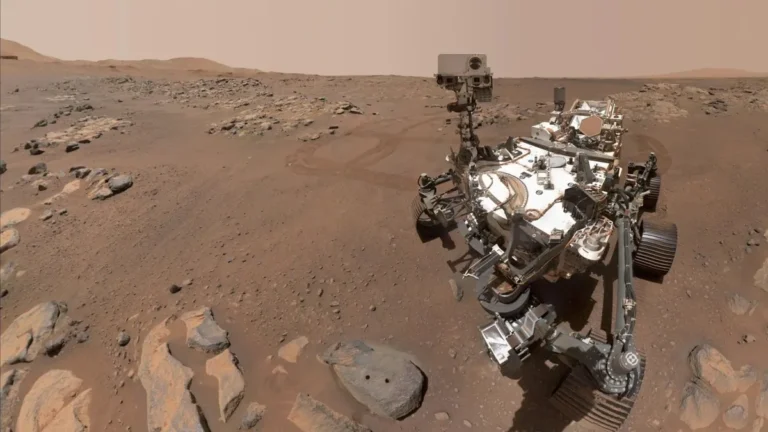
A Raman spectrometer called the Callisto Surface Composition Analyzer studies rock composition with laser light. Raman spectrometers are turning into a standard part of planetary missions. NASA’s Perseverance rover uses an ultraviolet Raman spectrometer for fine-scale mineralogy and organic matter detection, while ESA’s Rosalind Franklin rover and JAXA’s Martian Moons Explorer also carry them. It should determine whether carbon on Callisto’s surface is primordial or altered and should resolve the makeup of bright ice patches, rock-ice mixtures, and darker non-ice areas.
If the Raman spectrometer finds that some surface composition is aqueously altered, such a finding would support the idea of a subsurface ocean on Callisto. Its internal structure is uncertain but seems differentiated, with ice layers over a rock and metal core, and it may hold a saltwater ocean, though that remains uncertain. Callisto seems partially differentiated, and magnetometer data are unclear about whether an ocean exists.
The Callisto Lander Magnetometer will measure local magnetic fields, and combined with orbiter magnetometer data it should separate ionospheric signals from surface signals to reveal more about the interior, especially a potential subsurface ocean. The lander’s instruments would not see an underground ocean directly, but their measurements could provide evidence relevant to its existence and properties. Researchers hope to separate magnetic signals tied to Callisto’s ionosphere from signals that might come from deeper inside.
Earlier spacecraft observations hint that Callisto may hold a subsurface layer of electrically conductive liquid, possibly a salty ocean buried under its ice. Ganymede and especially Europa show strong evidence for subsurface oceans, but Callisto’s composition and structure are less certain. Understanding Callisto is an avenue to understanding Jupiter itself because the Galilean moons are expected to have formed in-situ rather than being captured objects.
An international team of astronomers led by Maria Camarca of Caltech gathered the JWST Near-Infrared Spectrograph data on Callisto. The Planetary Science Journal has accepted the study for publication, and it is available on the arXiv preprint server. NIRSpec observations looked at three views of Callisto: the trailing hemisphere, the giant Asgard impact basin, and Valhalla, the largest multi-ring impact structure in the solar system.
On the leading hemisphere, water ice distribution follows the terrain. Bright impact basins like Valhalla and Asgard and younger craters like Lofn and Heimdall show sharp spikes in water ice where impacts dug up fresh material. NIRSpec also detected a 3.1 micrometer Fresnel peak that indicates ice crystals and mapped water ice across the surface in fine detail.
On the trailing hemisphere, water ice forms a bullseye pattern that is weakest near the equatorial center and stronger at higher latitudes. The pattern is most likely shaped by plasma from Jupiter’s magnetosphere sweeping behind the moon and altering ice structure, with charged particles changing the ice in the process. Solid CO2 concentrates at the disk’s center on the trailing hemisphere, forming an anti-correlated pattern to water ice that supports the idea that particle radiation converts water ice and carbon-rich grains into CO2.
JWST found a 4.25-micrometer spectral band representing dry ice, or frozen CO2, on Callisto’s surface, though CO2 should not stay stable naturally without entrapment or replenishment. On the leading hemisphere, the strongest CO2 signal appears around Lofn and Heimdall craters, and because the craters are young the deposit is probably impact-derived and is the largest known CO2 reservoir not made by radiation. JWST detected a faint CO2-dominated atmosphere on Callisto.
The atmosphere is extremely patchy, with the highest concentration around the Valhalla basin, but it is misaligned with solid CO2 and hot areas, resembling Ganymede. This illogical pattern points to complex volatile processes that models still struggle to explain. JWST detected a clear absorption feature at 4.57 micrometers that current theory links to carbon-nitrogen-bearing compounds, and the signal is notably stronger on Callisto than on other Galilean moons.
The leading theory holds that irregular satellites regularly rain dust onto Callisto’s leading hemisphere, where nitrogen-rich minerals react with native carbonaceous material to form organic compounds. Scientists debate how the compounds arrive.
Valhalla is an old impact crater with concentric rings extending outward about 1,500 km and a bright central point that probably marks the original impact basin roughly 600 km across. Universe Today published a Voyager 1 mosaic of Callisto showing Valhalla as a large-scale feature with rings and a bright central point.
NASA launched Europa Clipper in October 2024 to study Europa, a Jovian moon believed to hold a subsurface ocean. Europa Clipper should reach Jupiter in April 2030 and make repeated close flybys of Europa to study its ice shell, composition, geology, and potential habitability. ESA’s JUICE mission is heading to the Jovian system and will use its high-resolution camera and spectrometer during planned 2030s flybys to capture more detailed images of Callisto’s surface than ever before. This could provide more insight into how the four Galilean moons differ.
China’s proposed Tianwen 4 mission takes a different primary target and scientific approach than Europa Clipper, planning to put instruments directly on Callisto’s surface. Focusing on Callisto will complement ESA’s JUICE mission, which targets Ganymede, and NASA’s Europa Clipper. Astronomy Magazine describes Tianwen-4 as China’s first voyage to the outer planets.
CNSA has discussed a Jovian system mission called Tianwen-4 since 2018, building on successes such as Chang’e 6, which collected the first sample from the lunar far side in 2024. As Yi Xu said, “The successful launch of the Chang’e 5 mission has inaugurated a new epoch in lunar science for Chinese scientists”. The mission is not designed to return samples, but it will attempt the challenging profile of landing on Callisto.
Phase two begins with two gravity assists — maneuvers that use a moon’s gravity to change a spacecraft’s speed or direction — at Callisto, then in February 2038 the spacecraft enters orbit around the moon, and the orbiter releases the lander sometime after that. Earlier planning points to a launch around 2029 on a Long March 5 heavy-lift rocket from the Wenchang Space Launch Center in Hainan province. The plan was first outlined in 2020 and will likely change, with possible revisions to the orbiter’s instruments, mapping camera, and resolution.
Despite the uncertainty, CNSA’s call for instrument proposals makes clear that China intends to land on Callisto. A 2024 report said Tianwen 4 would add a probe that continues to Uranus for a rare ice-giant flyby in the 2040s. However, a November 2026 social media post from CNSPACE said no Uranus flyby was mentioned in connection with Tianwen 4. Whether an Uranus leg remains part of the concept is unclear.
The Daily Galaxy reports that major challenges remain before Tianwen 4 can reach Jupiter, including instrument development, spacecraft integration, launch preparations, and the long trip between planets. It also notes that Jupiter lies hundreds of millions of miles farther from the Sun than Mars, which makes communication, navigation, power generation, and spacecraft operations especially challenging. The mission would also need to manage autonomous landing because of the long communication delay and lack of atmosphere.
After Ganymede, Callisto is Jupiter’s second-largest moon and one of the solar system’s most heavily cratered bodies. Its ancient surface preserves impact evidence stretching across billions of years, making it a valuable record of outer solar system conditions. The moon’s greatest scientific mystery may lie beneath its heavily cratered exterior.
Studying Jupiter’s magnetic environment and Callisto’s surface and interior could broaden understanding of how icy worlds formed, evolved, and preserved liquid water far from the Sun. Callisto may harbor clues to the history of the Jovian system.

Join the discussion