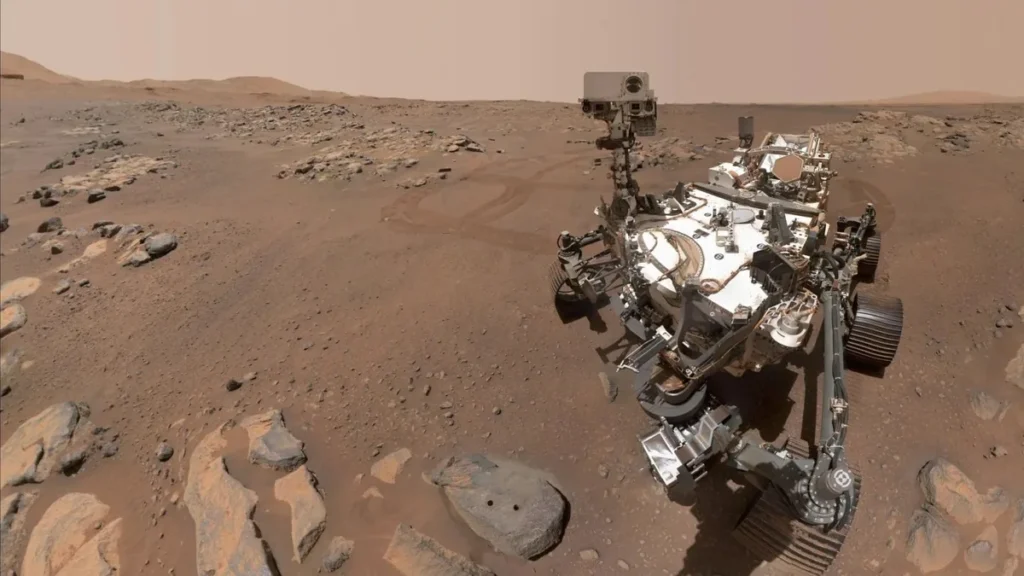
Key facts
- The Martian atmosphere is too thin and cold for liquid water to survive, while plentiful ice is thought to lie underneath the crust and surface ice remains especially around the poles.
- Researchers studied 738 craters using imagery from NASA's Mars Reconnaissance Orbiter and the ESA ExoMars Trace Gas Orbiter, building 3D maps from pairs of satellite images.
- Mars lies almost 600 times farther from Earth than the Moon.
- If confirmed as glaciers, the features could teach scientists about past ice ages on Mars and point to water reserves astronauts could tap on future missions.
On Nov. 17, 2026, an international team of researchers identified 29 steep, cliff-faced ice-rich deposits inside fresh impact craters in the Alba Mons region of Mars’s northern hemisphere, calling them an undescribed glacial landform on Mars.
The researchers studied 738 craters using imagery from NASA’s Mars Reconnaissance Orbiter and the ESA ExoMars Trace Gas Orbiter, building 3D maps from pairs of satellite images. The study team used orbital imagery and computer modeling to interpret how the glaciers formed and how the geology should be understood.
Downward slopes extend as far as 3 kilometers (1.9 miles) in some cases and end abruptly in sheer cliffs as high as 209 meters (686 feet). The researchers also examined similarly shaped features in Iceland as a comparison point for the Martian deposits.
Alba Mons is the largest volcano on Mars by surface area, spanning roughly the area of the contiguous United States, with a summit about 6.8 kilometers (22,000 feet) above the Martian reference elevation. A study published Nov. 4 in Science Advances reported unexpected hydrogen chloride gas spikes above Mars’s northern hemisphere during early summer over multiple Mars years, centered on volcanic fissures at the edges of Alba Mons.
Concentrations reached approximately 1.5 parts per billion, equal to roughly one or two molecules per billion molecules of atmospheric gas. NASA’s InSight lander detected more than 1,300 marsquakes during its mission, some possibly linked to underground magma movement.
The Martian atmosphere is too thin and cold for liquid water to survive, while researchers think plentiful ice lies underneath the crust and surface ice remains especially around the poles. Mars lies almost 600 times farther from Earth than the Moon.
Combined glacial flow and climate model outputs show the deposits are remnants of ice formed during a recent colder, high-obliquity period, preserved under favorable topographic conditions on pole-facing crater slopes. The researchers stated that Mars’s tilt has changed over history, shifting temperature patterns and the movement of water and ice. With further analysis, the newly discovered formation types might help determine when this part of Mars was most recently covered in ice and how the climate shifted.
The researchers wrote in their paper, published in Earth and Planetary Science Letters, that Viscous Flow Features, ice-rich landforms that record climate history in their internal structure and dynamics, are key to understanding the Late Amazonian climate history of Mars. The paper frames the ice-rich landforms as central to interpreting Mars’s recent climate evolution.
The morphology resembles steep termini of debris-covered or rock glaciers on Earth and has not been described for Martian debris-covered glaciers. Researchers compared the Martian glaciers to similarly shaped features in Iceland as a comparison point for interpreting debris-covered glaciers. Some cliffs show rocks that fell from the crater rim, traveled down the slope and collected at the bottom.
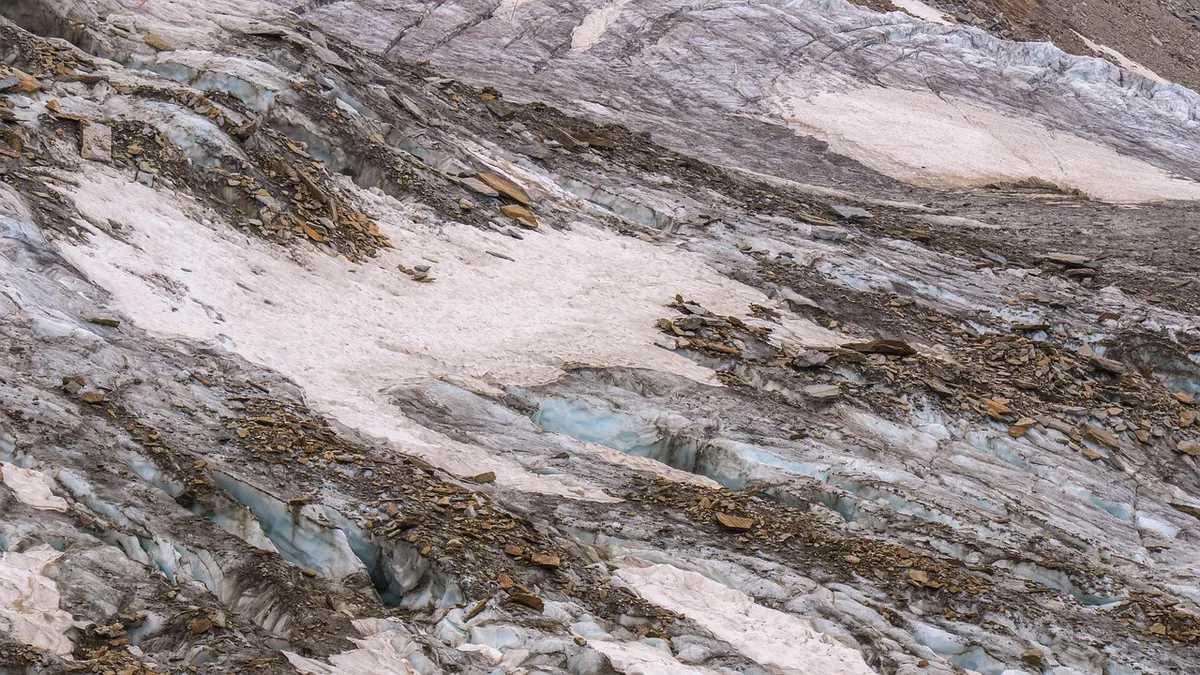
University of Arizona researchers led by Roberto Aguilar flew drones with ground-penetrating radar over Sourdough Rock Glacier in Alaska and Galena Creek Rock Glacier in Wyoming as Earth-based analogs for buried Martian glaciers, in work published May 1, 2026. The study appeared in the Journal of Geophysical Research: Planets. The University of Arizona study mounted ground-penetrating radar on drones for the first time, according to Roberto Aguilar.
The researchers flew drones at specific altitudes and speeds, in the direction of the glacier’s flow, with radar properly aligned to detect ice. Drone radar estimated debris thickness, assessed ice purity and spotted hidden rocky layers, and ground checks by excavating and drilling matched the radar measurements. Internal layers within buried glaciers represent different periods of ice accumulation and environmental conditions over centuries or millennia, and similar layers are likely present on Mars, according to Aguilar.
Debris-covered glaciers make up 5% of glaciers globally. These glaciers occur in mountain areas across the globe, including warmer parts of Colorado and California, where debris cover keeps ice from melting.
Current orbital radar technology cannot determine fine details such as debris layer thickness or internal rocky layers hidden from view on Martian glaciers, according to Roberto Aguilar. Researchers hope future Mars missions can use the drone methods to identify the best areas to drill into buried ice deposits and extract water locked beneath the surface for more than four billion years.
Buried ice deposits on Mars hold the best potential for finding evidence that microbial life may have once existed, although finding similar living microbes on Mars may be slim. Microbes on Earth live in buried glaciers and gradually break down rocks, which releases nutrients into meltwater. The researchers suggest similar subsurface environments on Mars could be promising targets in the search for past life.
If confirmed as glaciers, the features could teach scientists about past ice ages on Mars and point to water reserves astronauts could tap on future missions. The 29 glacier ice deposits are currently covered by rocks, dust and other debris that acts as protection against the atmosphere.
Images from CaSSIS and HiRISE show narrow fracture networks around Alba Mons, with some slicing into ice-rich surface deposits that may date back hundreds of thousands of years. The fractures appeared geologically young and may not survive indefinitely without renewal because of dust accumulation and seasonal changes. Next steps for studying the Alba Mons craters could involve collecting more detailed imagery, looking for similar formations elsewhere on Mars, and taking another trip to Iceland to examine Earth formations.

Join the discussion