Key facts
- Earth to Voyager 1 one-way travel time is about 24 hours, and the return reply takes another 24 hours.
- Voyager 1 holds the record as the farthest human-made object from Earth and keeps transmitting scientific data from interstellar space.
- The probe entered interstellar space, the area beyond the Sun's heliosphere, in August 2012.
- Contact with Voyager 1 was restored on October 20, 2026, without engineers sending troubleshooting commands.
NASA expects Voyager 1 to reach one light-day from Earth on Nov. 18, 2026, marking the first time any human-made object travels that distance.
On Nov. 18, Voyager 1 will be about 16.09 billion miles or 25.89 billion kilometers from Earth. A light-day measures how far light moves in 24 hours. The craft travels at roughly 38,000 miles per hour, or 61,155 kilometers per hour.
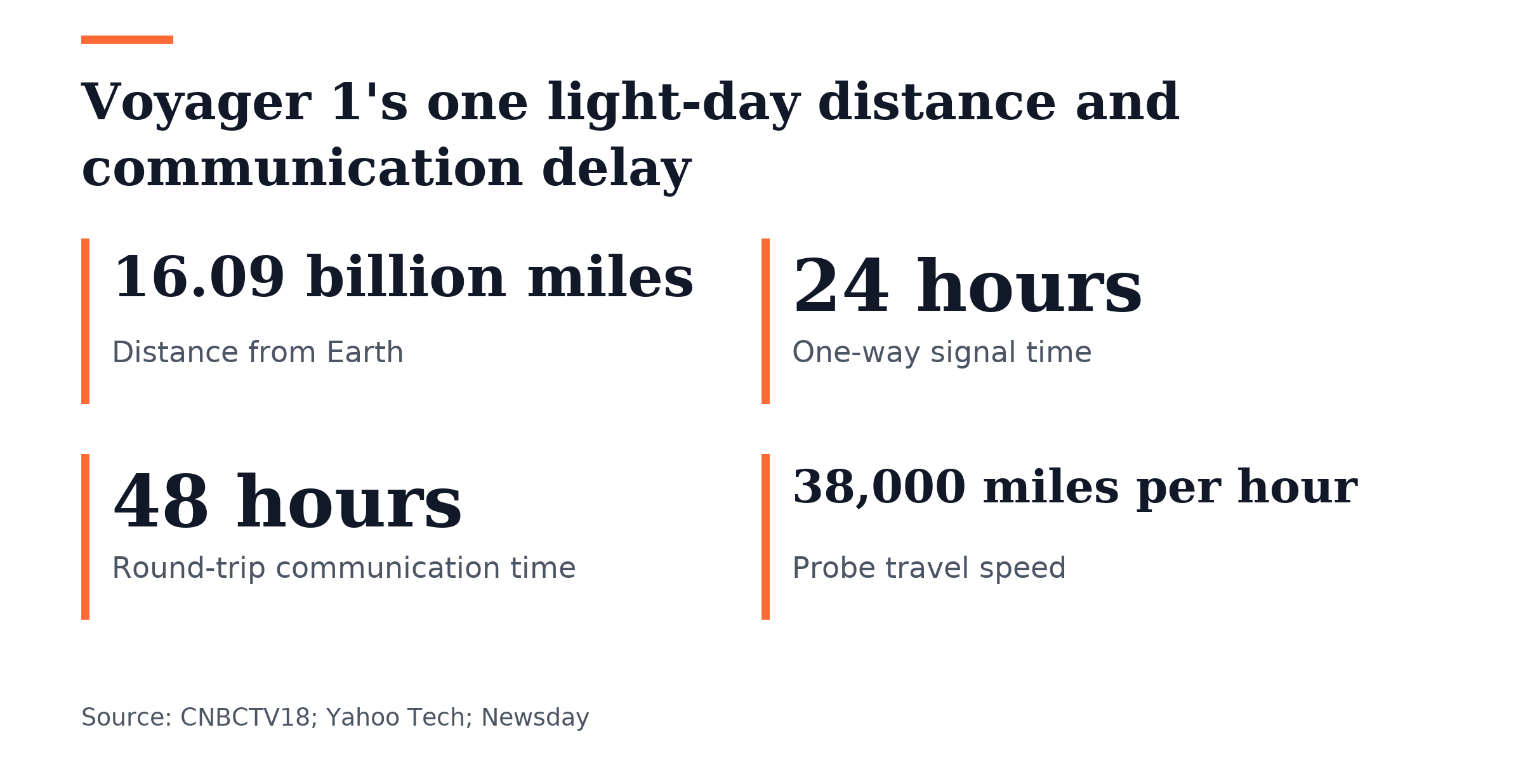
It takes about 24 hours for a signal to reach Voyager 1 from Earth, and another 24 hours for a reply to come back. Suzanne Dodd, Voyager project manager at NASA’s Jet Propulsion Laboratory, said senders must wait two days before getting a response.
Voyager 1 launched on Sept. 5, 1977, swept past Jupiter in 1979 and finished its Saturn encounter in 1980, ending its primary planetary mission. It crossed into interstellar space in August 2012, entering the zone beyond the Sun’s heliosphere, and remains farther from Earth than any other human-made object while transmitting scientific data.
In October 2026, the Deep Space Network heard nothing from Voyager 1 during planned contacts. Engineers found that one set of thrusters had stopped working, so the spacecraft’s fault protection system switched to backup thrusters on its own, but the exact cause remains under investigation. Contact came back on Oct. 20, 2026, even though engineers did not send troubleshooting commands. Kareem Badaruddin said, “This is the first time we’ve seen the spacecraft do something like this.”
In September 2026, mission controllers finished a power-saving move nicknamed Big Bang, turning off three devices and swapping in lower-power replacements. Without the changes, NASA would have needed to switch off another instrument by summer 2027. Voyager 1 runs on radioisotope thermoelectric generators, which turn heat from decaying plutonium into electricity, and both Voyager craft lose roughly four watts of power yearly. The probe left Earth with 10 science instruments, and operators have turned off several to save power.
A small team of NASA engineers at the Jet Propulsion Laboratory sends commands to Voyager 1 roughly once a week, with more contact if problems arise. NASA projects the craft needs 18,000 years to cover one light-year, the distance light travels in a year, and more than twice that span before nearing another star. NASA expects Voyager 2 to reach one light-day from Earth in 2035.
The probe captured the famous Pale Blue Dot photograph of Earth in 1990. Suzanne Dodd described the probe as “a national treasure.” Bill Nye, of the Planetary Society, said these missions have touched everyone on Earth. Every Voyager carries a 12-inch (30-centimeter) gold-plated phonographic record with greetings in 55 languages, along with images and diagrams, including a voice message from the young son of Carl Sagan, Nick.


Join the discussion