Key facts
- The UC San Diego analytical method compares separate polarization maps from different detector groups, allowing a genuine cosmic signal to cancel out while highlighting relative calibration discrepancies.
- The researchers tested their technique using eight polarization maps derived from observations collected by the European Space Agency Planck satellite.
- Comparing their approach with the established Minami-Komatsu analysis, the researchers found consistent results despite the differing underlying assumptions of the two methods.
- The new calibration technique can assist in searches for primordial gravitational waves by preventing telescope errors from misinterpreting E-mode polarization as B-mode patterns.
University of California San Diego researchers built an analytical test that separates a genuine cosmic rotation in the polarization of the cosmic microwave background from mistakes in the alignment of telescope polarization detectors, in work made public Sept. 24, 2026.
Cosmic birefringence is the possibility that the polarization of ancient radiation rotates slightly as it crosses space, which might indicate physics beyond the Standard Model. Scientists are checking whether shifts in polarization angles reflect real cosmological rotation or orientation errors in telescope polarization detectors. Earlier work has suggested the shift could be only a fraction of a degree across nearly 14 billion years of travel, and such a rotation would matter greatly for fundamental physics if it turns out to be cosmological rather than instrumental.
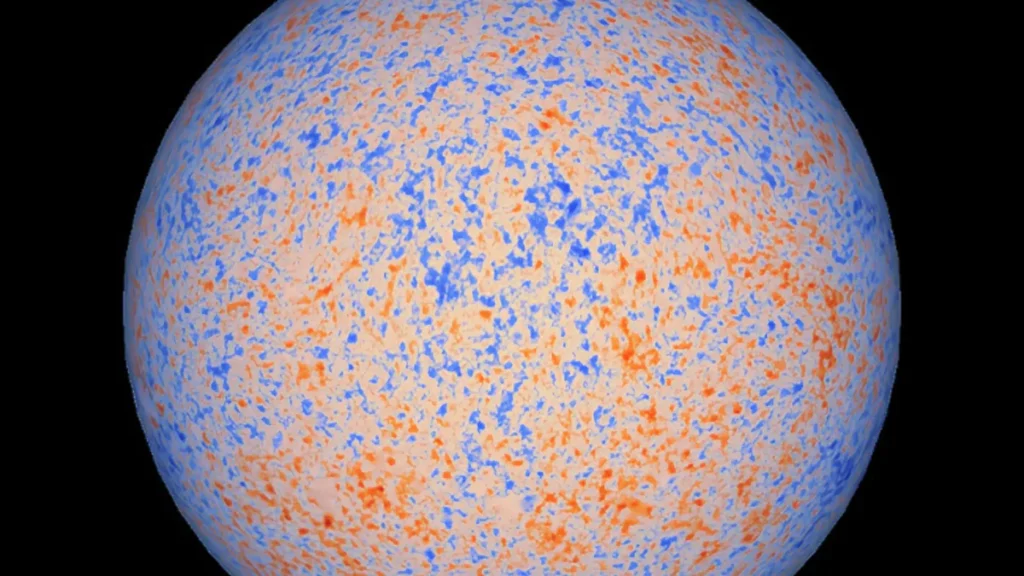
The cosmic microwave background is a faint glow of heat radiation left over from about 380,000 years after the Big Bang, a picture of the universe from nearly 13.8 billion years ago. When the universe was about 380,000 years old, it cooled enough to become transparent, and radiation scattering off free electrons then became slightly linearly polarized. Polarization is the direction in which light’s electric field vibrates, much like sunlight scattering through Earth’s atmosphere.
A mistake in the alignment of a telescope’s polarization detectors can create a signal that looks nearly identical to cosmic birefringence, and this alignment problem is the main hurdle the method had to clear before any rotation qualifies as new physics. If every detector carries the same alignment mistake, the resulting data cannot distinguish that mistake from a real cosmic rotation. A shared misalignment imitates a uniform rotation of the sky, and the signal alone cannot identify the source of the shift.
The approach from University of California San Diego researchers compares polarization maps built from different detector groups because a uniform telescope detector misalignment produces a spurious rotation that looks like cosmic birefringence. If the effect is genuine, it should appear in every map, and comparing the maps against each other can remove any rotation that all the maps have in common. Physicists built the technique using observations from the Planck satellite operated by the European Space Agency to separate genuine cosmological effects from instrument alignment mistakes in polarization measurements.
After the comparison, what remains shows calibration differences among the individual detector groups, and those leftover differences reveal calibration inconsistencies and how good the calibration of each detector set is relative to the others. Because the method removes any rotation shared by every map, it cannot on its own measure the total polarization angle or say how far the universe turned the light, which makes the method deliberately insensitive to the absolute rotation angle.
Establishing an absolute rotation still calls for an independent reference to calibrate the angle. Without an external calibration standard, the differential approach can only handle differences among detectors rather than the absolute rotation itself, so it serves as a calibration consistency test instead of a measurement of the cosmic rotation.
Anto I. Lonappan, a postdoctoral fellow, Brian Keating, a Chancellor’s Distinguished Professor of Physics, and Kam Arnold, an associate professor of physics, made up the research team. Their paper, Differential Polarization Calibration: A Consistency Test for Cosmic Birefringence, appeared in The Astrophysical Journal Letters in 2026 as 1009 (1): L12, with DOI 10.3847/2041-8213/aea401. The study describes an alternative estimator applied to existing space observatory observations to check instrument calibration before crediting subtle polarization shifts to new fundamental physics.
The team checked the technique against eight polarization maps made from observations gathered by the European Space Agency’s Planck satellite, using existing mission data to compare their differential calibration results with established analytical approaches. They also compared their method with the established Minami-Komatsu analysis and found consistent results even though the two methods rest on different assumptions. That agreement gives an independent check on relative detector calibration errors without determining absolute rotation angles by itself.
To get a number, the researchers connected their differential reconstruction to shared calibration values and estimated the cosmic birefringence angle at 0.37 plus or minus 0.12 degrees, matching earlier estimates by linking the deliberately insensitive differential method to accepted absolute calibration references. That agreement does not by itself prove the ancient light really rotated; it shows the method can reproduce earlier results and offers a separate path for studying calibration problems.
The polarization of the cosmic microwave background comes in two patterns. E modes come from density variations in the early universe and make symmetric patterns, and they were first detected in 2002. These symmetric E-mode patterns contrast with the curl-like B modes that could reveal primordial gravitational-wave signatures, and B modes look like curls or swirls, which makes them a target for scientists hunting primordial gravitational-wave signatures in the cosmic microwave background.
One source of B modes is gravitational lensing, when matter between our planet and the early universe bends ancient light, and researchers have already seen these lensing-produced B modes. Researchers are hunting for another kind of B mode that might have come from primordial gravitational waves produced during inflation, the universe’s first period of rapid expansion, but researchers have not found that signal yet. These primordial ripples in spacetime date to the earliest moments of the universe.
Finding primordial B modes would give strong evidence about gravitational waves from the early universe and could strongly back particular models of cosmic inflation, which might reshape theories of the universe’s origin. Even a small calibration error can make the much stronger E-mode signal look like B modes, turning an instrument flaw into a false cosmological discovery, so calibration checks matter. The new calibration technique can help searches for primordial gravitational waves by keeping telescope mistakes from reading E-mode polarization as B-mode patterns.
Independent verification will matter more as observatories get better at measuring cosmic polarization, because future instruments will need careful methods to separate true signals from equipment flaws, and when observatories such as the Simons Observatory reach higher precision, strong independent verification methods become necessary to confirm faint cosmological signatures. Keating leads the observatory as its principal investigator and pushes CMB polarization measurements toward higher precision.
Dark matter and dark energy make up roughly 95% of the universe’s total energy density and remain unexplained by the Standard Model. Confirming something like cosmic birefringence could offer clues about fields resembling axions or fields tied to dark energy that sit beyond current particle physics theories. If cosmic birefringence is confirmed someday, it could open a completely new way to study these cosmic mysteries and reveal evidence of physical laws beyond the ones we know now, opening a fresh view on dark matter, dark energy, and basic physics.
One explanation for the rotation would be a hypothetical field tied to particles similar to axions that could interact with light and slowly change its polarization; these axion-like particles are unconfirmed and do not have to be dark matter, and such fields lie beyond the Standard Model while potentially generating the observed rotation if they exist. Other ideas link the possible rotation to fields connected with dark energy, the puzzling phenomenon behind the universe’s accelerating expansion, giving another beyond-the-Standard-Model mechanism for the possible polarization shift.

Join the discussion