Key facts
- The ERC Advanced Grants competition funded 319 leading research teams across Europe with €838 million ($918.86 million USD) for projects intended to produce major scientific breakthroughs.
- Researchers will use HAMSTER, an accelerator mass spectrometry facility developed by Wallner's team and installed at HZDR in 2025, combined with laser-based technology that cuts measurement background.
- Prof. Sebastian M. Schmidt, Scientific Director of HZDR, called the award a remarkable recognition of Wallner's internationally leading research and said SUPREME builds on unique worldwide measurement capabilities.
- The Cambrian Period lasted from ca. 538.8 to 485 million years ago and coincided with the Cambrian Explosion, a rapid rise of complex marine life.
The European Research Council awarded Prof. Anton Wallner at Helmholtz-Zentrum Dresden-Rossendorf a €3 million ($3.29 million) grant on June 23, 2026, for SUPREME, a project that will trace nearby cosmic explosions over the past 500 million years to study the origins of heavy elements.
The European Research Council’s Advanced Grants program supports senior researchers pursuing ambitious projects intended to produce major scientific breakthroughs. Universe Today says Wallner and his team at Helmholtz-Zentrum Dresden-Rossendorf began SUPREME to find traces of elements from exploding stars. The award comes from the latest round of that competition.
SUPREME stands for Supernova and r-process radionuclides engraved on million-years old archives from Earth and Moon, according to EurekAlert. The name reflects the project’s focus on supernovae and rapid neutron-capture radionuclides preserved in ancient Earth and Moon materials.
Two questions drive SUPREME: how nearby supernovae affected Earth and biological evolution since the Cambrian Period, and how the heaviest elements are created and distributed to Earth and the Moon. The project covers the past 500 million years. Universe Today and EurekAlert describe these as the two central questions driving the research.
According to Universe Today, the Cambrian Period ran from ca. 538.8 to 485 million years ago. Universe Today identifies the interval as the time of the Cambrian Explosion, when complex marine life quickly appeared.
Universe Today says the continents lay mostly in the southern hemisphere and were largely barren at the start of the Cambrian. Later, life moved from the oceans to land, giving rise to plants, mammals, dinosaurs and primates.
Researchers with SUPREME will hunt for extremely rare radioactive isotopes in NASA lunar samples and in deep-sea sediments and ice cores, along with other geological archives. The goal is to identify and date nearby stellar explosions and energetic events.
These archives hold traces of interstellar material that reached Earth over millions of years. Scientists can use them to identify and date nearby supernovae and rare cosmic events.
The team will use HAMSTER, an accelerator mass spectrometry facility built by Wallner’s team and put in place at HZDR in 2025. HAMSTER, short for the Helmholtz Accelerator Mass Spectrometer Tracing Environmental Radionuclides, uses accelerator mass spectrometry together with laser-based technology to reduce measurement background. Universe Today and EurekAlert both describe the system this way.
The HAMSTER setup can detect individual atoms with great sensitivity and opens possibilities for astrophysics and other scientific applications. Its ability to count single atoms makes it suitable for searching geological samples for traces of ancient stellar debris. The laser-based technology reduces measurement background, improving the clarity of each result.
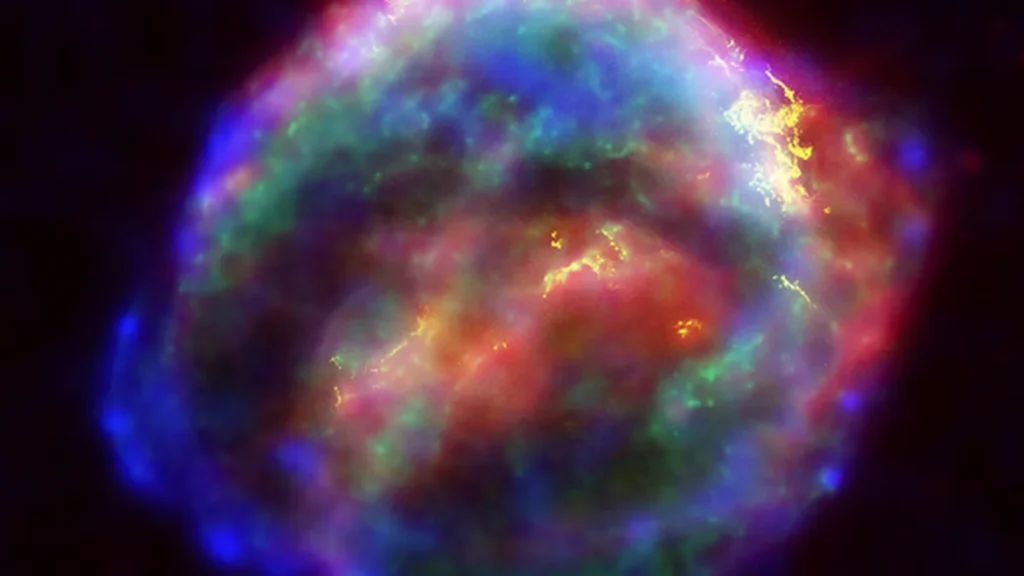
When a star reaches the end of its life and explodes, it creates intermediate elements from carbon and oxygen to iron and nickel, plus radioactive isotopes. Heavy elements including zinc, silver, tin, gold, mercury, lead, platinum and uranium form in those stellar explosions. Universe Today lists these elements among those produced at the end of stellar life cycles. SUPREME will look for the radioactive isotopes produced in those explosions.
The rapid neutron-capture process, known as the r-process, forms roughly half of the atoms heavier than iron found across the universe, according to Universe Today. SUPREME takes its name in part from this process, as shown by the project’s full title.
SUPREME builds on a measurement from June 2026, when HZDR detected curium-247 and plutonium-244 in interstellar matter trapped on Earth. Universe Today calls it the first major detection of isotopes tied to an r-process event.
The project aims to show where and how the universe creates its heaviest elements. It also plans to build a detailed timeline of nearby cosmic explosions. EurekAlert says that detecting more rare radionuclides and heavy elements will let the project show where and how the universe creates its heaviest elements and build that timeline.
Researchers expect the results to provide insights into the history of the cosmic neighborhood and its possible influence on Earth’s geology, species evolution and the planet itself. The findings should illuminate the history of the cosmic neighborhood and its possible effects on Earth’s geology and biology.
On June 23, 2026, the competition funded 319 leading research teams across Europe, providing €838 million ($918.86 million) for projects intended to produce major scientific breakthroughs. Universe Today and EurekAlert report the funding total and the number of teams.
EurekAlert reports that 3,329 proposals reached the competition, up 31 percent from 2,534 the prior year. Only 9.6 percent of proposals received funding. Three researchers based in Saxony succeeded in the latest ERC funding round, according to EurekAlert. EurekAlert notes the Saxon success in this funding round.
Prof. Anton Wallner works at the Institute of Ion Beam Physics and Materials Research at HZDR. The institute focuses on ion beam physics and materials research.
Prof. Sebastian M. Schmidt, Scientific Director of HZDR, said the award recognizes Wallner’s internationally leading research. He added that SUPREME builds on unique worldwide measurement capabilities. “This award is a remarkable recognition of Anton Wallner’s internationally leading research.” — Prof. Sebastian M. Schmidt, Scientific Director of HZDR
Winning one of the EU’s top research grants is an outstanding accomplishment, said Sebastian Gemkow, Saxony’s Minister of Science. He called it a major milestone and gain for Saxony as a research and innovation hub. “Securing one of the European Union’s most competitive research grants is an outstanding accomplishment.” — Sebastian Gemkow, Saxony’s Minister of Science
HZDR is an independent German research center that works in energy, health and matter. It operates large-scale facilities such as the Ion Beam Center, Dresden High Magnetic Field Laboratory and ELBE Center for High-Power Radiation Sources. Wallner’s team developed HAMSTER at this center.
HZDR belongs to the Helmholtz Association. It runs seven sites in Dresden, Freiberg, Görlitz, Grenoble, Leipzig, Rostock and Schenefeld near Hamburg, and employs almost 1,500 staff, including about 700 scientists and 200 PhD candidates. Its sites span Germany and France, with Grenoble and Schenefeld near Hamburg located outside Dresden.
The awards fall under the EU’s Horizon Europe program. EurekAlert identifies Horizon Europe as the program behind the grants. By tracing rare isotopes in lunar samples and terrestrial archives, SUPREME will attempt to connect nearby stellar explosions to changes in Earth’s geology and the evolution of life over half a billion years.





Join the discussion